
In digital environments, approval is visible, countable, and immediate. Likes, comments, shares, and views transform social response into measurable signals. Over time, these signals do more than reflect attention—they shape how individuals evaluate their own worth.
Introduction
In digital environments, approval is visible, countable, and immediate. Likes, comments, shares, and views transform social response into measurable signals.
Over time, these signals do more than reflect attention—they shape how individuals evaluate their own worth.
This shift is particularly powerful because it operates subtly. Validation feels affirming, engagement feels rewarding, and visibility feels validating. The psychological effects accumulate gradually, often without conscious awareness.
This article explores how digital validation influences self-worth, why the effects are often subtle, and how constant feedback can reshape identity at its foundation.
Key Dynamics of Digital Validation
- Quantification: Social approval becomes numerical, measurable, and comparable
- Externalization: Self-worth shifts from internal assessment to external metrics
- Reinforcement Loop: Platforms reward content that generates engagement, creating behavioral conditioning
- Visibility = Value: Engagement metrics become proxy measures for personal relevance and worth
What Is Digital Validation?
Digital validation refers to external confirmation received through online interaction—likes, comments, shares, followers, views.
Unlike traditional social feedback, digital validation is:
- Quantified: Approval becomes numerical rather than qualitative
- Visible: Feedback is publicly displayed and comparable
- Immediate: Response arrives within seconds or minutes
- Persistent: Metrics remain visible indefinitely, creating ongoing evaluation
- Algorithmic: Engagement determines visibility, creating feedback loops
This shifts validation from a relational experience—someone expressing appreciation in conversation—into a performance metric that can be tracked, optimized, and compared.
When Approval Becomes Measurable
Metrics change meaning. A post does not simply feel appreciated—it performs well or poorly. Visibility becomes a proxy for value.
The Transformation of Social Feedback
Traditional social validation operated through:
- Facial expressions and body language
- Verbal affirmation and conversation
- Attention and time investment
- Qualitative responses that conveyed nuance
Digital validation operates through:
- Numerical counts (likes, views, shares)
- Algorithmic amplification (trending, recommended)
- Comparative ranking (most liked, most viewed)
- Performance dashboards (insights, analytics)
Over time, individuals learn to associate higher numbers with success, relevance, and personal worth. The brain's reward systems respond to engagement notifications with dopamine release—the same neurochemical response associated with other reward-based behaviors.
Silence, by contrast, can feel like rejection—even when no rejection is intended.

The Externalization of Self-Worth
Self-worth traditionally develops through internal processes: competence, connection, autonomy, and self-understanding.
Digital validation externalizes this process. When value is repeatedly mirrored through engagement metrics, self-assessment shifts outward. Worth becomes something granted rather than felt.
Internal vs External Self-Worth
Traditional Internal Self-Worth
- Source: Personal values, competence, relationships, self-reflection
- Stability: Relatively stable across contexts
- Validation: Internal sense of alignment with values
- Feedback: Qualitative, relational, contextual
- Timeframe: Develops over years through experience
Externalized Digital Self-Worth
- Source: Engagement metrics, visibility, algorithmic ranking
- Stability: Fluctuates with every post and notification
- Validation: External confirmation through measurable response
- Feedback: Quantitative, immediate, public
- Timeframe: Real-time evaluation updated constantly
The shift is profound: self-worth moves from something you cultivate internally to something the platform reports back to you.


Beauty, Visibility, and Reward
In visual platforms, beauty plays a central role in validation. Content aligned with dominant beauty standards tends to receive more visibility and engagement.
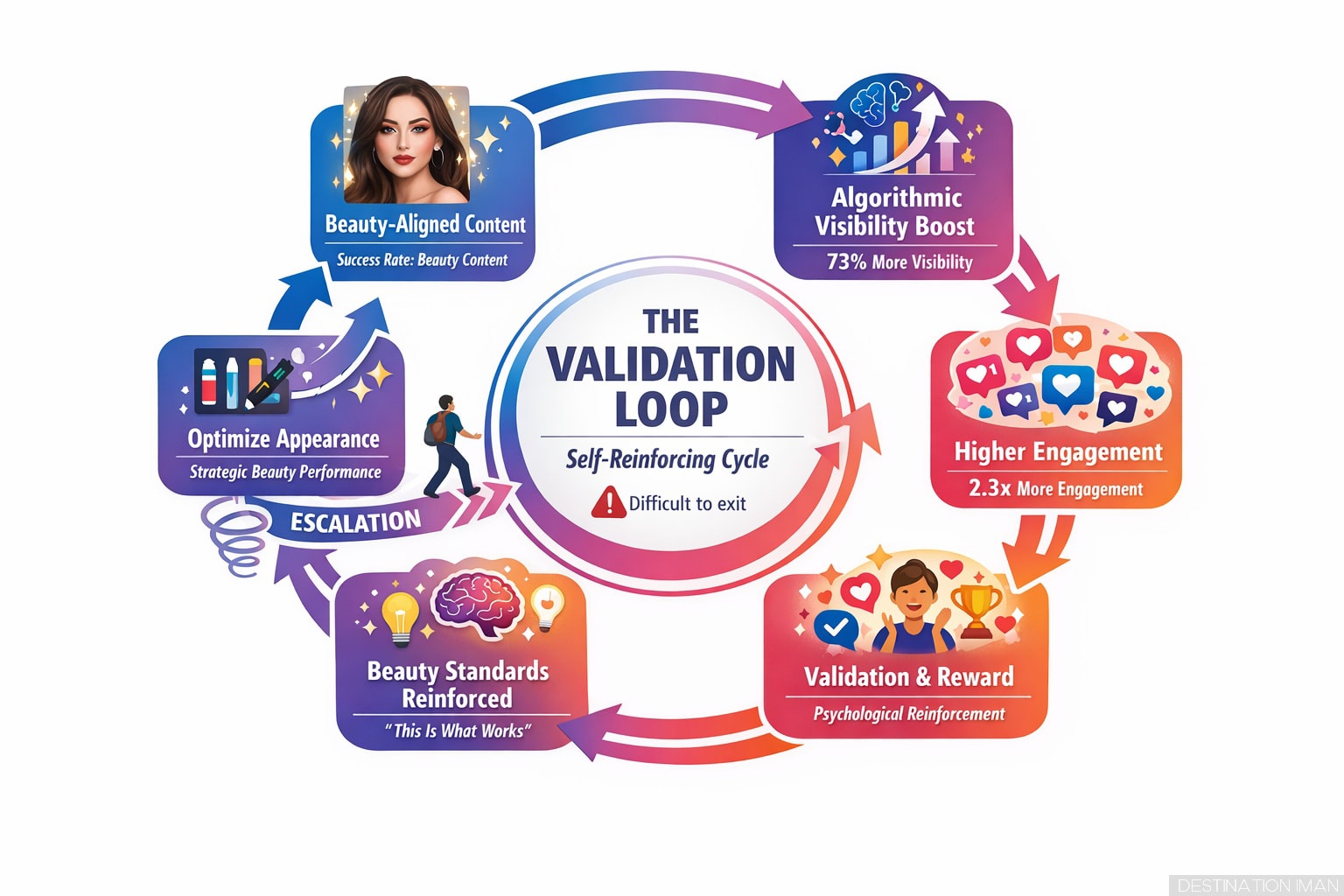
This creates a self-reinforcing loop:
- Beauty increases visibility (algorithmic amplification favors visually appealing content)
- Visibility increases validation (more views generate more engagement)
- Validation reinforces beauty norms (success teaches what works)
- Individuals optimize for those norms (filters, editing, strategic presentation)
- The cycle repeats and intensifies
As a result, appearance becomes a strategic asset rather than a personal attribute. Beauty is no longer simply experienced—it is performed, optimized, and measured through engagement.
The Beauty-Validation Feedback Loop
How the Loop Operates
- Algorithmic Preference: Platforms prioritize visually engaging content (faces, beauty, aesthetic appeal)
- Engagement Reward: Beauty-aligned posts receive higher engagement (likes, shares, saves)
- Psychological Reinforcement: Success teaches users to optimize appearance for validation
- Normalization: What succeeds algorithmically becomes internalized as "what works"
- Escalation: Competition for visibility drives increasingly perfected presentation
Psychological Impact
Reliance on digital validation produces several interconnected psychological effects that accumulate over time.
Core Psychological Effects
- Heightened Sensitivity to Feedback: Emotional response to engagement becomes disproportionate to actual social significance
- Fluctuating Self-Esteem: Self-worth rises and falls with each post's performance
- Performance-Identity Fusion: Difficulty separating how content performs from personal value
- Comparative Anxiety: Constant comparison with others' visible engagement metrics
- Withdrawal Sensitivity: Strong negative response to lack of engagement or declining metrics
Why Inconsistency Intensifies Effects
These effects are particularly intensified when validation is inconsistent—praised one moment, ignored the next.
Variable reward schedules—where outcomes are unpredictable—create stronger behavioral conditioning than consistent rewards. This is the same mechanism that underlies gambling addiction.
Social media engagement operates on variable reward schedules: sometimes a post receives hundreds of likes, sometimes dozens, sometimes nearly none—for reasons that often feel arbitrary.
Psychological Warning Signs
Indicators of validation dependency:
- Checking engagement metrics repeatedly within minutes of posting
- Feeling anxious or disappointed when posts receive lower-than-expected engagement
- Mood fluctuating based on social media response
- Editing or deleting posts that don't perform well
- Feeling pressure to post even when not genuinely motivated
- Comparing your engagement metrics to others' constantly
- Difficulty enjoying experiences without documenting them for social media
- Self-worth feeling unstable or externally determined
When Identity Depends on Response
When self-worth is externally regulated, identity becomes reactive rather than self-directed.
Individuals may adjust expression, appearance, or opinion to maintain validation. Over time, this can blur the line between genuine preference and strategic self-presentation.
The Identity Adaptation Process
Stage 1: Initial Experimentation
Users try different types of content, noticing which posts receive more engagement. This feels like normal social learning.
Stage 2: Pattern Recognition
Certain content types, aesthetics, or topics consistently perform better. Users begin unconsciously optimizing toward what works.
Stage 3: Strategic Presentation
Self-presentation becomes increasingly calculated. Users consciously adjust content to maximize engagement, sometimes at the expense of authenticity.
Stage 4: Identity Fusion
The strategic persona and authentic self begin to merge. It becomes difficult to distinguish between "what I want to share" and "what will perform well."
Stage 5: Dependency
Self-worth becomes fundamentally dependent on external validation. Identity feels unstable without constant confirmation from engagement metrics.
The self becomes shaped not by internal coherence, but by anticipated response. The question shifts from "What do I want to express?" to "What will people engage with?"

The Anxiety of Silence
One of the least discussed aspects of digital validation is silence—the absence of response.
When content receives little engagement, users often experience unease disproportionate to the situation. A post with 23 likes instead of 200 can trigger genuine distress.
Why Silence Feels Like Rejection
This anxiety reflects how deeply validation has been internalized as a measure of relevance and worth:
- Visibility equals value: Low engagement signals irrelevance
- Comparison is constant: Your 23 likes are visible next to someone else's 2,300
- Algorithmic punishment: Low engagement reduces future visibility, creating downward spiral
- Public performance: "Failure" is visible to your entire network
- Identity threat: If worth depends on engagement, silence threatens self-concept
Absence of response becomes meaningful—even when it should not be. The post may have been shown to fewer people algorithmically, posted at a suboptimal time, or simply not prompted immediate response—none of which reflects actual social rejection.
Yet the emotional experience can mirror genuine social exclusion.


Rebuilding Self-Worth Offline
Rebuilding self-worth does not require abandoning digital spaces entirely. It requires re-centering value internally—separating performance from identity and reclaiming self-assessment as an internal process.
Practical Strategies for Reclaiming Internal Worth
Reconnecting with Internal Self-Worth
- Separate expression from outcome: Practice creating, sharing, or expressing without checking engagement metrics
- Limit metric visibility: Use browser extensions or app settings to hide like counts and follower numbers
- Schedule posting and step away: Post content and deliberately avoid checking responses for 24 hours
- Identify non-digital sources of worth: Competence, relationships, values, contributions that exist offline
- Practice unmeasured activities: Engage in hobbies, conversations, or creative work that produces no metrics
- Reflect on values vs validation: Regularly ask "Does this align with my values?" instead of "Will this get engagement?"
- Notice validation-seeking patterns: Observe when you're checking metrics, what triggers it, what you're seeking
- Cultivate offline validation: Invest in relationships where appreciation is relational, not quantified
Rebalancing the Internal-External Balance
The goal is not to eliminate all external feedback—humans are social beings who naturally seek connection and affirmation. The goal is to rebalance so that external validation informs but does not determine self-worth.
Healthy Relationship with Validation
- External feedback is informative but not definitive
- Self-worth remains relatively stable regardless of engagement
- Expression is driven by internal motivation, not performance anxiety
- Low engagement feels neutral or mildly disappointing, not devastating
- Identity feels coherent and self-directed
Practices that emphasize presence, competence, and connection help restore balance:
- Presence: Engaging fully in experiences without documenting for external validation
- Competence: Building skills and completing projects that provide internal satisfaction
- Connection: Investing in relationships where value is mutual, not measured
Conclusion
Digital validation reshapes self-worth by turning social response into a visible, measurable score. What begins as affirming feedback can become a system of constant evaluation where worth feels externally determined.
The core mechanisms are:
- Quantification transforms relational approval into performance metrics
- Externalization shifts self-worth from internal assessment to external confirmation
- Reinforcement loops condition behavior through variable reward schedules
- Identity fusion blurs the line between authentic self and strategic performance
While feedback can be affirming and social connection valuable, dependence on validation risks reducing identity to performance—a self continuously adjusted to optimize for external response.
Recognizing the difference between validation and value is essential to maintaining a stable sense of self in digital environments. Self-worth that depends primarily on external metrics will always be fragile, fluctuating with every post, every notification, every algorithmic shift.
Rebuilding internal self-worth does not mean rejecting all external feedback—it means reclaiming assessment as an internal process, where worth is felt rather than granted, and identity is self-directed rather than performance-optimized.
Sources & Further Reading
Academic & Research Sources
- Body Image Journal — Research on media, appearance, and self-esteem
- American Psychological Association — Self-Worth and Digital Validation
- New Media & Society — Digital Identity and Feedback Systems
- Pew Research Center — Social Media and Psychological Well-Being
- Nature Human Behaviour — Social Media Effects on Mental Health
- Cyberpsychology, Behavior, and Social Networking — Digital Behavior Research