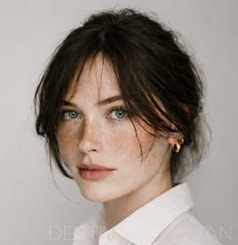
Confidence doesn't just change how you feel—it physically transforms how you look. Research in psychology and neuroscience reveals that emotional state directly alters posture, facial expression, muscle tension, and even perceived facial symmetry. The result? Two people with identical features can appear dramatically different based solely on their level of confidence.
This article explores the neuroscience and psychology behind how confidence changes visual appearance, why others perceive confident people as more attractive, and how this transformation happens at both conscious and unconscious levels.
The Neuroscience of Confidence and Appearance
Confidence is not merely a mental state—it triggers measurable physiological changes. When you feel confident, your brain releases neurotransmitters like dopamine and serotonin, which regulate mood, muscle tension, and stress response. These neurochemical changes directly affect how your body holds itself and how your face appears to others.
The Brain-Body Connection
Neuroscience research demonstrates that emotional states are embodied—they manifest physically through what's called the somatic nervous system. Confidence activates specific neural pathways that:
Neurological Changes Associated with Confidence
- Reduce cortisol: Lower stress hormone levels decrease facial tension and muscle rigidity
- Increase dopamine: Enhances reward processing, creating genuine facial warmth and approachability
- Activate motor cortex: Improves posture control and movement fluidity
- Regulate amygdala: Reduces fear-based facial expressions like furrowed brows and tight jaws
- Enhance prefrontal cortex function: Improves emotional regulation visible in stable, calm expressions
These neurological changes occur automatically—you don't consciously control them. Yet they profoundly affect how others perceive you.

How Confidence Changes Posture and Body Language
Posture is one of the most immediate and noticeable ways confidence transforms appearance. Research shows that posture affects not only how others see you but also how you see yourself—a phenomenon called embodied cognition.
The Visible Posture Transformation
Confident vs Insecure Posture
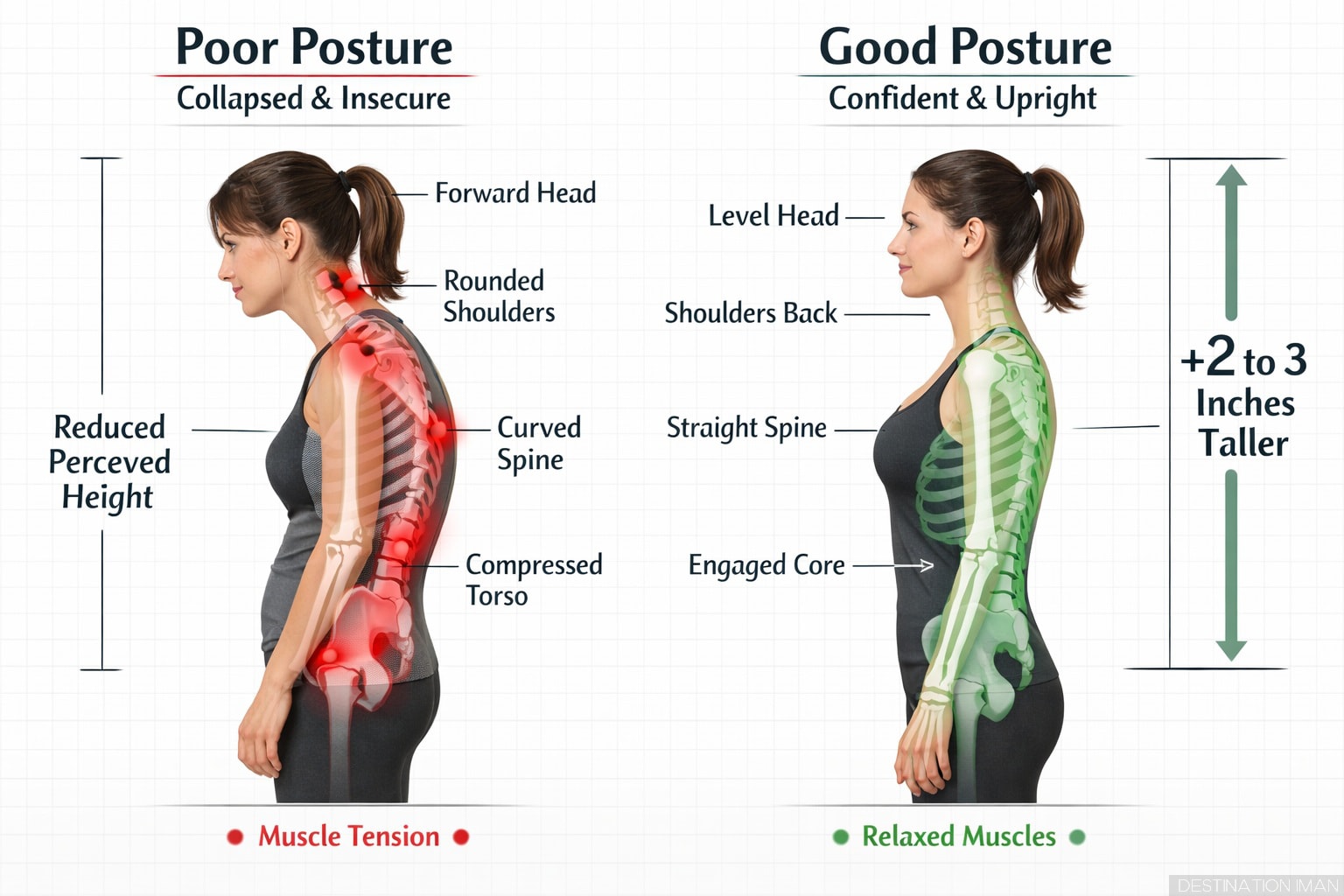
- Confident Posture: Shoulders back and down, chest open, spine elongated, head level, weight balanced, arms relaxed
- Insecure Posture: Shoulders hunched forward, chest collapsed, spine curved, head down, weight shifted, arms crossed or hidden
- Visual Impact: Confident posture adds perceived height, improves body proportions, creates visual openness, and signals emotional stability
The Power Pose Effect
Research on "power posing" has shown that adopting confident postures—even when you don't initially feel confident—can trigger hormonal changes that increase actual confidence. While the magnitude of this effect is debated, the visual impact is undeniable: open, expansive postures consistently increase perceived confidence, competence, and attractiveness.
Facial Expression: The Confidence Microexpressions
Confidence transforms facial appearance through subtle microexpressions—tiny muscle movements that occur in fractions of a second. These unconscious signals communicate emotional state more powerfully than words.
The Confident Face
Facial Markers of Confidence
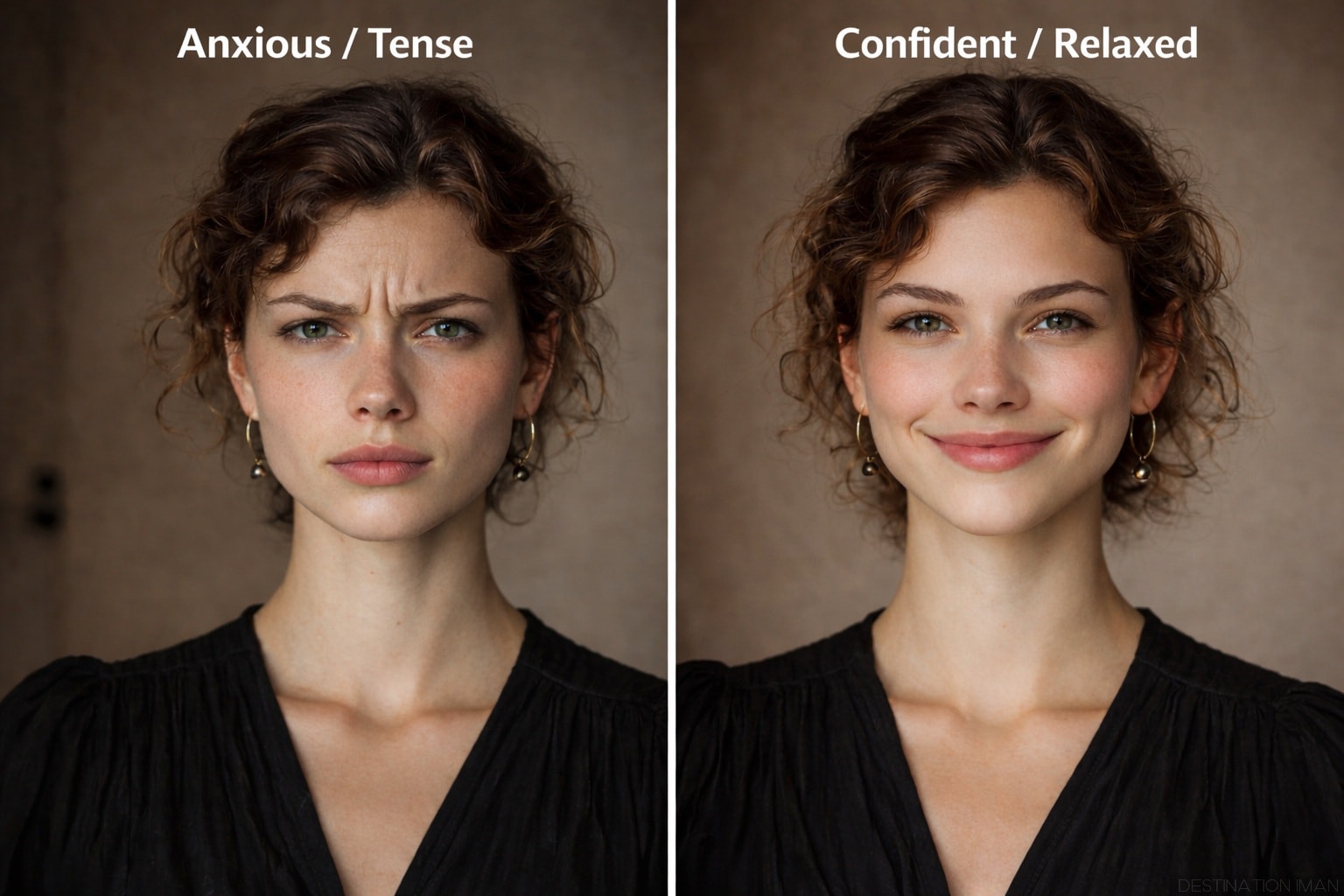
- Relaxed forehead: No tension lines or furrowed brows signaling worry
- Soft eye focus: Steady gaze without darting or avoidance, appearing engaged but not aggressive
- Raised brows (slightly): Open, receptive expression rather than defensive or guarded
- Genuine smile: Duchenne smile engaging eye muscles (crow's feet), not just mouth
- Relaxed jaw: No clenching or tension that creates harsh facial lines
- Symmetrical expression: Balanced muscle activation across both sides of face
Why Tension Reduces Attractiveness
When you lack confidence, stress hormones like cortisol cause facial muscles to tighten. This creates:
- Deepened tension lines (forehead, between brows, around mouth)
- Reduced facial symmetry (uneven muscle contraction)
- Narrow eye aperture (appearing guarded or fearful)
- Tight lips (communicating discomfort or disapproval)
- Overall facial hardness (versus the softness of relaxation)
Observers unconsciously interpret these signals as negative personality traits—even when they have no conscious awareness of why someone seems "less approachable."
Why Others Perceive Confident People as More Attractive
The attractiveness boost from confidence isn't imaginary—it's rooted in evolutionary psychology and social perception mechanisms.
The Evolutionary Advantage
Throughout human evolution, confidence signaled valuable traits: social competence, resource access, emotional stability, and genetic fitness. Our brains evolved to rapidly assess these signals through body language and facial cues.
The Perception Cascade
When someone observes confident body language and facial expressions, their brain makes rapid, automatic inferences:
0.1 seconds: Initial Assessment
Brain categorizes posture, facial openness, movement quality as "confident" or "uncertain"
0.5 seconds: Trait Attribution
Confident signals trigger assumptions: competent, socially skilled, emotionally stable, trustworthy
1-3 seconds: Attractiveness Judgment
These positive trait assumptions generalize to overall attractiveness assessment—the halo effect in action
Ongoing: Confirmation Bias
Observer continues to interpret ambiguous signals positively, reinforcing initial assessment

The Confidence-Appearance Feedback Loop
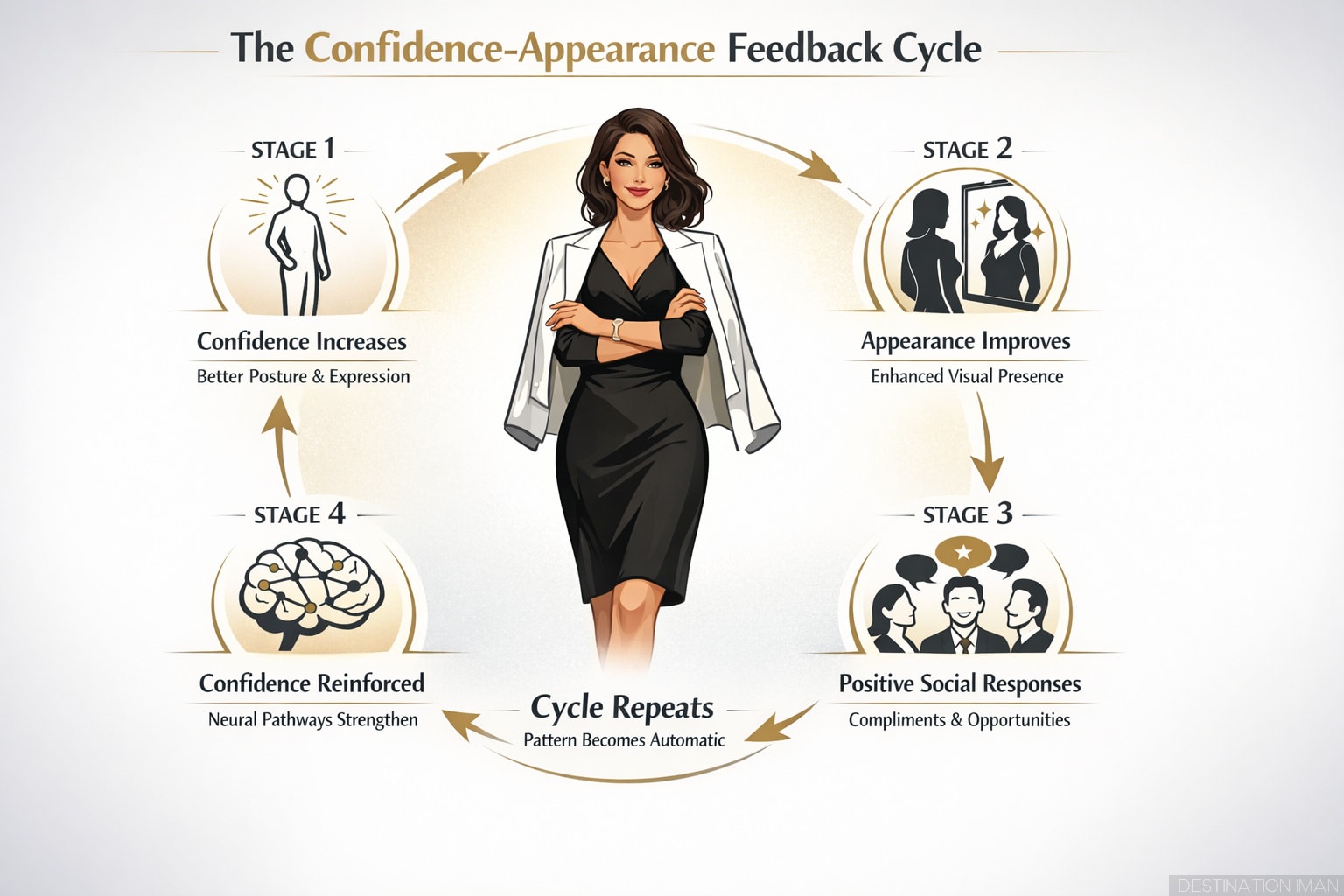
Confidence and appearance exist in a powerful feedback loop: confidence improves appearance, which generates positive social responses, which further increases confidence.
The Positive Spiral
The Feedback Loop Stages
- Stage 1 — Confidence increases: Better posture, relaxed facial expressions, open body language
- Stage 2 — Appearance improves: Others perceive you as more attractive, competent, approachable
- Stage 3 — Social responses change: More smiles, positive interactions, opportunities, compliments
- Stage 4 — Confidence reinforced: Positive feedback validates confidence, strengthening neural pathways
- Stage 5 — Cycle repeats: Each iteration strengthens the pattern, making confident appearance more automatic
Breaking the Negative Loop
The reverse is also true: low confidence creates closed posture and tense expressions, which reduce perceived attractiveness, leading to fewer positive responses, which further undermines confidence. However, this cycle can be interrupted at any point.
Confidence in Photography and First Impressions
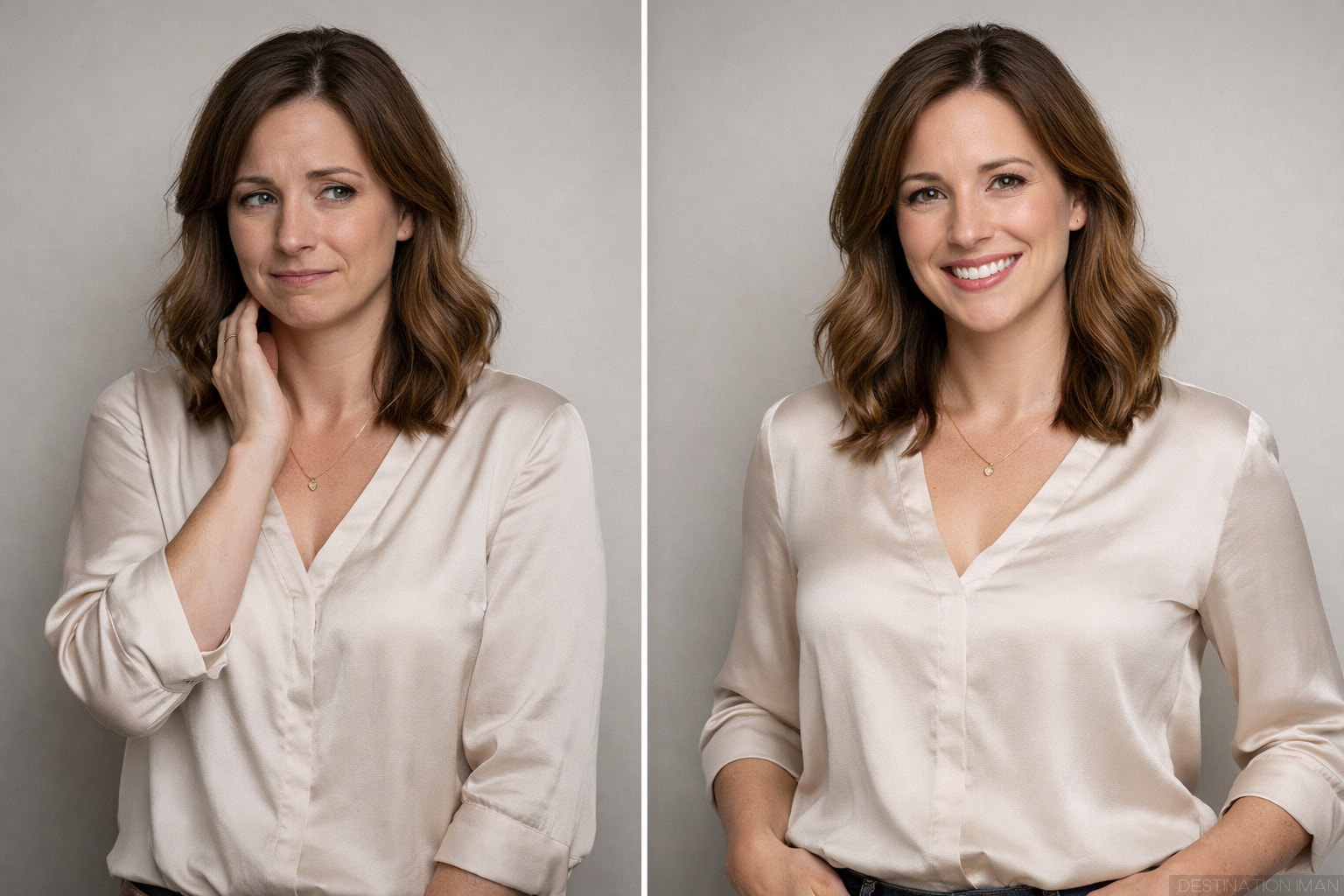
The confidence-appearance connection is especially visible (and sometimes problematic) in photography and video. Unlike real-life interaction where movement and energy communicate confidence, still images freeze a single moment—amplifying the importance of posture and expression.
Why Camera-Confidence Matters
Camera-Confident vs Camera-Shy
- Camera-Confident: Relaxed shoulders, genuine smile, comfortable stance, natural hand position, eyes engaged with lens
- Camera-Shy: Tense shoulders, forced smile, awkward stance, stiff hands, eyes avoidant or strained
- Result: The camera-confident person appears significantly more attractive in photos despite potentially having identical features
First Impressions in the Digital Age
In an era where first impressions increasingly happen through screens—dating apps, social media, professional headshots—the ability to project confidence through static images has become crucial. Research shows that profile photos displaying confident body language receive significantly more positive responses than technically superior photos with tense posture.

Can You Cultivate Confidence to Change Appearance?
The practical question: if confidence transforms appearance, can you deliberately cultivate confidence to look better? The research suggests yes—with important nuances.
The Mind-Body Approach
Confidence cultivation works bidirectionally: internal work (psychology, self-perception) and external practice (posture, expression, movement) reinforce each other.
Strategies for Building Visual Confidence
- Practice power postures: Regularly adopt confident physical positions to trigger hormonal changes
- Facial relaxation exercises: Consciously release jaw tension, soften forehead, relax eye muscles
- Movement awareness: Notice and adjust posture throughout the day, especially in social situations
- Mirror practice: Observe your confident vs tense expressions to build awareness
- Breathing techniques: Deep diaphragmatic breathing reduces cortisol and facial tension
- Video feedback: Record yourself speaking to identify unconscious tension patterns
- Social exposure: Gradually increase comfortable social interaction to build genuine confidence
- Cognitive reframing: Challenge negative self-talk that creates defensive body language
The Authenticity Question
An important distinction: practiced confidence (adopting confident body language even when nervous) differs from authentic confidence (genuine inner security). Both improve appearance, but authentic confidence is sustainable and doesn't require constant effort.
Key Takeaways
Core Insights: Confidence and Appearance
- Confidence triggers neurological changes that physically alter posture and facial expression
- Confident posture can add 2-3 perceived inches of height and improve body proportions
- Facial microexpressions communicate confidence unconsciously but powerfully
- Others perceive confident individuals as more attractive due to evolutionary social assessment mechanisms
- The confidence-appearance feedback loop is self-reinforcing in both positive and negative directions
- Photography amplifies confidence differences because it removes the context of movement and energy
- Confidence can be cultivated through both internal psychological work and external postural practice
- Authenticity matters—practiced confidence improves appearance but genuine confidence is sustainable
- Confidence doesn't change your features; it removes tension that distorts them
Sources & References
Academic & Research Sources
- Royal Society Open Science (2024) — "What is beautiful is still good: the attractiveness halo effect in the era of beauty filters"
- Langlois, J. H., et al. (2000). Maxims or myths of beauty? A meta-analytic and theoretical review. Psychological Bulletin
- Psychology Today — Body Language Cues That Increase Physical Attraction
- NIH Research — Dominant, open nonverbal displays are attractive at zero acquaintance
- NewBeauty (2026) — The Neuro Aesthetic Era and Human Perception
- Carney, D. R., Cuddy, A. J., & Yap, A. J. (2010). Power posing: Brief nonverbal displays affect neuroendocrine levels and risk tolerance. Psychological Science
- American Psychological Association — Embodied Cognition Research