Introduction
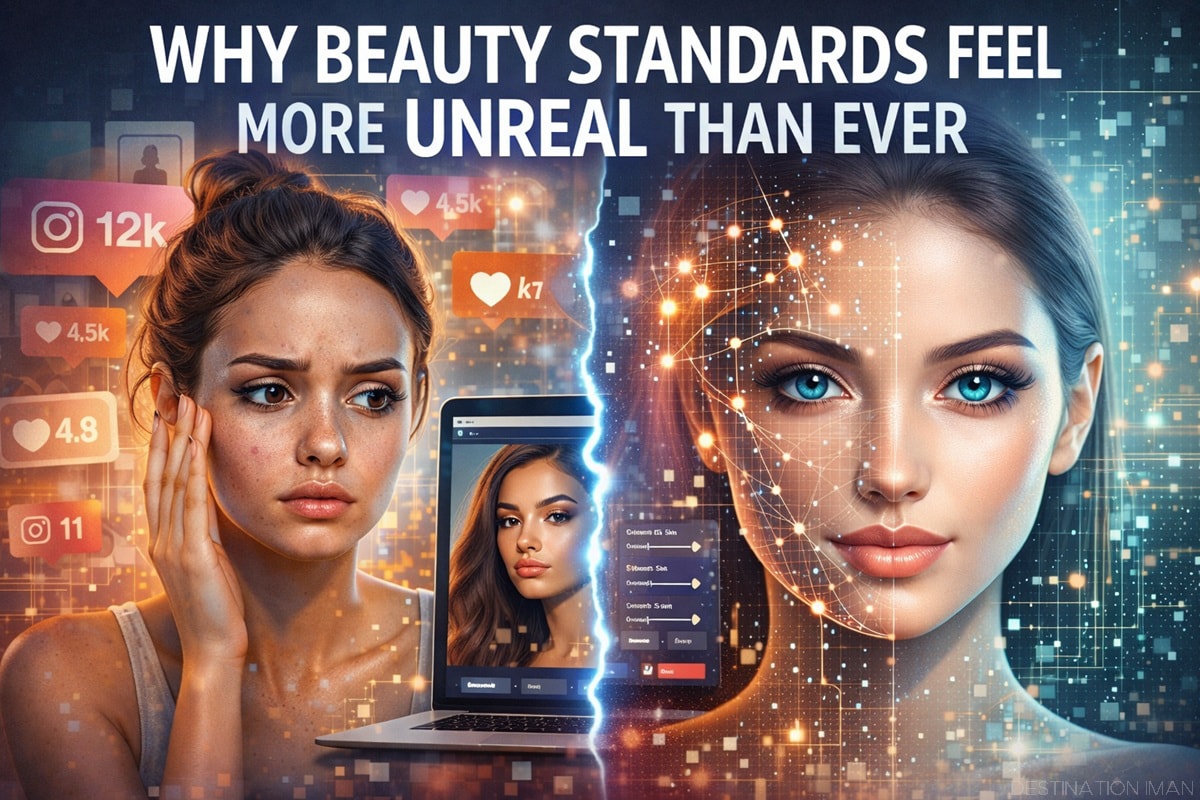
Across social media, therapy sessions, and casual conversations, the same phrase keeps appearing: beauty standards feel "unreal," "fake," "impossible." This is not nostalgia or resistance to change. It reflects something structural—a fundamental break between beauty as aspiration and beauty as alienation.
This article examines why modern beauty standards feel uniquely disconnected from human reality, how this disconnection intensified between 2020 and 2026, and what living in this gap does to identity and self-perception.
The Feeling of Disorientation
The sensation of unreality is not abstract. People describe specific experiences:
Common Experiences of Unreality
- Looking at photos from a social event and feeling their memory of the evening doesn't match what appeared online
- Meeting someone in person after seeing their profile and experiencing jarring cognitive dissonance
- Adjusting their own face with filters and feeling more comfortable with the altered version than their reflection
- Scrolling through beauty content and wondering if any of it corresponds to physical reality
From Idealized to Engineered
Historically, beauty standards were idealized—exaggerated, aspirational, but still anchored to human biology. A 1950s Hollywood starlet was heavily styled and photographed under perfect conditions, but she existed. Her face was real.
Digital beauty standards are engineered. They emerge from:
- Machine learning models trained on millions of images to identify maximum visual appeal
- Algorithms that amplify specific features correlated with engagement metrics
- Real-time filters that reshape faces during capture, not after
- AI-generated faces that blend features from multiple sources into statistically optimized composites
The shift is subtle but total. When a beauty ideal is engineered rather than observed, it stops functioning as aspiration and becomes alienation. You are not being asked to approximate something admirable—you are being measured against something impossible.
The Cognitive Dissonance Problem
Human brains are pattern-recognition machines. When you see a face repeatedly, your brain builds a model of what "normal" faces look like.
For most of human history, this model was built from physical faces. Now, for many people—especially those under 25—the model is built primarily from algorithmically curated digital faces.
This creates measurable cognitive dissonance:
- Physical faces begin to register as "flawed" versions of digital faces
- Texture, asymmetry, and movement feel like errors rather than human characteristics
- The mirror becomes a source of confusion because it doesn't match the internalized reference
How Impossible Became Normal
The Baseline Shift
In 2015, a heavily filtered selfie looked obviously filtered. By 2020, subtle enhancement became standard. By 2026, many users can no longer reliably identify what has been altered.
This normalization happened through:
Four Stages of Filter Normalization
- Default activation: Beauty filters active by default on most camera apps
- Algorithmic reward: Enhanced images receiving consistently higher engagement
- Peer pressure: Unfiltered posts standing out as "brave" rather than normal
- Platform design: Editing tools integrated seamlessly into content creation workflow
The Uncanny Middle Ground
Modern filters occupy a dangerous middle ground. They are:
- Subtle enough to appear plausible
- Sophisticated enough to avoid obvious distortion
- Consistent enough to feel like an improved version of "you"
- Impossible enough to never match your physical face
Why 2026 Feels Like Peak Unreality
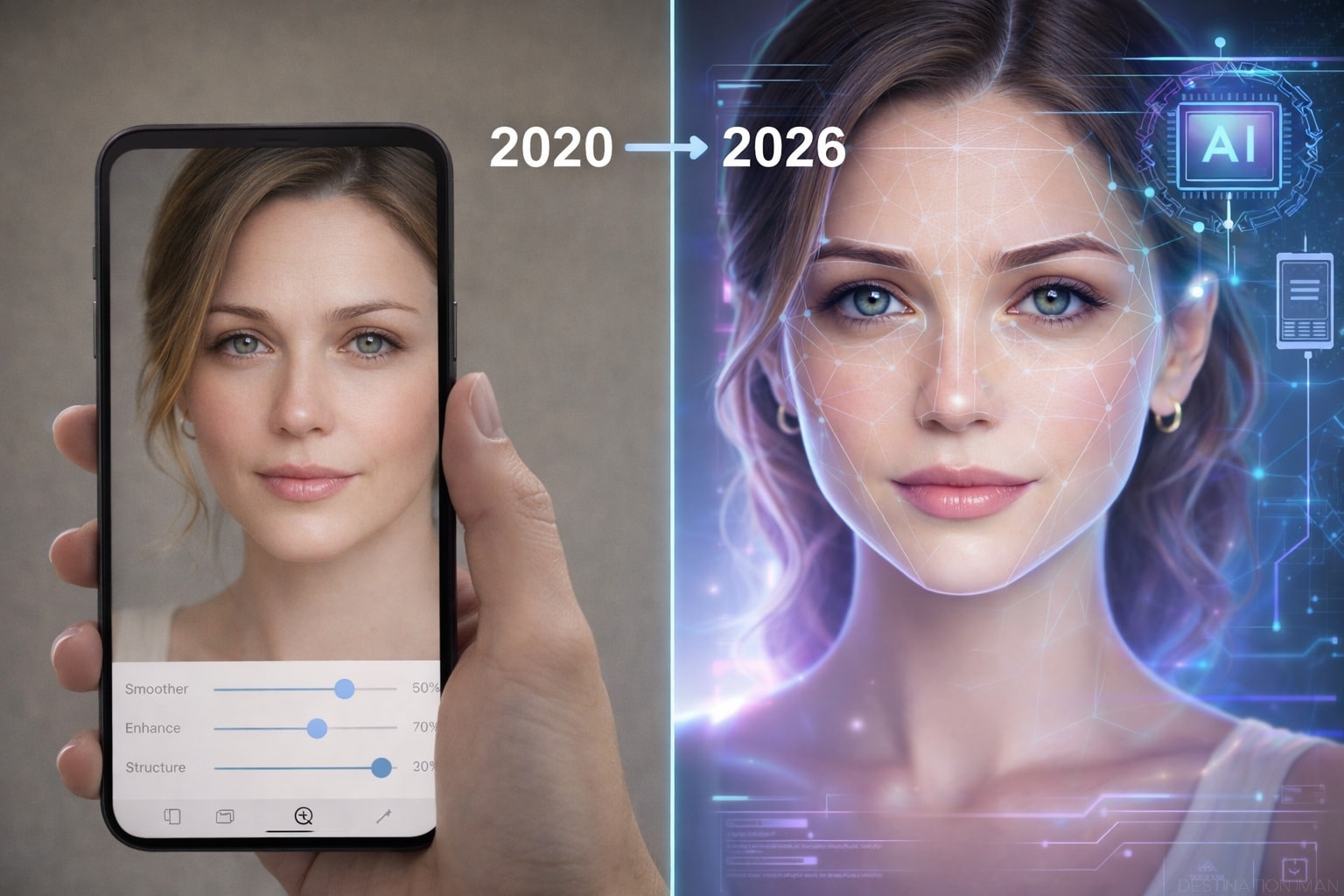
Several developments between 2023 and 2026 intensified the sense of unreality:
AI Beauty Filters Go Mainstream
Advanced generative AI filters became standard features across major platforms. Unlike earlier filters that smoothed and lightened, these:
- Restructure facial geometry in real-time
- Apply lighting that cannot exist in physical space
- Create expressions that blend the user's face with idealized templates
- Operate at such speed that users experience no perceptible lag
The result: Millions of users now interact with AI-mediated versions of themselves as default.
Virtual Influencers Become Indistinguishable
By 2025, several virtual influencers—entirely AI-generated personas—accumulated millions of followers who believed they were real people. The technology reached a threshold where synthetic faces could not be reliably identified by visual inspection alone.
The result: A new category of unreality—beauty standards derived from beings that never existed outside of algorithms.
The Feedback Loop Accelerates
As AI-generated and heavily filtered faces dominate visual feeds:
- Beauty product marketing increasingly references digital aesthetics
- Cosmetic procedures aim to replicate screen-optimized features
- Real faces shift toward digital approximations
- The gap between achievable and visible grows wider
Deepfake Beauty Normalization
By late 2025, tools allowing face-swapping and feature adjustment became accessible to average users. Apps promised to show you "what you'd look like with better genetics."
The result: Normalization of the idea that your actual face is merely one possible version—and probably not the best one.
The Psychological Toll
Dissociation from Physical Self
Extended exposure to unreal beauty standards produces measurable psychological effects:
Three Forms of Digital Dissociation
- Mirror avoidance: Users report preferring their phone camera to mirrors because the phone version feels "more like me"
- Identity confusion: Difficulty answering "what do I actually look like?" without a reference device
- Embodiment disruption: Sensation of living alongside your appearance rather than inhabiting it
The Exhaustion of Constant Evaluation
When beauty standards are unreal but omnipresent, evaluation becomes constant:
- Every mirror check becomes a comparison against an impossible standard
- Every photo requires immediate assessment: "Is this acceptable?"
- Every social situation includes mental calculation of visual performance
The Collapse of Context
Pre-digital beauty standards had context. You understood that magazine models existed in professional conditions—lighting, makeup, styling—not accessible to daily life.
Digital beauty standards appear in the same context as your own images. A friend's filtered selfie appears next to yours in identical framing and lighting. The algorithmic feed makes no distinction between professional content and casual posts.
Living in Two Realities
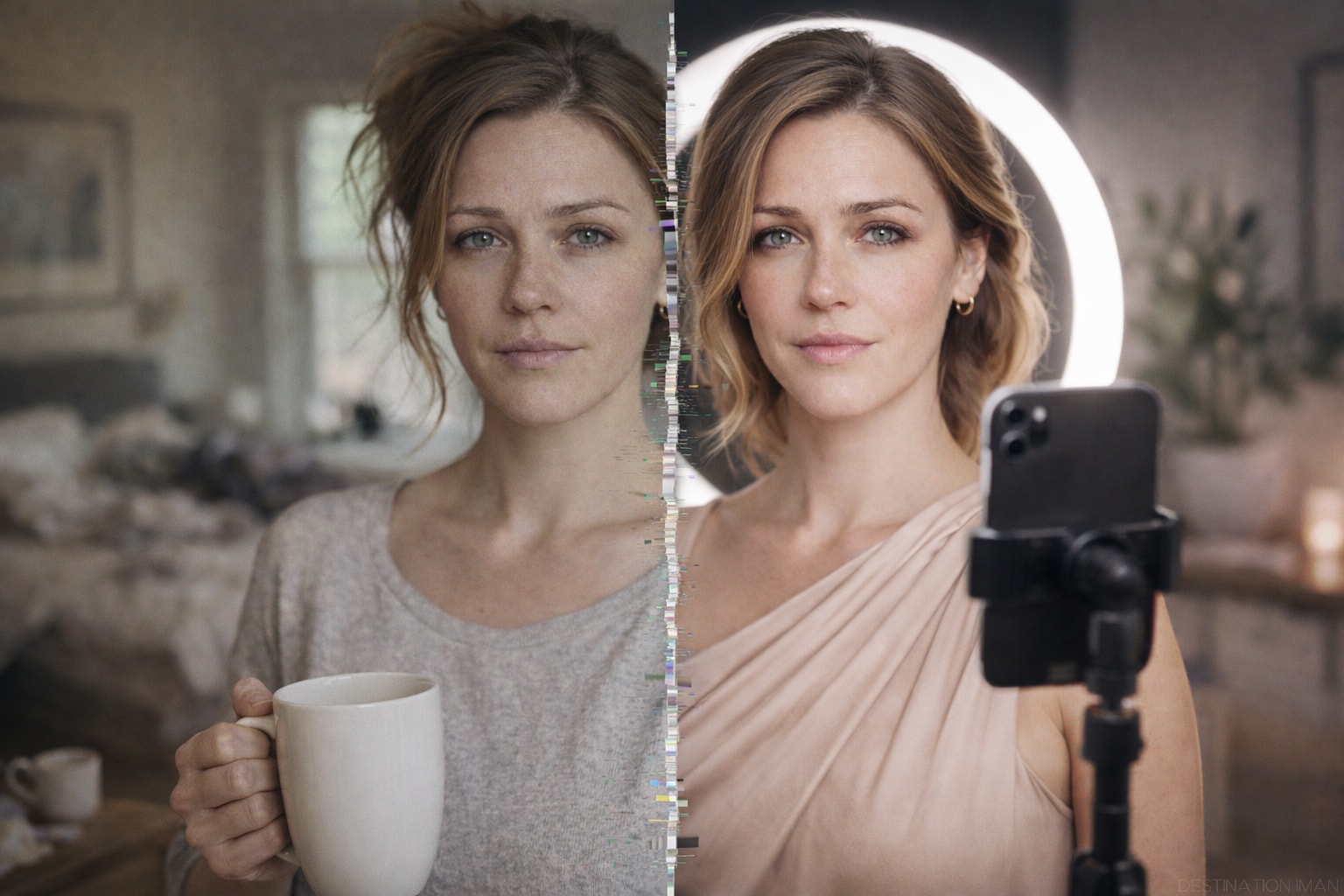
The Split Self
Many users describe experiencing two versions of themselves:
Curated, optimized, consistent
Receives social validation
Feels "presentable" and "acceptable"
Exists in controlled 2D space
Variable, textured, aging
Exists in uncontrolled 3D space
Feels inadequate by comparison
Requires constant management
This split creates chronic low-level stress. You are simultaneously both versions, yet neither feels fully authentic.
The Reality Shock
Common scenarios where unreality becomes tangible:
Four Common Reality Shock Moments
- Dating apps to first dates: The person across the table looks different enough from their profile that you feel deceived, even though you've also optimized your own images
- Video calls: Your face on screen doesn't match your mental image, creating discomfort throughout the call
- Professional photography: Even professional photos of your real face feel "worse" than your filtered selfies, because they capture texture and dimension that digital tools erase
- Group photos: Immediate awareness of how your face compares to others in the frame, sorted by perceived optimization level
When You Stop Recognizing Yourself
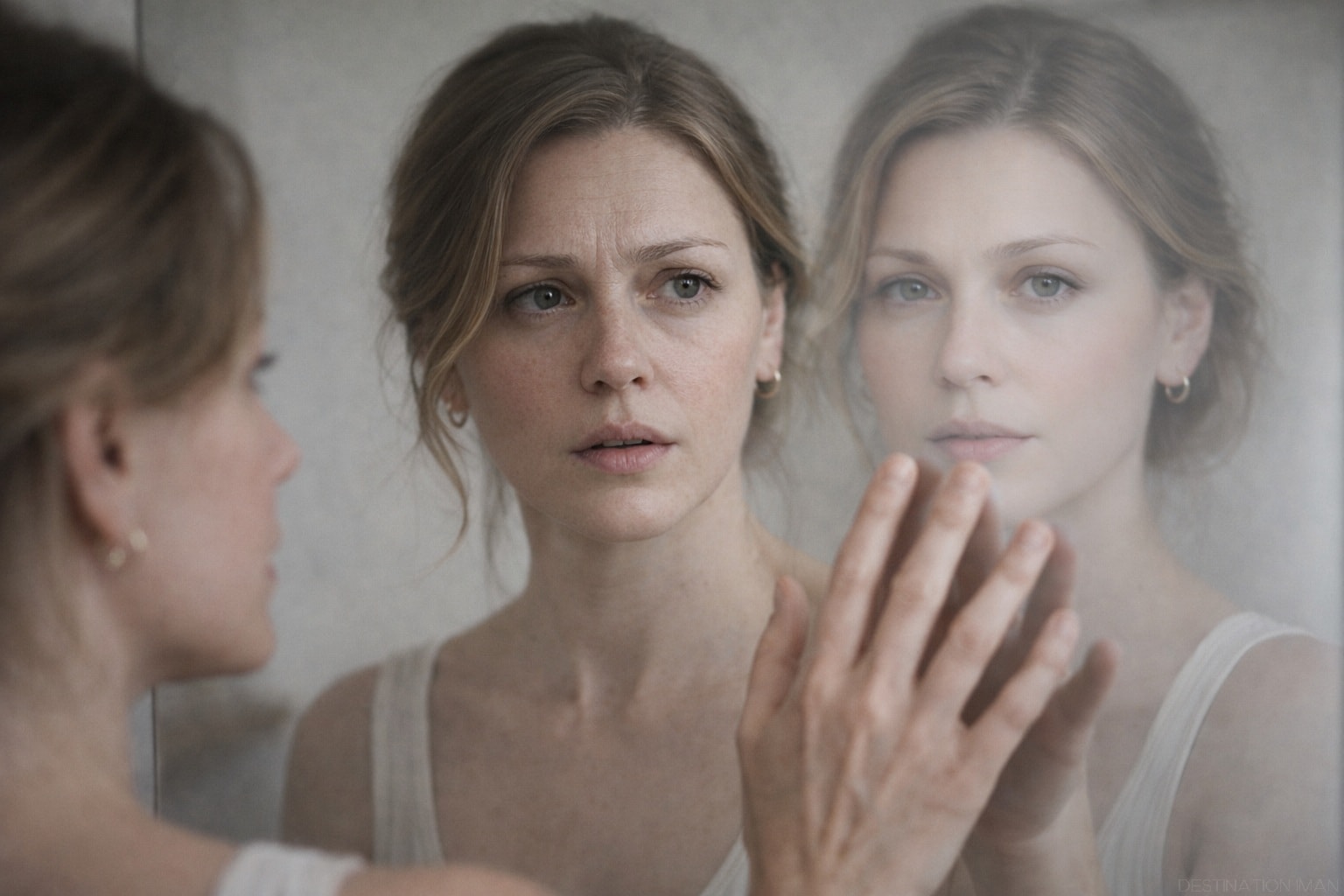
The most disorienting aspect of unreal beauty standards is not dissatisfaction—it is confusion about what you actually look like.
The Reference Point Problem
Which version is "you"?
- The mirror (which changes with lighting)
- The rear phone camera (which applies computational photography)
- The front camera with subtle filter (which you use most often)
- The filtered selfie (which gets posted and receives validation)
- The edited version (which matches the feed aesthetic)
The Stranger in the Mirror
Users increasingly report a specific phenomenon: seeing their own reflection and experiencing a moment of non-recognition. Not "I look bad today" but "who is that?"
This is not dysmorphia in the clinical sense—it is perceptual drift caused by spending more time seeing your face through digital mediation than in physical reflection.
Can This Rebalance?
Why Simple Solutions Won't Work
Common advice—"just stop using filters," "take a social media break," "practice self-acceptance"—fails because it treats a systemic problem as individual choice.
What Actual Change Requires
At the Platform Level
- Default-off rather than default-on filters
- Mandatory disclosure of AI enhancement in commercial content
- Algorithmic adjustments that don't systematically reward optimization
- Diverse representation in what gets amplified
At the Cultural Level
- Reduced social penalty for unoptimized appearance
- More visible presence of unfiltered faces in media
- Acknowledgment that digital beauty is a category distinct from physical beauty
- Understanding that "authenticity" cannot be performed through careful curation
At the Individual Level
- Conscious diversification of visual inputs
- Cultivation of non-appearance-based sources of value and identity
- Regular unmediated physical presence (time spent not being visually evaluated)
- Critical awareness of when images have been optimized—including your own
The Direction of Change
There are early signs of pushback:
- Growing discourse around AI disclosure in beauty content
- Increased visibility of "Instagram vs. Reality" comparisons
- Some platforms experimenting with "unfiltered" modes or badges
- Regulatory attention in several countries regarding digital manipulation disclosure
But meaningful change will be slow. The current system is not accidental—it is profitable, self-reinforcing, and globally distributed.

Conclusion
Beauty standards feel more unreal than ever because they increasingly are unreal—derived from engineered imagery, synthetic faces, and algorithmic optimization rather than human variation.
This creates a specific form of alienation: you are being asked to measure yourself against standards that do not correspond to physical possibility, using tools that make approximation feel perpetually insufficient.
The psychological toll is not simply dissatisfaction—it is disorientation, a growing uncertainty about what "real" means when the most visible version of reality is the most heavily mediated one.
Rebalancing requires more than individual action. It requires recognizing that what feels like personal inadequacy is often an appropriate response to impossible standards—and that those standards are design choices, not natural evolution.
The question is not whether you can meet these standards. The question is whether these standards should exist at all.
Sources & Further Reading
- Body Image Journal – Research on Appearance and Media
- New Media & Society – Digital Culture Studies
- Pew Research Center – Social Media & Technology
- Nature Human Behaviour – Perception of Artificial Faces
- American Psychological Association – Social Media and Mental Health
- Royal Society – The Uncanny Valley
- The Wall Street Journal – The Facebook Files