
Why do certain faces—Audrey Hepburn, Muhammad Ali, Marilyn Monroe, David Bowie, Frida Kahlo—remain instantly recognizable decades after their peak fame, while countless conventionally beautiful faces fade from memory? Iconic faces transcend simple attractiveness to achieve something more powerful: they become visually unforgettable, emotionally resonant, and culturally symbolic. Understanding what makes a face iconic reveals the complex interplay between psychology, neuroscience, cultural context, and visual storytelling.
This article explores the science behind facial iconicity, examining how distinction, emotional expression, cultural timing, and media amplification combine to create faces that become permanent fixtures in collective visual memory.
What Does "Iconic Face" Mean?
An iconic face is not simply a beautiful face—it's a face that achieves visual permanence in cultural memory. Iconic faces become instantly recognizable symbols that carry meaning beyond the individual, representing eras, movements, or cultural values.
The Characteristics of Iconicity
What Makes a Face Iconic
- Visual memorability: Instantly recognizable even in minimal context or silhouette
- Emotional resonance: Evokes feeling and connection beyond physical appearance
- Cultural symbolism: Represents larger ideas, movements, or zeitgeist
- Temporal transcendence: Remains recognizable across decades
- Distinctive features: Unique visual elements that prevent confusion with others
- Media amplification: Repeated exposure through powerful imagery
Iconic status is earned through a combination of inherent visual qualities, perfect cultural timing, and strategic media presentation. It's not accidental—it's the result of multiple aligned factors.
Why Iconic Faces Are Not Perfect
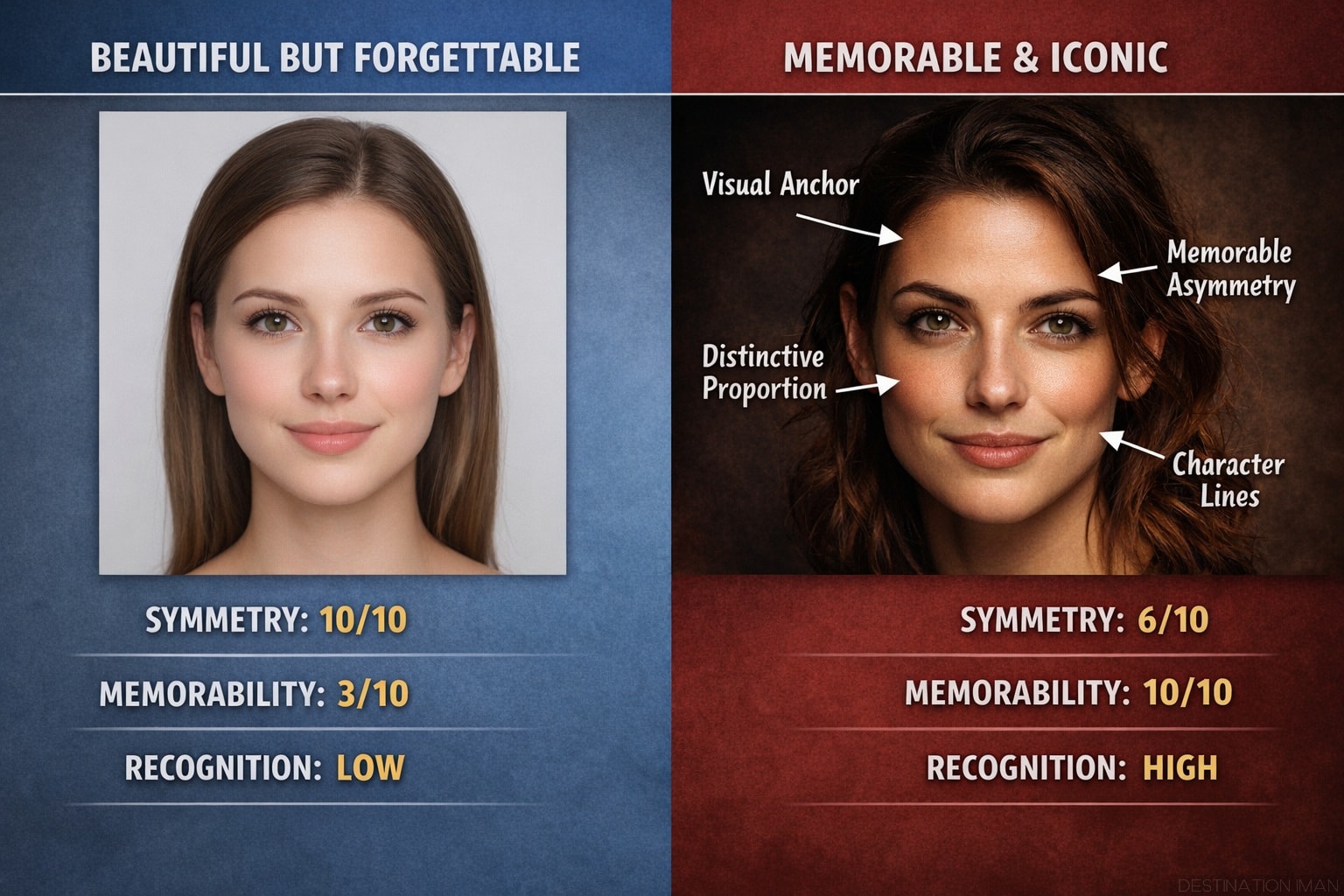
Contrary to popular belief, iconic faces rarely conform to classical beauty ideals or perfect symmetry. Research in perception psychology reveals that perfectly symmetrical, average faces are often perceived as boring and forgettable.
The Memorability Paradox
Iconic faces typically contain elements that create visual tension:
- Unusual proportions: Eyes set wider or closer than average, prominent noses, distinctive jawlines
- Asymmetries: Slight irregularities that add character and individuality
- Unexpected combinations: Features that wouldn't typically be paired together
- Strong contrasts: High differentiation between features and skin tone
The Brain's Preference for Distinctiveness
The brain remembers faces that deviate from the prototype. When encoding faces into long-term memory, neural systems prioritize features that make a face stand out from the average "face template" stored in memory. This creates a paradox: the most attractive faces may not be the most memorable.
The Power of Distinctive Features
Iconic faces almost always contain one or two dominant features that serve as visual anchors—immediately identifiable elements that enable rapid recognition even from minimal cues.
Types of Distinctive Visual Anchors
Iconic Feature Categories
- Eyes: Unusual shape, size, spacing, or intensity (e.g., Audrey Hepburn's doe eyes, David Bowie's heterochromia)
- Bone structure: Prominent cheekbones, strong jawline, distinctive profile (e.g., Grace Jones, Tilda Swinton)
- Nose: Distinctive shape that defies conventional "perfect" standards (e.g., Barbra Streisand, Adrien Brody)
- Lips: Unusual fullness, shape, or expression (e.g., Angelina Jolie, Mick Jagger)
- Facial contrast: High differentiation between features and skin (e.g., Elizabeth Taylor)
- Proportions: Unexpected ratios that create visual interest (e.g., Cara Delevingne's brows)
The Single-Feature Recognition Phenomenon
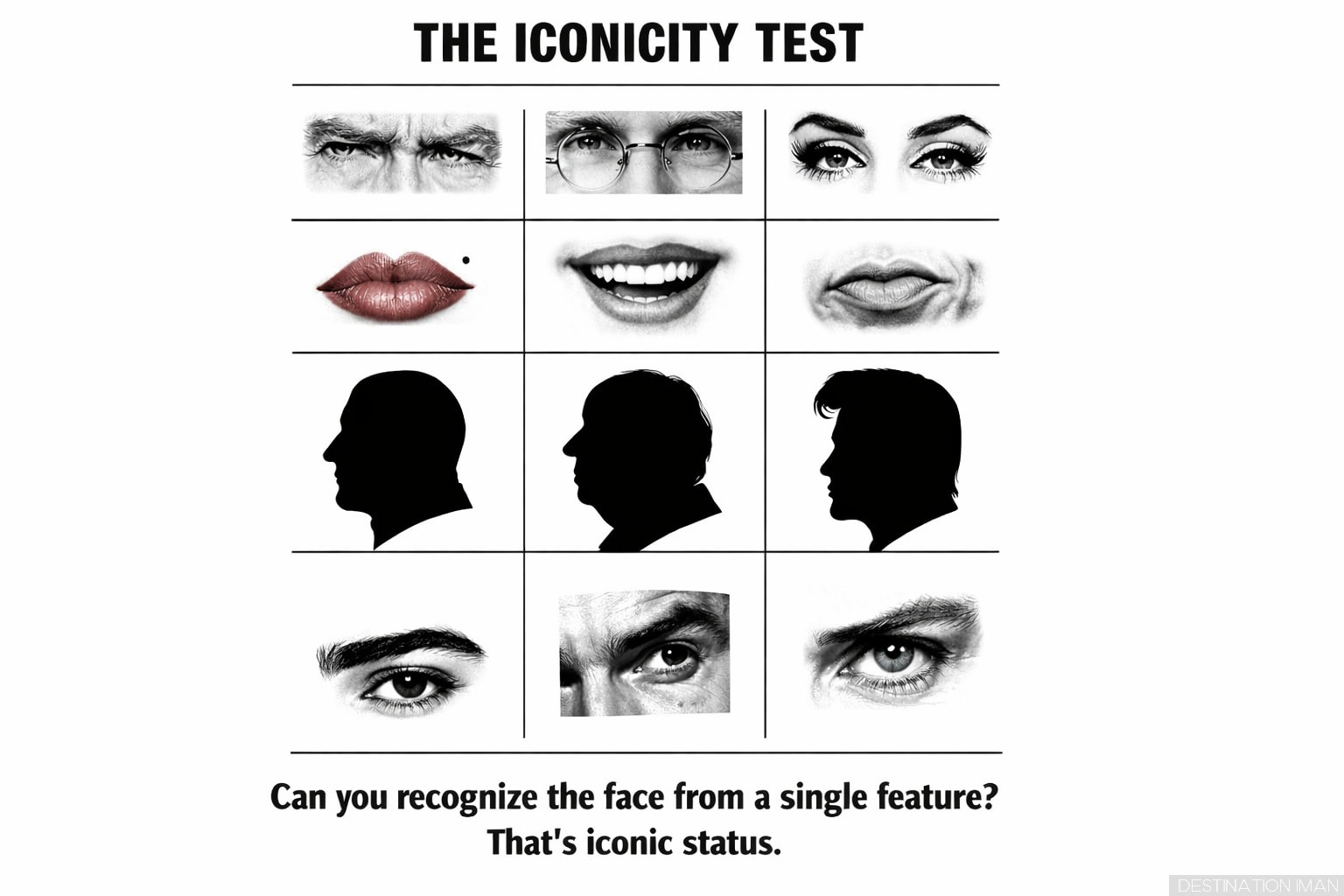
Truly iconic faces can often be recognized from a single feature in isolation—showing just the eyes, lips, or silhouette is sufficient for identification. This is the ultimate test of iconicity: the face has been encoded so strongly in cultural memory that partial information triggers complete recognition.

Familiarity, Visual Memory, and Recognition
The human brain is extraordinarily specialized for face recognition—dedicating specific neural regions to this task. Iconic faces exploit these systems through strategic repetition and emotional association.
The Mere-Exposure Effect in Facial Iconicity
As established in visual culture research, repeated exposure to a face increases both familiarity and positive evaluation. Iconic faces benefit from massive exposure through:
- Media saturation: Films, photographs, magazine covers, advertisements
- Cultural reproduction: Posters, merchandise, artistic reinterpretation
- Social transmission: Discussions, references, comparisons in popular discourse
- Cross-generational exposure: Continued visibility across decades
The Cultural Memory Loop
Stage 1: Introduction
Distinctive face appears in culturally significant context (film, music, fashion, historical moment)
Stage 2: Amplification
Media repetition builds familiarity while distinctive features ensure memorability
Stage 3: Emotional Association
Face becomes linked with specific feelings, values, or cultural moments
Stage 4: Symbol
Face transcends individual to represent larger concepts (era, movement, ideal)
Stage 5: Permanence
Face achieves cultural immortality—recognizable even generations later
Expression, Presence, and Charisma
A static face—no matter how distinctive—rarely becomes iconic without expression, presence, and charisma. These dynamic qualities transform distinctive features into emotional experiences.
The Role of Emotional Expression
Iconic faces are rarely photographed in neutral expressions. Instead, they're captured displaying signature emotional qualities:
- Intensity: Direct, penetrating gaze that creates connection (e.g., Steve McCurry's "Afghan Girl")
- Enigma: Mysterious ambiguity that invites interpretation (e.g., Mona Lisa, Greta Garbo)
- Joy: Authentic happiness that feels infectious (e.g., Louis Armstrong, young Princess Diana)
- Defiance: Challenging expression that conveys strength (e.g., Frida Kahlo, Nina Simone)
- Seduction: Inviting intimacy while maintaining distance (e.g., Marlene Dietrich)
Charisma as Measurable Quality
Charisma is not personality—it's behavioral signaling visible in photographs. Micro-expressions, posture, gaze direction, and facial muscle activation communicate confidence, warmth, and presence that static features alone cannot.


The Neuroscience of Memorable Faces
Modern neuroscience reveals specific brain mechanisms that make certain faces unforgettable. Understanding these processes explains why iconicity is not random but follows predictable patterns.
The Fusiform Face Area (FFA)
The fusiform face area is a region in the temporal lobe specialized for face recognition. Iconic faces activate the FFA more strongly than average faces, creating more robust neural encoding.
Neural Mechanisms of Facial Memory
- Fusiform Face Area (FFA): Primary face recognition center—iconic faces create stronger activation
- Amygdala: Emotional association—links faces to feelings, enhancing memory
- Hippocampus: Long-term memory formation—distinctive+emotional faces encode more durably
- Prefrontal cortex: Contextual association—links faces to cultural meaning and narratives
- Visual cortex: Feature processing—distinctive features create unique neural signatures
The Emotional Memory Advantage
Faces associated with strong emotions are remembered better than neutral faces. Iconic faces typically appear in emotionally charged contexts—landmark films, historical moments, cultural movements—which enhances neural encoding through amygdala activation.
Culture, Era, and Perfect Timing
Iconic faces don't exist in isolation—they emerge at specific cultural moments when their aesthetic and symbolic qualities resonate with collective consciousness. Timing is crucial to iconicity.
Cultural Resonance
Every era elevates faces that embody its values, anxieties, or aspirations:
- 1920s: Clara Bow, Louise Brooks—rebellion, modernity, new feminine freedom
- 1950s: Marilyn Monroe, James Dean—glamour, youth rebellion, post-war optimism/angst
- 1960s: Twiggy, Muhammad Ali—countercultural change, civil rights, anti-establishment
- 1980s: Madonna, Prince—gender fluidity, MTV visual culture, excess and experimentation
- 2000s: Diverse iconography reflecting globalization and digital culture
Faces become iconic when they visually represent what a culture is thinking about, struggling with, or aspiring toward. They're symbols, not just people.

Fashion, Styling, and Visual Identity
While distinctive features provide raw material, consistent styling and visual identity transform a memorable face into an iconic brand. Fashion doesn't create iconicity, but it amplifies and crystallizes it.
The Power of Signature Looks
Iconic faces typically have signature visual elements that become inseparable from their identity:
- Audrey Hepburn: Little black dress, updo, oversized sunglasses
- David Bowie: Constantly evolving but always theatrical makeup and styling
- Frida Kahlo: Unibrow, traditional Mexican dress, floral headpieces
- Grace Jones: Androgynous geometric styling, sharp angles
- Kurt Cobain: Grunge aesthetic, blonde hair, flannel—visual anti-fashion statement
These signature looks serve multiple functions:
How Styling Enhances Iconicity
- Visual consistency: Repeated aesthetic creates strong memory associations
- Brand differentiation: Unique styling prevents confusion with others
- Symbolic communication: Style choices signal values and identity
- Reproduction ease: Distinctive looks are easily imitated, spreading recognition
- Cultural storytelling: Fashion choices add narrative layers to the face
Strong visual identity allows a face to function as a recognizable brand—instantly identifiable across contexts and resistant to time.
Photography and the Creation of Iconic Images
Many iconic faces are remembered not for how they looked in reality, but for how they were photographed. Photography is not neutral documentation—it's aesthetic construction that can create or destroy iconicity.
Technical Factors in Iconic Photography
Photography Elements That Build Icons
- Lighting: Dramatic contrast that emphasizes distinctive features and creates mood
- Composition: Framing that focuses attention on most compelling elements
- Angle: Perspective that maximizes visual impact of unique features
- Expression timing: Capturing peak emotional moment or signature look
- Context removal: Isolating face from distracting background
- Post-processing: Enhancement that intensifies distinctive qualities
The Photographer's Role
Iconic faces often result from collaboration with visionary photographers who understand how to translate distinctive features into powerful images:
- Richard Avedon's stark, confrontational portraits
- Annie Leibovitz's narrative celebrity photography
- Helmut Newton's provocative fashion imagery
- Steve McCurry's emotionally intense photojournalism
These photographers didn't just document faces—they constructed visual legends through technical mastery and artistic vision.
Why We Remember Some Faces Forever
Synthesizing neuroscience, psychology, and cultural factors reveals a clear pattern in what makes faces unforgettable.
The Iconicity Formula
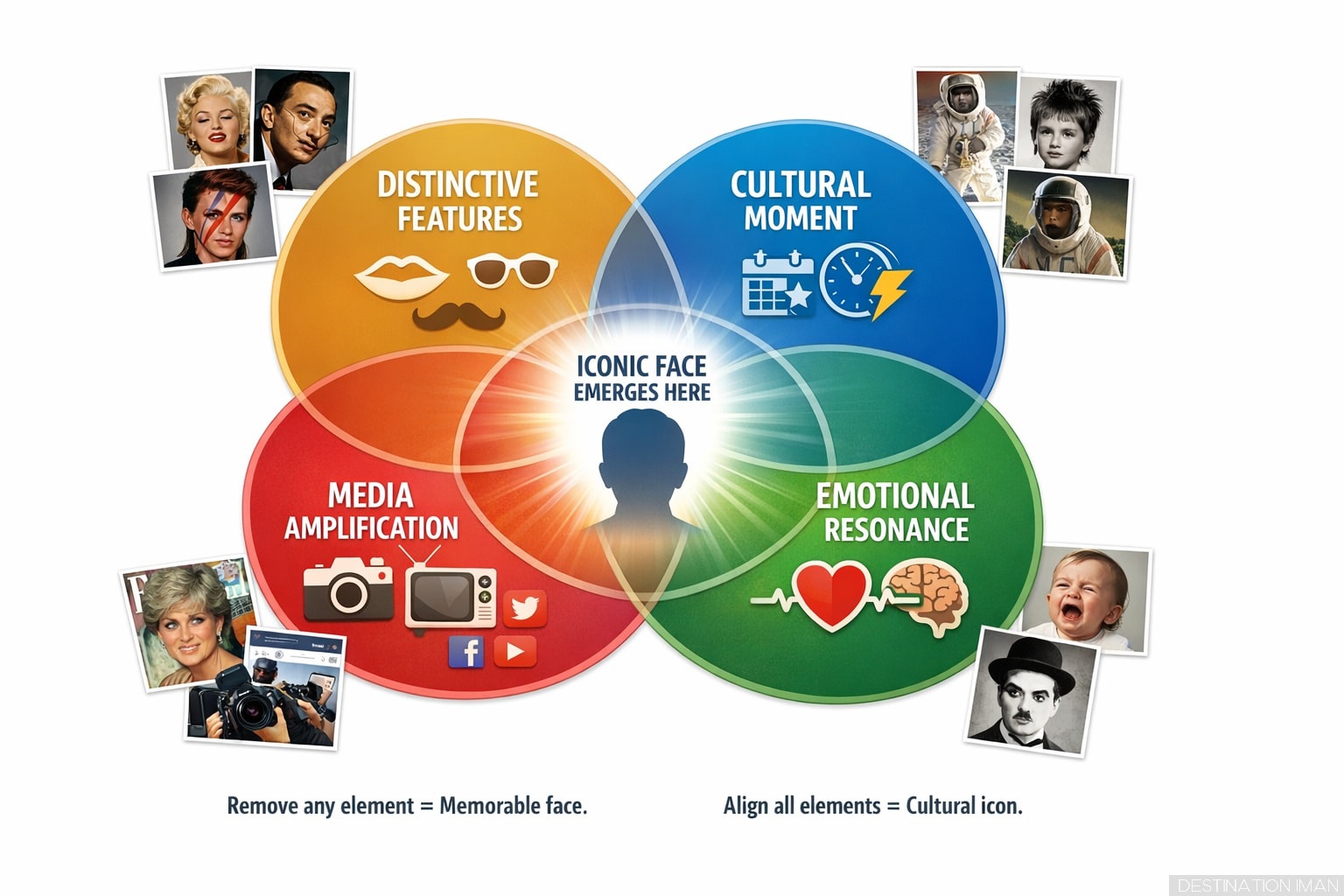
Iconic faces emerge when multiple factors align:
Requirements for Facial Iconicity
- Distinctive features: Visual uniqueness that prevents confusion and aids memory encoding
- Emotional expressiveness: Charisma, presence, or intensity captured in images
- Cultural resonance: Appearance at the right historical moment with symbolic meaning
- Media amplification: Repeated exposure through powerful imagery across platforms
- Narrative association: Connection to compelling stories, movements, or cultural moments
- Visual consistency: Signature styling that reinforces recognition
- Photographic immortalization: Captured in technically excellent, emotionally powerful images
- Cross-generational transmission: Continued relevance and exposure beyond original era
Remove any single element and the face may be memorable—but not iconic. True iconicity requires the complete constellation of factors working in concert.
Key Takeaways
Core Insights: Iconic Faces and Timeless Beauty
- Iconic faces are memorable and culturally symbolic, not merely beautiful
- Perfect symmetry creates beauty but not memorability—distinctiveness is key
- Distinctive features serve as visual anchors enabling rapid recognition
- The brain prioritizes unique features over average ones in memory encoding
- Emotional expression and charisma transform static features into magnetic presence
- Cultural timing is crucial—iconic faces embody their era's values and anxieties
- Consistent styling and visual identity amplify recognition and cultural permanence
- Photography constructs iconicity as much as features do—image and face are inseparable
- Mere-exposure effect builds familiarity while distinctiveness ensures memorability
- Neuroscience shows iconic faces activate memory and emotion centers more strongly
- Iconicity requires alignment of multiple factors: features, timing, media, emotion, and narrative
- Iconic faces become symbols representing concepts larger than the individual
Sources & References
Academic & Research Sources
- NIH — The Effects of Face Attractiveness on Face Memory
- Neuropsychologia — Effects of Attractiveness on Face Memory Separated from Distinctiveness
- NIH — Social Psychological Face Perception: Why Appearance Matters
- PsyPost (2025) — New Psychology Research on "Vibe" and Beauty Interaction
- Royal Society Open Science (2024) — What is Beautiful is Still Good: The Attractiveness Halo Effect
- Zajonc, R. B. (1968). Attitudinal Effects of Mere Exposure. Journal of Personality and Social Psychology
- Berger, J. (1972). Ways of Seeing. BBC/Penguin Books
- Kahneman, D. (2011). Thinking, Fast and Slow. Farrar, Straus and Giroux
- Psychology Today — Facial Perception and Memory Research