
Have you ever noticed that attractive people often seem more confident, intelligent, and socially skilled—even before they've said a word? This isn't coincidence. It's the halo effect, a powerful cognitive bias where one positive characteristic (like physical attractiveness) influences our overall impression of a person, causing us to unconsciously attribute other positive traits to them.
This article explores the psychology behind the halo effect, why attractiveness triggers confidence perception, how this bias creates self-fulfilling prophecies, and what research reveals about this universal human tendency that shapes everything from hiring decisions to romantic attraction.
What Is the Halo Effect?
The halo effect is a cognitive bias in which our overall impression of a person influences how we perceive their specific traits. When someone possesses one positive characteristic—like physical attractiveness—we unconsciously assume they also possess other positive characteristics, such as intelligence, competence, kindness, or confidence.
The Halo Metaphor
The term "halo effect" comes from religious iconography, where saints are depicted with glowing halos symbolizing their goodness. Similarly, one "glowing" trait creates a metaphorical halo that casts positive light on all other attributes—whether or not those attributes actually exist.
Core Characteristics of the Halo Effect
- Unconscious operation: The bias occurs automatically, below conscious awareness
- Overgeneralization: One trait inappropriately influences judgment of unrelated traits
- Universal phenomenon: Documented across cultures, ages, and contexts
- Immediate activation: Judgments form within seconds of exposure
- Persistent bias: Difficult to override even with contradictory information
- Bidirectional effect: Negative traits create reverse halo (horn effect)
The History and Science Behind the Halo Effect
The halo effect was first identified and named by psychologist Edward Thorndike in 1920, though humans have likely been experiencing this bias throughout evolutionary history.
Thorndike's Original Research
Edward Thorndike discovered the halo effect while studying how military officers rated their subordinates. He found that officers who rated soldiers highly on one trait (like physical appearance) also rated them highly on completely unrelated traits (like leadership ability or intelligence)—even when no correlation existed.
Modern Research Confirmation
A century of psychological research has consistently validated and expanded Thorndike's findings:
Why Does the Halo Effect Exist?
Evolutionary psychologists propose several explanations for why this cognitive bias developed:
- Cognitive efficiency: Making rapid judgments based on limited information improved survival
- Attractiveness-health correlation: Physical attractiveness historically correlated with genetic health
- Social learning: Attractive individuals often receive better treatment, developing actual confidence
- Stereotyping necessity: Brains need mental shortcuts to process overwhelming social information
Why Attractiveness = Perceived Confidence
Among all traits affected by the halo effect, confidence is one of the most consistently attributed to attractive people. This happens through multiple psychological mechanisms.
The Body Language Connection
Attractive people often develop confident body language through positive social feedback throughout their lives. Observers then mistake this learned behavior for innate personality traits.
Perception vs Reality
- What we perceive: "That attractive person is naturally confident, charismatic, and self-assured"
- Actual mechanism: Years of positive social responses created confident behaviors + halo effect amplifies perception
- The bias: We attribute confidence to inherent personality rather than social conditioning
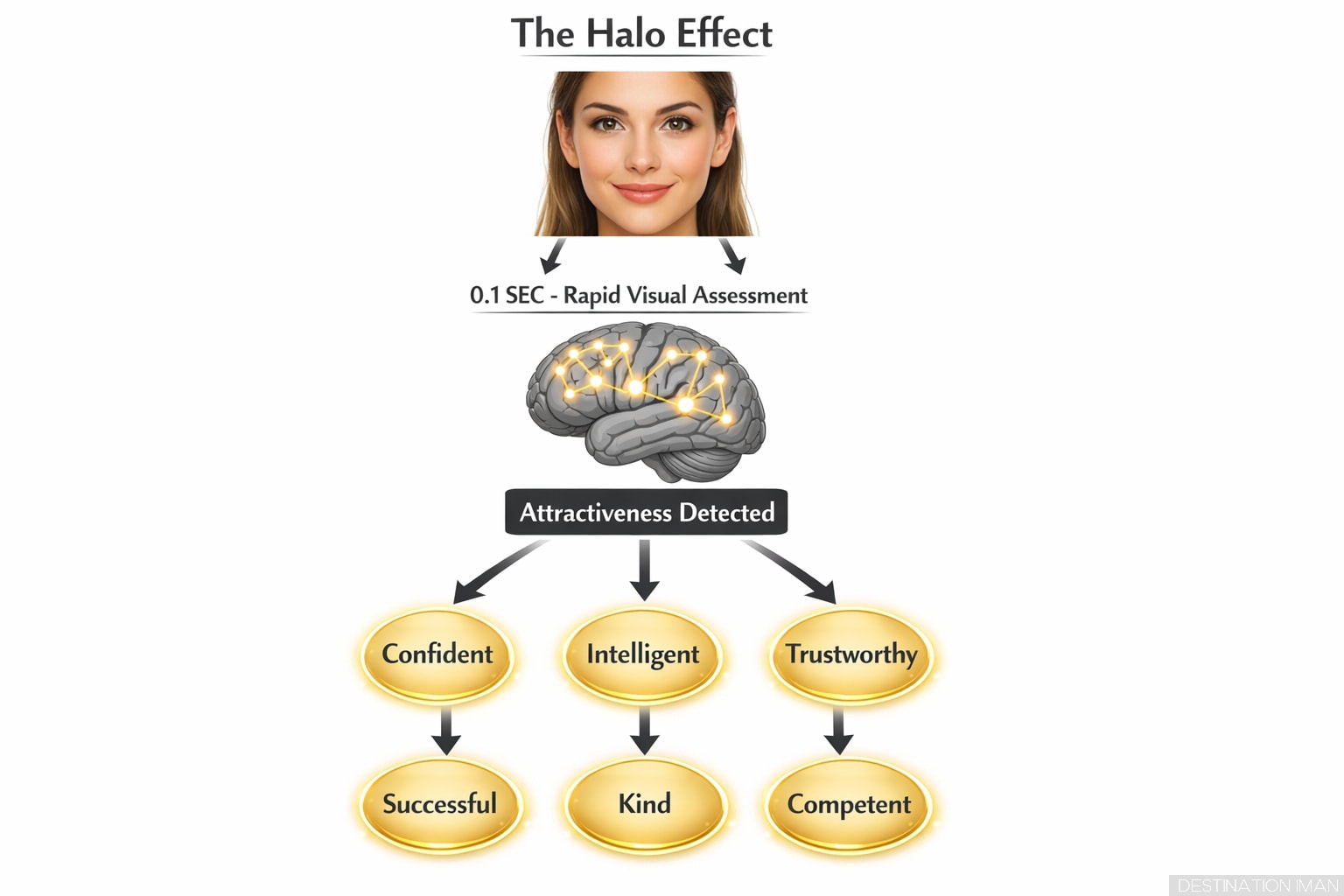
The Immediate Judgment Timeline
0.1 Seconds: Visual Processing
Brain rapidly categorizes face as attractive based on symmetry, health markers, and cultural standards
0.3 Seconds: Halo Activation
Positive attractiveness assessment triggers automatic positive trait assumptions including confidence
1 Second: Trait Attribution
Observer has already formed impression: "confident, competent, socially skilled"—before person speaks
Ongoing: Confirmation Bias
Observer selectively notices behaviors confirming initial impression, ignoring contradictory evidence
Why Confidence Specifically?
Confidence is particularly linked to attractiveness because:
- Body language overlap: Confident posture and attractive presentation often coincide
- Social status signaling: Both attractiveness and confidence signal high social value
- Circular reinforcement: Positive responses to attractiveness build actual confidence
- Evolutionary value: Confidence historically indicated leadership and resource access

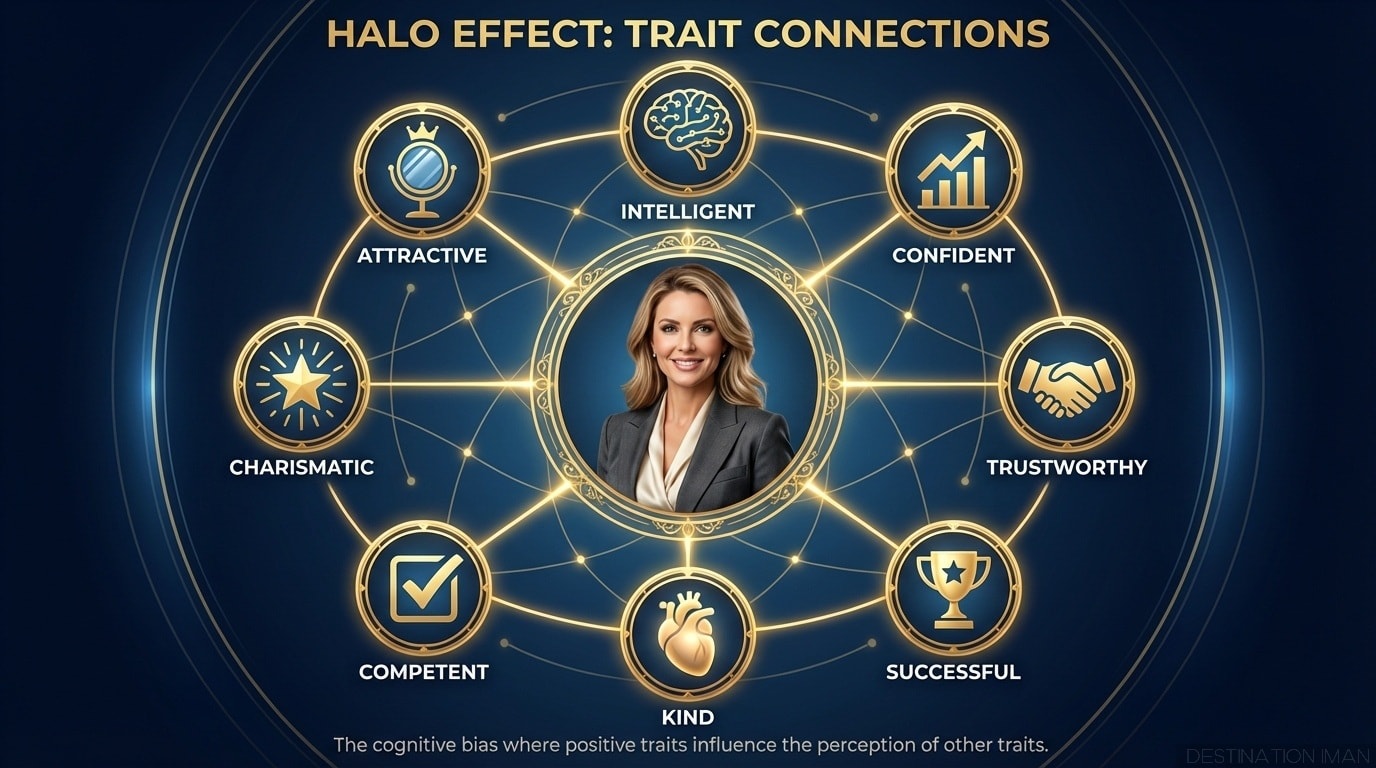
What Other Traits Get Attributed?
Confidence is just one of many positive traits the halo effect associates with attractiveness. Research has documented a wide range of overgeneralized assumptions.
The "What Is Beautiful Is Good" Stereotype
Psychologists call this phenomenon the "what is beautiful is good" stereotype—a well-documented tendency to attribute positive personality traits to attractive people.
Traits Commonly Attributed to Attractive People
- Intelligence: Attractive people rated as smarter despite no correlation with IQ scores
- Competence: Perceived as more capable and skilled across professional domains
- Trustworthiness: Judged as more honest and reliable in interactions
- Kindness: Assumed to have warmer, more generous personalities
- Success: Expected to achieve more in career and relationships
- Social skills: Perceived as more charismatic and socially adept
- Leadership ability: Seen as more capable of leading and influencing others
- Emotional stability: Assumed to be psychologically healthier and more balanced
Real-World Impact of These Attributions
These biased trait attributions have measurable real-world consequences:
The Halo Effect in Real-World Contexts
The halo effect operates across virtually all social domains, often with significant consequences for individuals' life outcomes.
Employment and Career Advancement
Attractiveness bias in professional contexts is well-documented and substantial:
- Hiring decisions: Attractive candidates receive more interview invitations and job offers
- Salary negotiations: Attractive employees earn significantly more for identical work
- Promotions: Physical appearance affects advancement opportunities
- Performance reviews: Attractive employees rated higher on competence and leadership
Education and Academic Perception
The halo effect influences how teachers and peers perceive students:
- Teacher expectations: Attractive students expected to perform better academically
- Grading bias: Some studies show grade advantages for attractive students on subjective assignments
- Peer popularity: Physical attractiveness strongly predicts social acceptance
- Leadership selection: Attractive students more likely chosen for leadership positions
Criminal Justice System
Perhaps most troubling, the halo effect affects legal outcomes:
- Jury decisions: Attractive defendants less likely to be found guilty
- Sentencing: When convicted, attractive individuals receive lighter sentences
- Victim credibility: Attractive victims perceived as more credible witnesses
- Exception: When attractiveness was used to commit crime (fraud), bias reverses
Romantic and Social Relationships
Dating and friendship formation show strong halo effects:
- Initial attraction: Physical appearance dominates first impressions in dating
- Personality attribution: Attractive dates assumed to have better personalities
- Relationship satisfaction: Attractiveness affects how partners' behaviors are interpreted
- Social circles: Attractive individuals often have larger, more diverse social networks

The Self-Fulfilling Prophecy
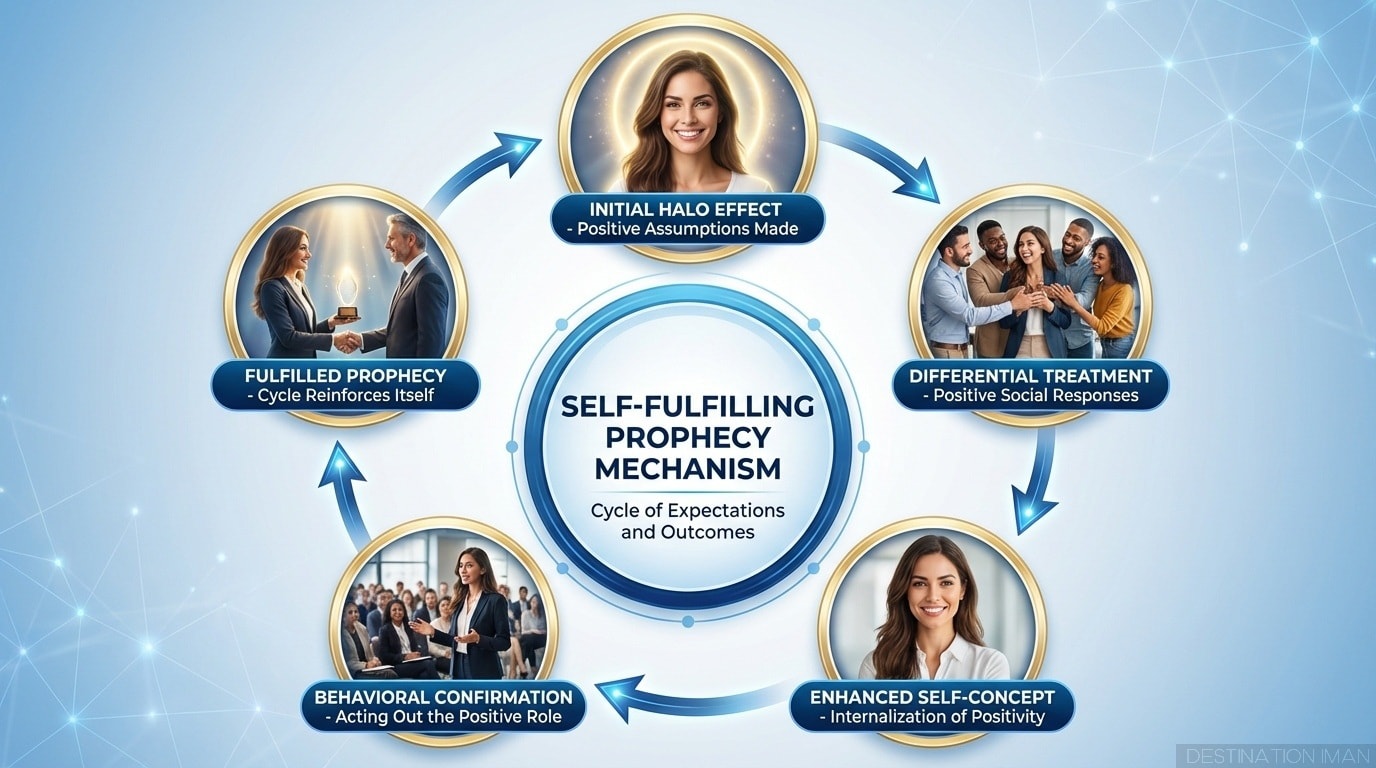
One of the most fascinating aspects of the halo effect is how it creates self-fulfilling prophecies—where biased expectations actually create the traits they assume exist.
The Feedback Loop Mechanism
Stage 1: Initial Bias
Attractive person encounters positive halo effect assumptions (confident, intelligent, likeable)
Stage 2: Differential Treatment
Others treat them according to these assumptions—more warmth, more opportunities, more social engagement
Stage 3: Behavioral Response
Positive treatment builds actual confidence, social skills, and self-esteem
Stage 4: Trait Development
Repeated positive interactions develop genuine competence, confidence, and charisma
Stage 5: Confirmation
Observers conclude: "See, I was right—attractive people really are more confident!"
Nature vs Nurture Confusion
This self-fulfilling cycle makes it difficult to separate:
- Innate traits: Characteristics genuinely independent of appearance
- Socially constructed traits: Characteristics developed through differential treatment
- Perceived traits: Characteristics attributed but not actually present

The Reverse Halo Effect (Horn Effect)
The halo effect works bidirectionally. When someone possesses a negative characteristic, we unconsciously assume they possess other negative traits—called the horn effect or devil effect.
How the Horn Effect Operates
Just as attractiveness creates positive assumptions, physical unattractiveness or other negative traits trigger negative generalizations:
Halo Effect vs Horn Effect
- Halo Effect: Attractive → assumed confident, intelligent, kind, successful
- Horn Effect: Unattractive → assumed insecure, less intelligent, cold, unsuccessful
- Both biases: Operate unconsciously, resist correction, create self-fulfilling prophecies
The Unfairness Amplification
The horn effect creates systematic disadvantages that compound over time:
- Social rejection: Less warmth and engagement from others
- Fewer opportunities: Passed over for jobs, promotions, social invitations
- Lower expectations: Teachers, employers, peers expect less
- Negative interpretations: Ambiguous behaviors interpreted negatively
- Confidence erosion: Repeated negative treatment undermines self-esteem
Halo Effect in the Digital Age
Digital technology and social media have amplified and transformed the halo effect in unprecedented ways.
Beauty Filters and Enhanced Bias
The 2024 Royal Society study found that beauty filters don't reduce the halo effect—they enhance it. Digitally perfected faces trigger even stronger positive trait assumptions.
AI and Algorithmic Bias
Recent research reveals that artificial intelligence systems have learned human halo effect biases:
- Resume screening AI: Some systems favor attractive profile photos
- Social media algorithms: Attractive content receives algorithmic boost
- Recommendation systems: Beauty bias affects content visibility
- Dating apps: Algorithms optimize for attractiveness, amplifying halo effects
The Perception Drift Phenomenon
Constant exposure to filtered, enhanced digital faces is creating what psychologists call "perception drift"—a gradual shift in what we consider "normal" or attractive.
Can You Break Free from the Halo Effect?
The halo effect is deeply ingrained in human cognition, but awareness and deliberate practices can reduce its influence on your judgments—and potentially mitigate its effects on how you're perceived.
Reducing Your Own Halo Effect Bias
Strategies for Fairer Judgment
- Awareness practice: Consciously notice when making rapid attractiveness-based assumptions
- Delayed judgment: Wait for behavioral evidence before forming personality conclusions
- Trait separation: Evaluate each characteristic independently, not as a package
- Counter-stereotyping: Actively consider counter-examples to attractiveness stereotypes
- Blind evaluation: When possible, assess qualifications without appearance information
- Diverse exposure: Regularly interact with people of varying appearance levels
- Metacognitive monitoring: Ask yourself "Am I judging this person or their appearance?"
Minimizing Halo Effect Impact on You
While you can't control others' biases, you can reduce halo effect disadvantages:
Strategies for Overcoming Bias
- Skill demonstration: Provide concrete evidence of competence early in interactions
- Confident communication: Body language and speech patterns influence perception independent of facial attractiveness
- Professional presentation: Grooming and styling signal competence even when features are average
- Warmth and engagement: Positive personality traits can override attractiveness bias
- Credibility building: Establish expertise and authority through credentials and achievements
- Strategic self-presentation: Emphasize strengths that trigger alternative positive biases
Ethical Implications and Awareness
Understanding the halo effect raises important ethical questions about fairness, discrimination, and social responsibility.
The Justice Problem
The halo effect creates systematic advantages and disadvantages based on factors largely outside individual control. This raises questions:
- Is appearance-based bias a form of discrimination that should be addressed?
- Should industries implement "blind" evaluation processes to reduce attractiveness bias?
- How do we balance genuine preferences with systemic unfairness?
- What responsibility do attractive people have regarding unearned advantages?
Institutional Responses
Some organizations are taking steps to reduce appearance bias:
- Blind recruitment: Removing photos and names from initial application reviews
- Structured interviews: Standardized questions reduce subjective bias
- Bias training: Educating decision-makers about halo effect mechanisms
- Diverse panels: Multiple evaluators reduce individual bias impact
- Objective criteria: Emphasizing measurable qualifications over impressions
Individual Responsibility
While systemic change is important, individuals can practice ethical awareness:
- Question assumptions: Actively challenge attractiveness-based judgments
- Value substance: Prioritize character and competence over appearance
- Extend opportunity: Consciously include people who might face horn effect disadvantages
- Recognize privilege: If you benefit from halo effect, acknowledge and counteract it
- Teach awareness: Help others recognize and reduce their appearance biases
Key Takeaways
Core Insights: The Halo Effect
- The halo effect is a cognitive bias where one positive trait creates overgeneralized positive impressions
- Physical attractiveness triggers assumptions about confidence, intelligence, competence, and kindness
- The bias operates unconsciously in 0.1-1 second, before conscious thought
- Halo effect influences hiring, promotions, criminal sentencing, academic assessment, and romantic interest
- Self-fulfilling prophecies occur: positive treatment creates the traits the bias assumes exist
- The horn effect (reverse halo) creates systematic disadvantages for less attractive individuals
- Digital age amplifies halo effect through filters, social media, and AI algorithmic bias
- Cross-cultural research confirms halo effect is universal human phenomenon
- Awareness helps but doesn't eliminate bias—it's deeply embedded in cognition
- Ethical responsibility exists to recognize and counteract appearance-based discrimination
- Halo effect is both descriptive (documents bias) and prescriptive (creates reality through feedback)
Sources & References
Academic & Research Sources
- Thorndike, E. L. (1920). A constant error in psychological ratings. Journal of Applied Psychology, 4(1), 25-29.
- Royal Society Open Science (2024) — "What is beautiful is still good: the attractiveness halo effect in the era of beauty filters"
- Langlois, J. H., et al. (2000). Maxims or myths of beauty? A meta-analytic and theoretical review. Psychological Bulletin, 126(3), 390-423.
- ArXiv (2025) — "Uncovering an Attractiveness Bias in Multimodal Large Language Models"
- Nisbett, R. E., & Wilson, T. D. (1977). The halo effect: Evidence for unconscious alteration of judgments. Journal of Personality and Social Psychology, 35(4), 250-256.
- Kahneman, D. (2011). Thinking, Fast and Slow. Farrar, Straus and Giroux.
- The Decision Lab — Halo Effect Research Overview
- Psychology Today (2022) — Beauty Goggles: The Attractiveness Halo Effect Across Cultures
- Positive Psychology — Halo Effect: Why We Judge a Book by Its Cover
- NIH — The Attractiveness Halo Effect and the Babyface Stereotype in Older and Younger Adults