Visual culture—the images, symbols, fashion, and media that surround us—powerfully shapes how we perceive beauty, attractiveness, and aesthetic value. In 2026, this influence has intensified through algorithmic curation, AI-driven filters, and constant visual exposure. Understanding how beauty standards are constructed through visual culture reveals that what feels "natural" or "obviously beautiful" is actually learned conditioning.
This article explores the psychology of visual culture, how media and algorithms shape modern beauty standards, the mechanisms of aesthetic conditioning, and why beauty ideals that feel universal are actually culturally and technologically constructed.
What Is Visual Culture?
Visual culture refers to the totality of images, symbols, design, fashion, and media that shape how societies see and interpret the world. Unlike written language, visual information is processed rapidly and emotionally—making it especially powerful in forming unconscious beliefs about beauty, status, and desirability.
The Dominance of Visual Information
In modern life, visual culture dominates communication. From social media feeds to billboard advertising, fashion editorials to TikTok videos, humans are exposed to thousands of curated images daily—each subtly reinforcing specific aesthetic values.
Why Visual Signals Are So Powerful
Visual processing occurs faster than conscious thought. The brain evaluates aesthetic information—symmetry, color, proportion, familiarity—in milliseconds, triggering emotional responses before rational analysis begins. This makes visual conditioning particularly effective and resistant to conscious override.
The Role of Aesthetics in Human Perception
Aesthetics is not simply about "what looks pretty"—it's the study of how the brain evaluates harmony, balance, pattern, and meaning in visual stimuli. Human aesthetic preferences combine evolutionary instincts with cultural learning.
Universal Aesthetic Principles
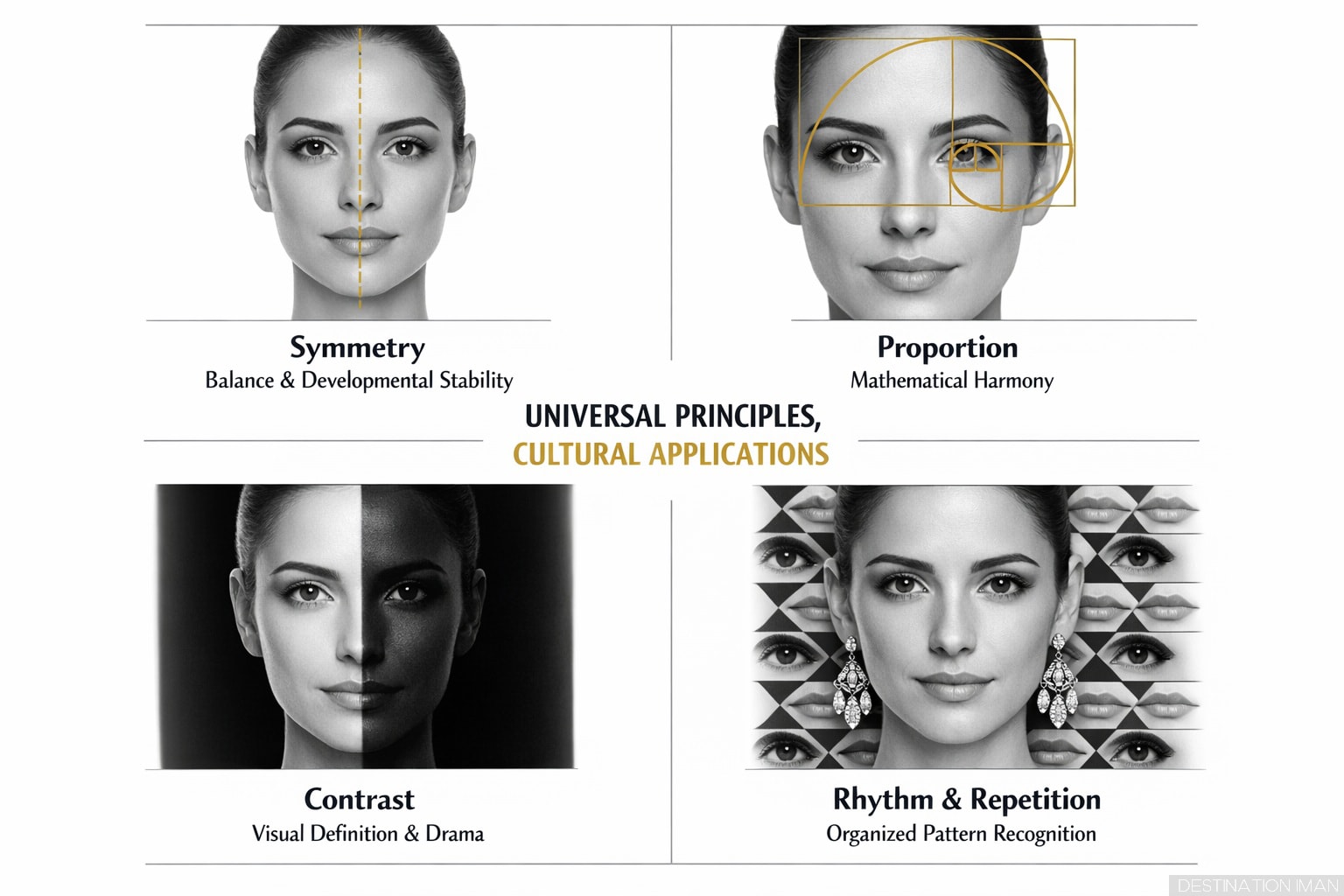
Certain aesthetic principles appear cross-culturally, suggesting some biological basis:
Core Aesthetic Preferences
- Symmetry: Balanced features signal developmental stability and health
- Proportion: Specific ratios (golden ratio, facial thirds) create visual harmony
- Contrast: Clear differentiation between features aids processing and memorability
- Rhythm and repetition: Patterns feel organized and intentional
- Novelty within familiarity: Slight variations on known patterns intrigue without threatening
Cultural Overlay on Aesthetic Perception
While some preferences may be universal, culture determines how these principles are applied and which principles dominate. What counts as "good proportion" varies dramatically across cultures and eras—demonstrating that aesthetic judgment is learned, not innate.
How Beauty Standards Are Formed
Beauty standards are not discovered—they are constructed through complex social, economic, and technological processes. Understanding this construction reveals that current standards are neither inevitable nor permanent.
The Building Blocks of Beauty Standards
Factors That Shape Beauty Ideals
- Cultural history: Historical aesthetics create baseline expectations and nostalgia-driven revivals
- Economic conditions: Wealth displays shift (thinness vs. curves) based on scarcity vs. abundance
- Media representation: Repeated visual exposure creates familiarity and preference (mere-exposure effect)
- Technological capability: Available tools (photography, filters, surgery) expand what's achievable and therefore desired
- Social power dynamics: Dominant groups' aesthetics become aspirational standards
- Biological signals: Evolutionary preferences provide raw material culture reshapes
The Temporal Nature of Beauty
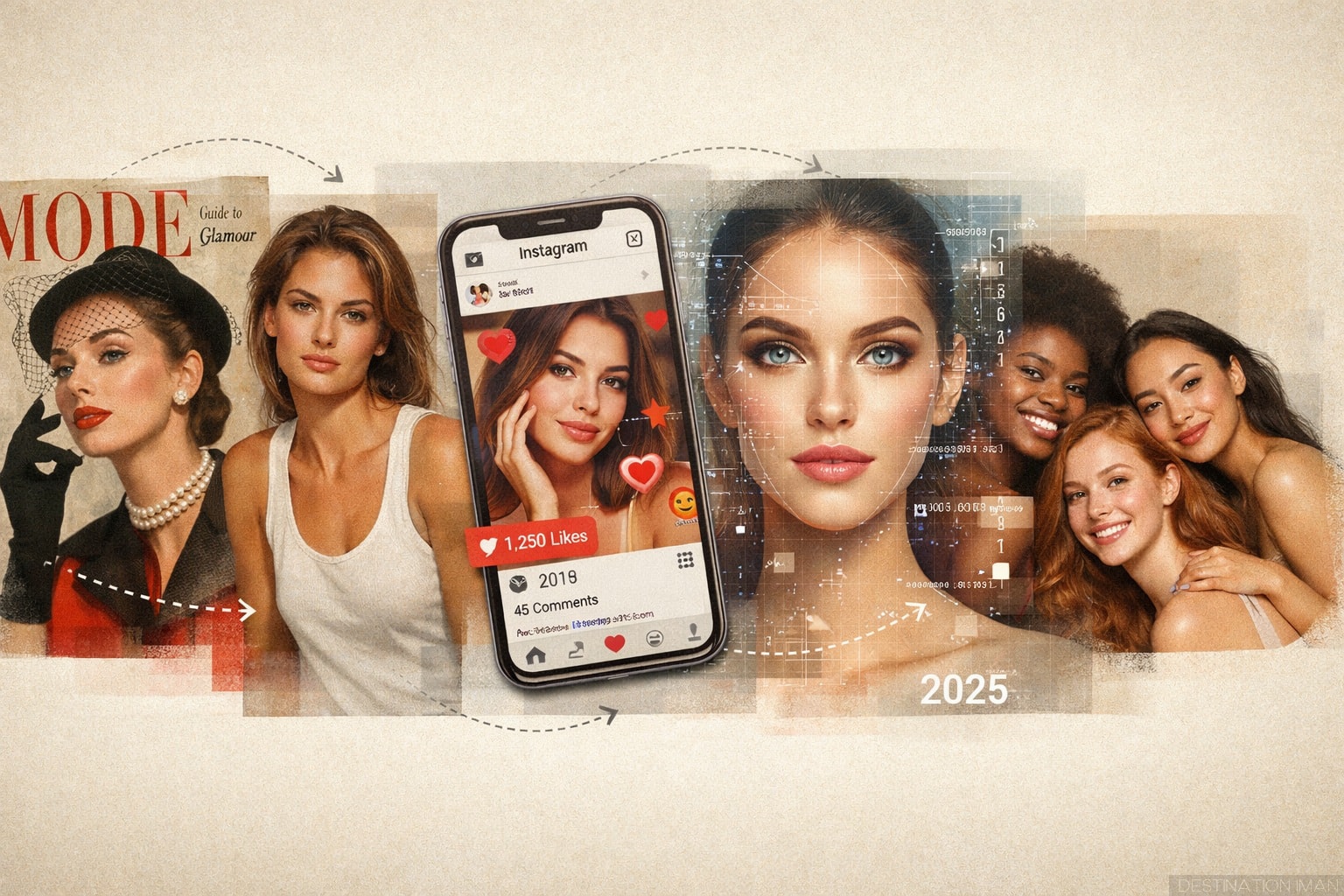
What's considered attractive in one era may be invisible or even undesirable in another. Historical examples demonstrate this fluidity:
- Victorian Era: Pale skin, full figures, delicate features signaled wealth and femininity
- 1920s: Boyish slim figures, short hair, minimal curves became modern ideal
- 1950s: Hourglass curves, emphasized femininity returned as post-war standard
- 1990s: Heroin chic, extreme thinness, minimalism dominated fashion
- 2010s: Instagram curves, enhanced features, "Instagram face" emerged
- 2020s: Natural beauty, diversity, authenticity become aspirational (while filters intensify)
Media, Fashion, and Visual Conditioning
Fashion magazines, advertising, cinema, television, and digital media act as visual training systems. Repeated exposure to specific body types, facial features, and styling creates unconscious familiarity—which the brain interprets as beauty.
The Mere-Exposure Effect in Visual Culture
One of psychology's most robust findings explains much of media's power: the mere-exposure effect demonstrates that people develop preferences for things simply because they encounter them frequently—even without conscious awareness or inherent quality.
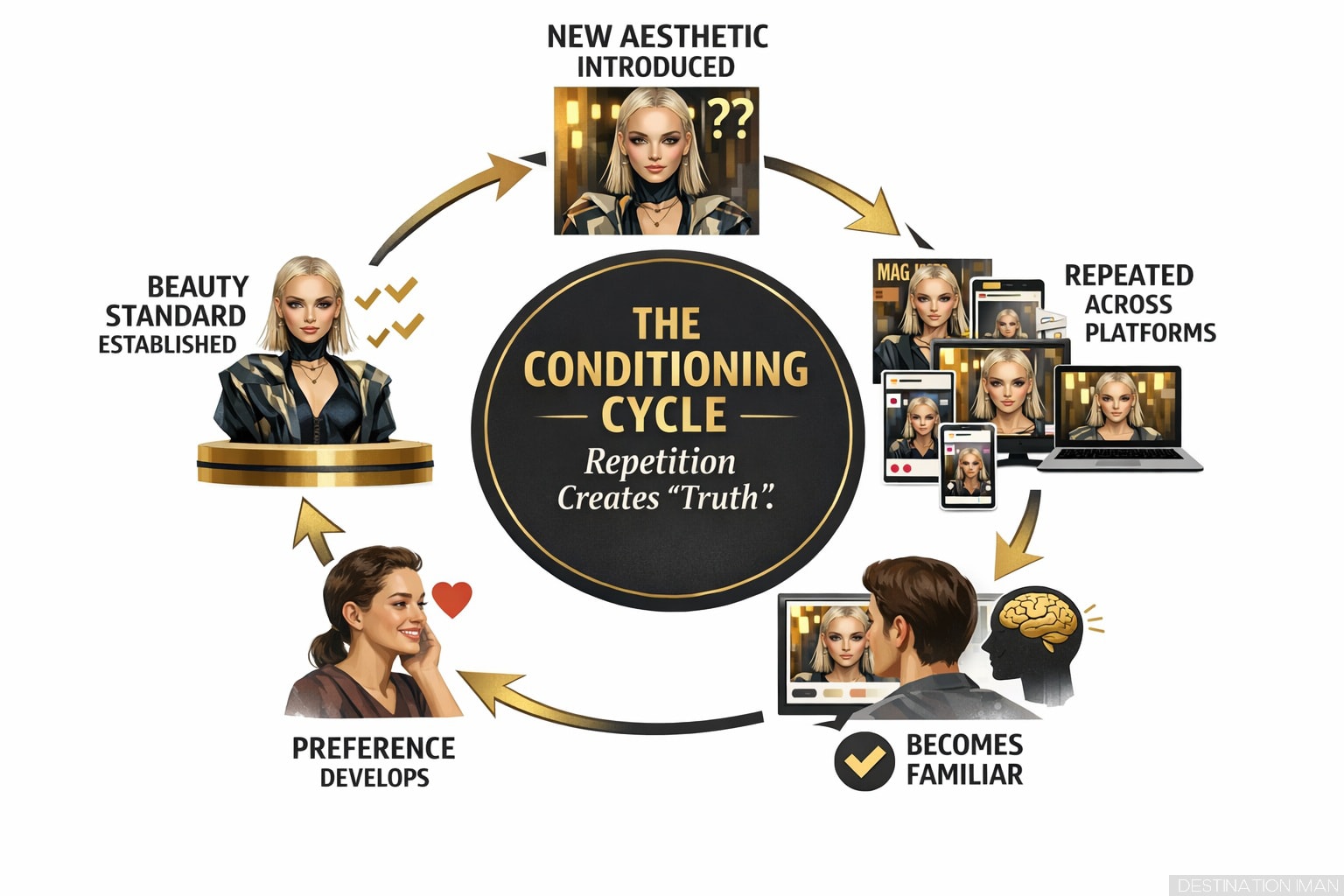
How Media Creates Beauty "Truth"
Media doesn't reflect beauty standards—it creates them through repetition:
Stage 1: Introduction
New aesthetic (body type, feature, style) appears in media—initially feels novel or even strange
Stage 2: Repetition
Consistent exposure across platforms (fashion, advertising, entertainment) builds familiarity
Stage 3: Normalization
Repeated aesthetic begins feeling "normal" and "natural" rather than constructed
Stage 4: Preference
Familiarity translates to preference—now perceived as objectively attractive
Stage 5: Standard
Aesthetic becomes beauty standard against which alternatives are judged (and often found lacking)
Fashion as Aesthetic Laboratory
Fashion industry serves as experimental space where new beauty concepts are tested, refined, and either adopted or abandoned. Runway shows, editorial spreads, and celebrity styling introduce aesthetic variations—with media repetition determining which become mainstream standards.
Algorithmic Beauty: AI and Social Media
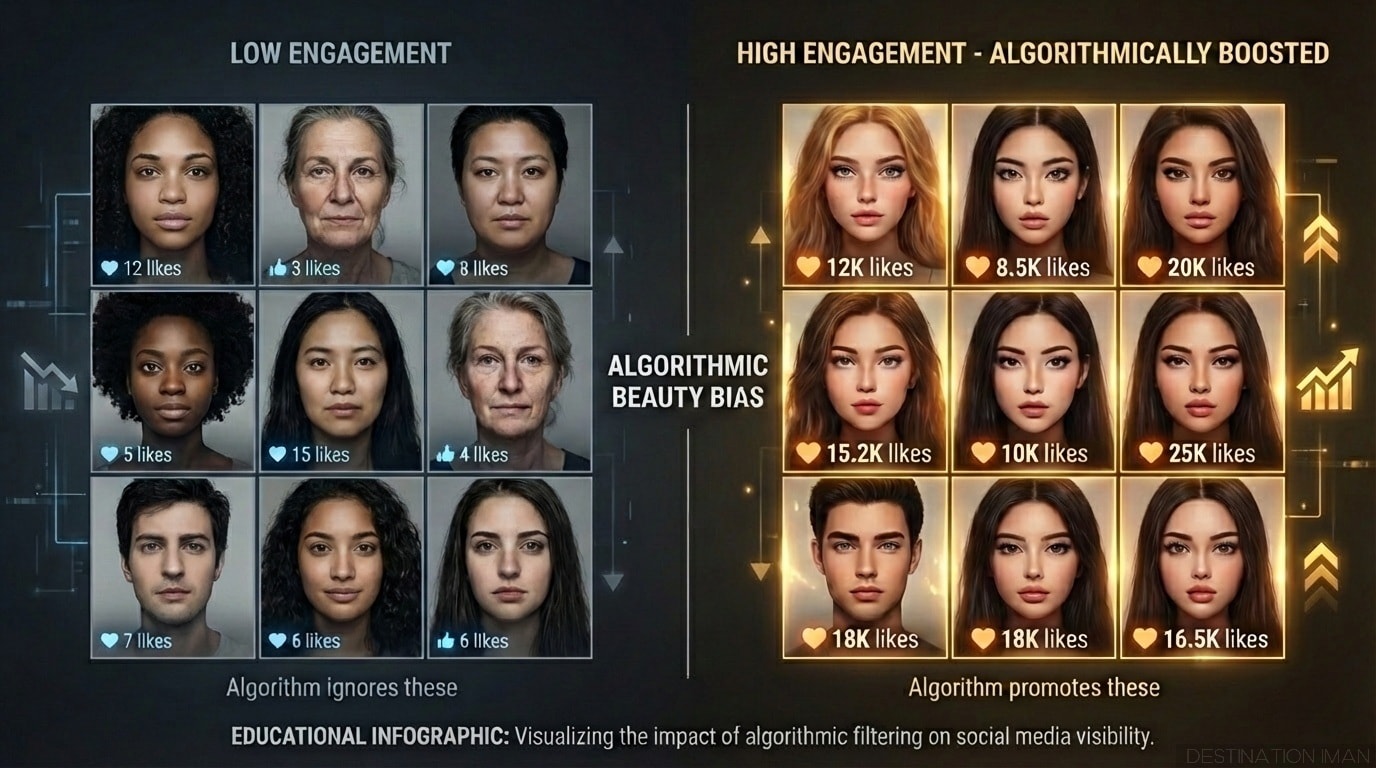
The 2020s introduced a new force in beauty standard formation: algorithmic curation. AI-driven recommendation systems and beauty filters don't just reflect preferences—they actively shape them through feedback loops.
How Algorithms Reshape Beauty Perception
Algorithmic Beauty Mechanisms
- Engagement optimization: Algorithms promote content generating highest engagement—typically conventionally attractive faces
- Filter normalization: AI beauty filters set new baselines for "normal" appearance (smoothed skin, enlarged eyes, slimmed features)
- Recommendation homogenization: Similar content recommendations create echo chambers of specific aesthetics
- Viral aesthetic convergence: Trending looks spread rapidly, creating temporary but intense beauty standards
- Data-driven iteration: AI learns which features drive engagement, reinforcing those in future recommendations
The "Instagram Face" Phenomenon
Researchers have identified a specific aesthetic that dominates Instagram and TikTok—dubbed "Instagram Face"—characterized by:
- High cheekbones and defined contours
- Large eyes with thick lashes
- Full lips and small nose
- Smooth, pore-less skin
- Specific makeup style (contoured, highlighted)
- Often ethnically ambiguous features
This aesthetic emerged not from traditional beauty industry but from algorithmic selection—the cumulative result of billions of engagement decisions amplified by recommendation systems.
Faces, Bodies, and Cultural Ideals
Visual culture dictates not only what is considered attractive but how faces and bodies should be presented, posed, and styled. These presentation rules are as culturally specific as the features themselves.
Facial Presentation Standards
Current visual culture emphasizes specific facial qualities:
- Symmetry and balance: Faces digitally altered or posed to maximize symmetry
- Clear structure: High contrast lighting emphasizes bone structure and definition
- Youth markers: Smooth skin, full lips, bright eyes prioritized
- Expression control: Specific "model face" expressions signal confidence and poise
- Gaze direction: Direct eye contact suggests confidence; averted gaze signals mystery
Body Language and Aesthetic Power
Visual culture teaches body presentation through repeated modeling:
Culturally Coded Body Presentation
- Posture: Upright, elongated spine signals confidence and status
- Stance: Weight distribution, hip angles follow gendered conventions
- Hand placement: Where hands rest carries meaning (power poses vs. demure positions)
- Spatial presence: How much space one "takes up" signals confidence or submission
- Movement quality: Fluid vs. rigid motion communicates different aesthetic values
These presentation rules are learned entirely through visual exposure—rarely explicitly taught but powerfully enforced through aesthetic approval/disapproval.

Photography and the Illusion of Beauty
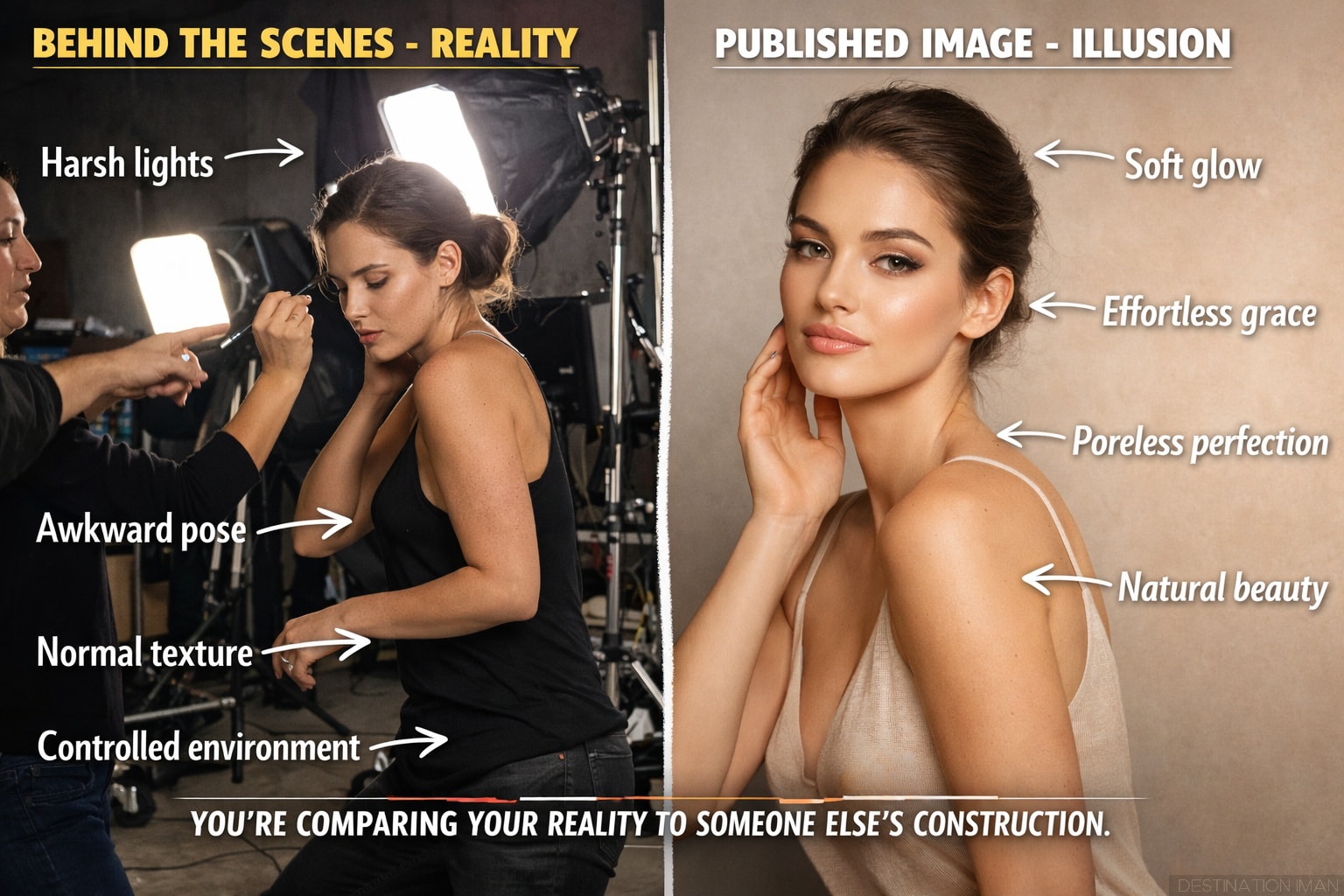
Photography is not neutral documentation—it's aesthetic construction. Camera angle, lighting, lens choice, posing, and post-processing dramatically alter perception, creating "beauty" that may not exist in three-dimensional reality.
Technical Beauty Construction
How Photography Creates Beauty
- Lighting control: Soft light minimizes texture; hard light creates drama and definition
- Lens selection: Focal length affects facial proportions (wide-angle distorts; telephoto flatters)
- Angle manipulation: Camera height and rotation optimize perceived features
- Posing technique: Body positioning creates illusions of proportion and balance
- Post-processing: Digital editing smooths, reshapes, and perfects beyond human possibility
The Comparison Problem
People unconsciously compare themselves not to reality but to carefully constructed photographic illusions. This creates impossible standards—comparing unedited three-dimensional self to edited two-dimensional image.
Visual Identity and Self-Image
Visual culture doesn't just set external beauty standards—it shapes how individuals construct identity. Clothing, grooming, posture, and styling become tools for navigating or resisting dominant aesthetics.
Identity Performance Through Visual Choices
Every visual choice communicates relationship to cultural aesthetics:
- Conformity: Adopting mainstream beauty practices signals belonging and social awareness
- Distinction: Selective adoption with personal variations creates individual identity
- Resistance: Deliberately opposing standards signals rejection of mainstream values
- Subculture affiliation: Alternative aesthetics mark membership in specific communities
The Psychological Weight of Visual Standards
Constant exposure to beauty standards affects psychological well-being:
This psychological impact demonstrates that visual culture isn't superficial—it shapes fundamental aspects of self-concept and confidence.
Are Beauty Standards Changing?
Modern visual culture is paradoxically both more diverse and more homogenized than ever before. Digital platforms enable alternative aesthetics to gain visibility—while algorithms simultaneously push toward conformity.
The Diversity Paradox
Contemporary beauty culture shows contradictory trends:
Diversification vs. Homogenization
- Diversification: More ethnic diversity, body types, ages represented; "authentic" beauty celebrated; niche aesthetics find audiences
- Homogenization: Algorithmic beauty convergence; AI filters create uniform "perfect" faces; global platform dominance spreads specific aesthetics worldwide
- Result: Appearance of diversity while underlying standards intensify and spread
The Multiplication of Standards
Rather than beauty standards disappearing, they've multiplied. People now navigate competing ideals:
- Natural beauty: "No makeup" makeup, effortless appearance
- Instagram aesthetic: Filtered perfection, obvious enhancement
- Authentic diversity: Celebrating unique features and variations
- Fitness ideal: Athletic bodies and health-focused appearance
- Minimalist elegance: Understated sophistication and refinement
This multiplication doesn't reduce pressure—it increases it, as individuals feel expected to excel across multiple aesthetic systems simultaneously.
Key Takeaways
Core Insights: Visual Culture and Beauty Standards
- Visual culture shapes beauty perception through repeated exposure and conditioning
- Beauty standards are culturally constructed, not biologically determined or universal
- The mere-exposure effect explains why familiar aesthetics feel "naturally" beautiful
- Algorithms now actively co-create beauty standards through engagement optimization
- AI filters are resetting baselines for "normal" human appearance
- Photography constructs beauty through technical manipulation, not neutral documentation
- Visual presentation rules (posture, styling, expression) are learned through media exposure
- Beauty standards change across time and culture, proving their constructed nature
- Modern visual culture shows both diversification and algorithmic homogenization
- Multiple competing beauty standards increase rather than decrease appearance pressure
- Understanding visual culture as construction—not reflection—enables critical distance from its influence
Sources & References
Academic & Research Sources
- Acta Psychologica (2025) — "How AI and Social Media are Redefining Aesthetic Norms"
- Sage Journals (2025) — "Development and Validation of the Perceptions of Beauty Standards Scale"
- NIH (2025) — "Digital Culture and Aesthetic Orientation: Associations with Body Perception"
- ResearchGate (2026) — "The Role of Social Media in Shaping Beauty Standards and Self-Esteem"
- Zajonc, R. B. (1968). Attitudinal Effects of Mere Exposure. Journal of Personality and Social Psychology
- Berger, J. (1972). Ways of Seeing. BBC/Penguin Books
- Kahneman, D. (2011). Thinking, Fast and Slow. Farrar, Straus and Giroux
- Elite Learning (2025) — Understanding the Influence of Social Media on Beauty Standards
- Psychology Today — Beauty and Perception Research
Related Articles
- Why Certain Faces Look Iconic: The Psychology Behind Timeless Beauty
- Why We Find Symmetry Attractive: The Psychology and Biology Explained
- The Psychology of Color and Beauty: How Colors Shape Perception
- Beauty Through Different Cultures: How Ideals Change Around the World
- Why Beauty Standards Feel More Unreal Than Ever