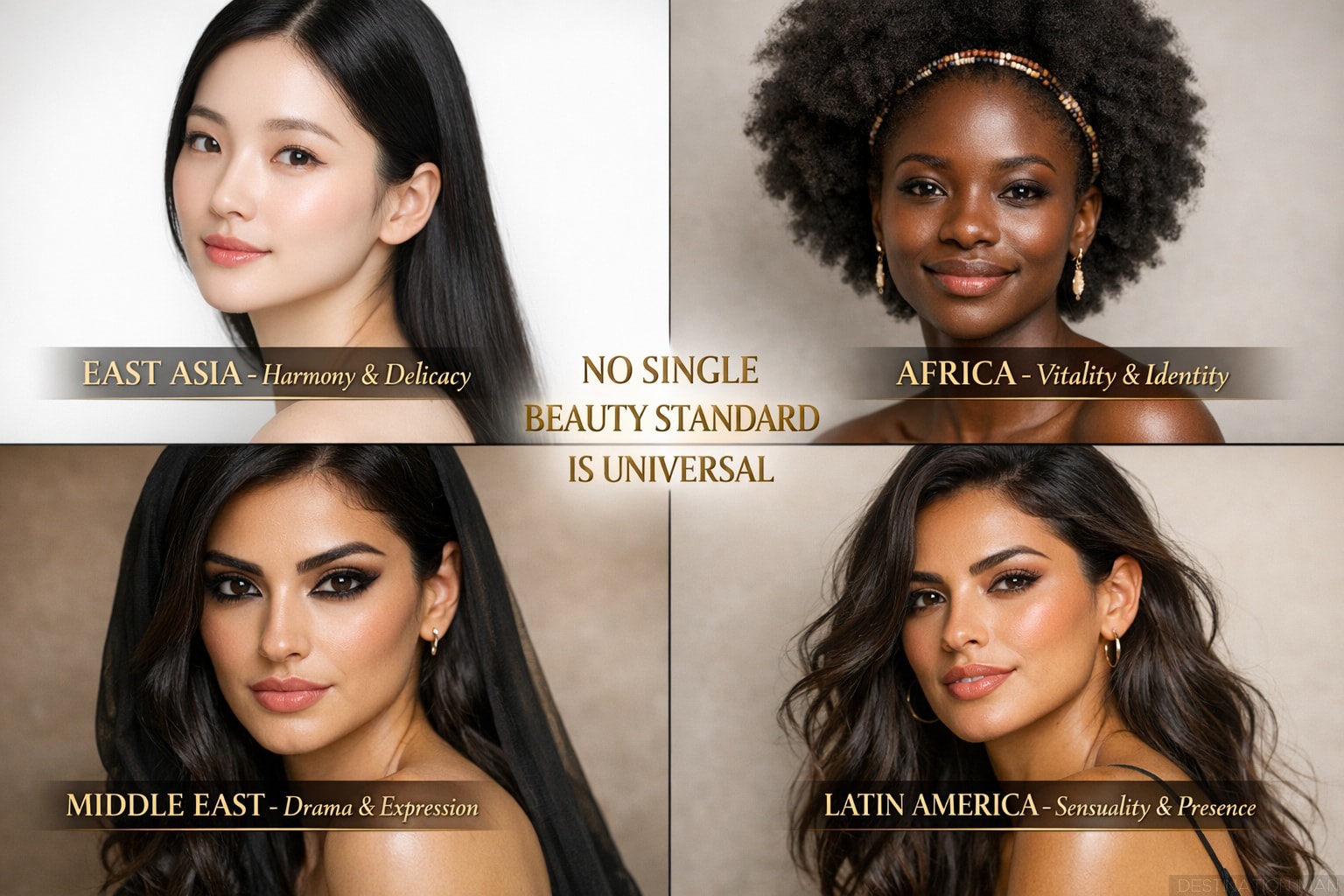
Is a slim face with porcelain skin universally beautiful? Or curves celebrated everywhere? The answer: neither. Beauty standards vary so dramatically across cultures that what one society considers ideal may seem unusual—or even unattractive—to another. From East Asia's obsession with V-line faces and glass skin to the Middle East's kohl-rimmed eyes and Latin America's celebration of curves, this article explores how different cultures define beauty—and why globalization is both preserving and erasing these differences.
Drawing on 2024-2026 research, we examine specific beauty practices across five major regions, the tension between biology and culture, and how social media is creating both homogenization and renewed cultural pride.
Is Beauty Universal or Cultural?
The question of whether beauty is universal or culturally constructed has occupied philosophers, scientists, and artists for centuries. The modern answer: both.
Humans share certain basic perceptual preferences rooted in evolutionary psychology—symmetry, averageness, signs of health and youth. These preferences appear cross-culturally and likely evolved because they signal reproductive fitness.
However, culture determines how these signals are interpreted, emphasized, and transformed into specific ideals. What counts as "healthy skin" varies from Korean glass skin to Brazilian sun-kissed glow. What signals "femininity" ranges from delicate East Asian features to voluptuous Latin American curves.
Universal vs Cultural Beauty Factors
- Universal (biological): Symmetry, clear skin, healthy hair, proportionality, youth markers
- Cultural (learned): Skin tone preferences, body size ideals, facial feature emphasis, adornment styles, color symbolism
- Individual (personal): Familiarity bias, exposure effects, unique experiences shape attraction
- Temporal (era-specific): Fashion cycles, economic conditions, media representation shift ideals over decades
This means beauty operates on multiple levels simultaneously: a Korean woman may be judged attractive universally for her facial symmetry, culturally for her porcelain skin matching Korean ideals, and individually because she resembles someone the viewer finds familiar.
Biology vs Culture in Beauty Perception
Evolutionary psychology proposes that beauty preferences evolved as fitness indicators. Features signaling health, youth, and reproductive capacity became attractive because individuals who found these traits desirable left more offspring.
Biological Foundations
Features with cross-cultural appeal include:
- Facial symmetry: Signals developmental stability
- Clear, healthy skin: Indicates lack of disease and parasites
- Full, glossy hair: Reflects nutritional health and youth
- Proportionate features: Averageness reduces probability of genetic abnormalities
- Secondary sexual characteristics: Femininity (higher estrogen) and masculinity (higher testosterone) signal reproductive readiness
Cultural Overlay
Culture doesn't erase biology—it interprets and amplifies it. East Asian cultures may value small faces not because small is biologically superior but because cultural aesthetics emphasize delicacy and refinement. Latin American appreciation for curves reflects cultural values around sensuality and vitality, not a biological imperative.
Western Beauty Ideals
Western beauty standards—primarily derived from European and North American cultures—have historically emphasized facial symmetry, youth, individual expression, and slenderness. However, "Western" is not monolithic; ideals vary between Northern and Southern Europe, coast and inland America, and across ethnic communities.
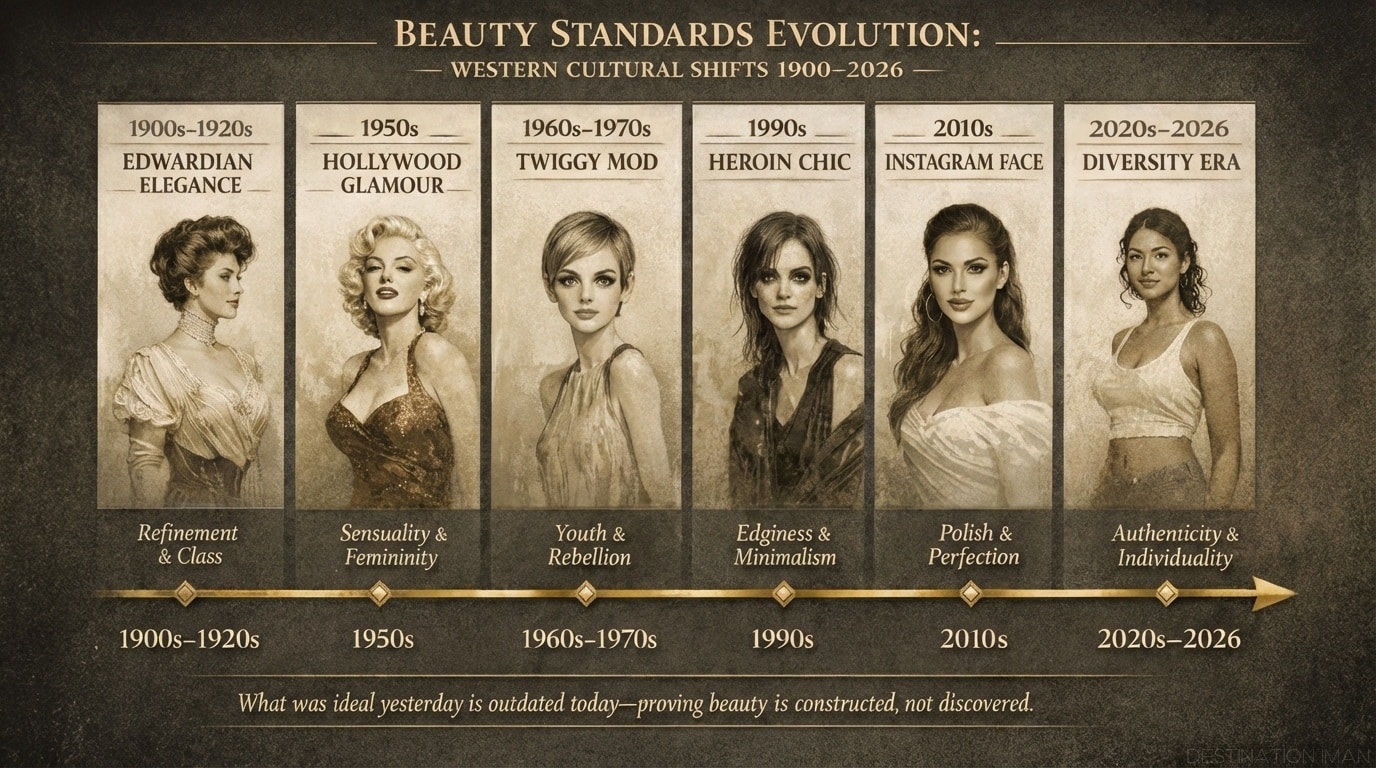
Historical Evolution of Western Beauty
1900s-1920s: Gibson Girl & Edwardian Elegance
Hourglass figure, pale skin, upswept hair. Beauty = refinement and class.
1950s-1960s: Hollywood Glamour
Marilyn Monroe curves, red lips, dramatic eyes. Beauty = femininity and sensuality.
1960s-1970s: Twiggy & The Mod Look
Extreme thinness, androgynous features, large eyes. Beauty = youth and rebellion.
1990s-2000s: Heroin Chic
Waifish, pale, under-eye darkness. Beauty = edginess and minimalism.
2010s: Instagram Face
Sculpted contour, full lips, perfect brows. Beauty = polish and perfection.
2020s-2026: Diversity & Authenticity
Multiple body types, ethnic features celebrated, natural textures. Beauty = individuality and self-expression.
Current Western Trends (2025-2026)
Modern Western beauty increasingly emphasizes wellness, individuality, and "natural" enhancement (even when achieved through extensive procedures). The paradox: "natural" beauty often requires significant time, money, and intervention.
East Asian Beauty Standards
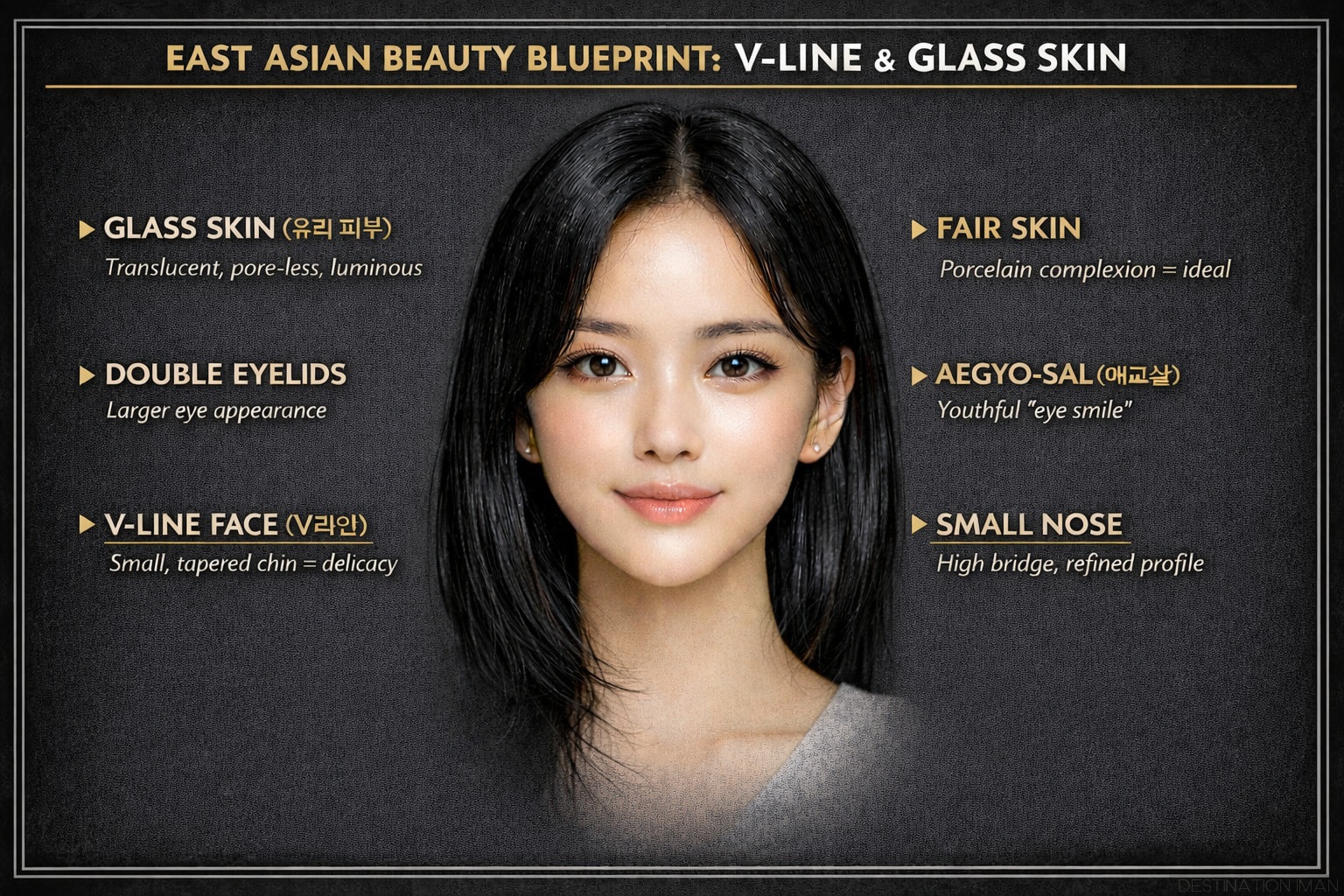
East Asian beauty ideals—particularly influential in South Korea, Japan, and China—prioritize smooth porcelain skin, small V-line faces, large eyes, and overall facial harmony over dramatic features or contrast.
Core East Asian Beauty Principles
East Asian Aesthetic Values
- Glass skin (유리 피부): Translucent, luminous, pore-less complexion reflecting light evenly
- V-line face (V라인): Small, narrow face tapering to sharp chin—signals delicacy and youth
- Double eyelids: Larger eye appearance; surgery is common to create crease
- Aegyo-sal (애교살): Small under-eye "fat pockets" signaling youthfulness and cuteness
- Small nose with high bridge: Refined, not prominent
- Fair skin (하얀 피부): Historically associated with wealth (indoor life vs manual labor)
- Facial harmony (균형미): No single feature dominates; balance prioritized over drama
The V-Line Obsession
Skin Whitening and Colorism
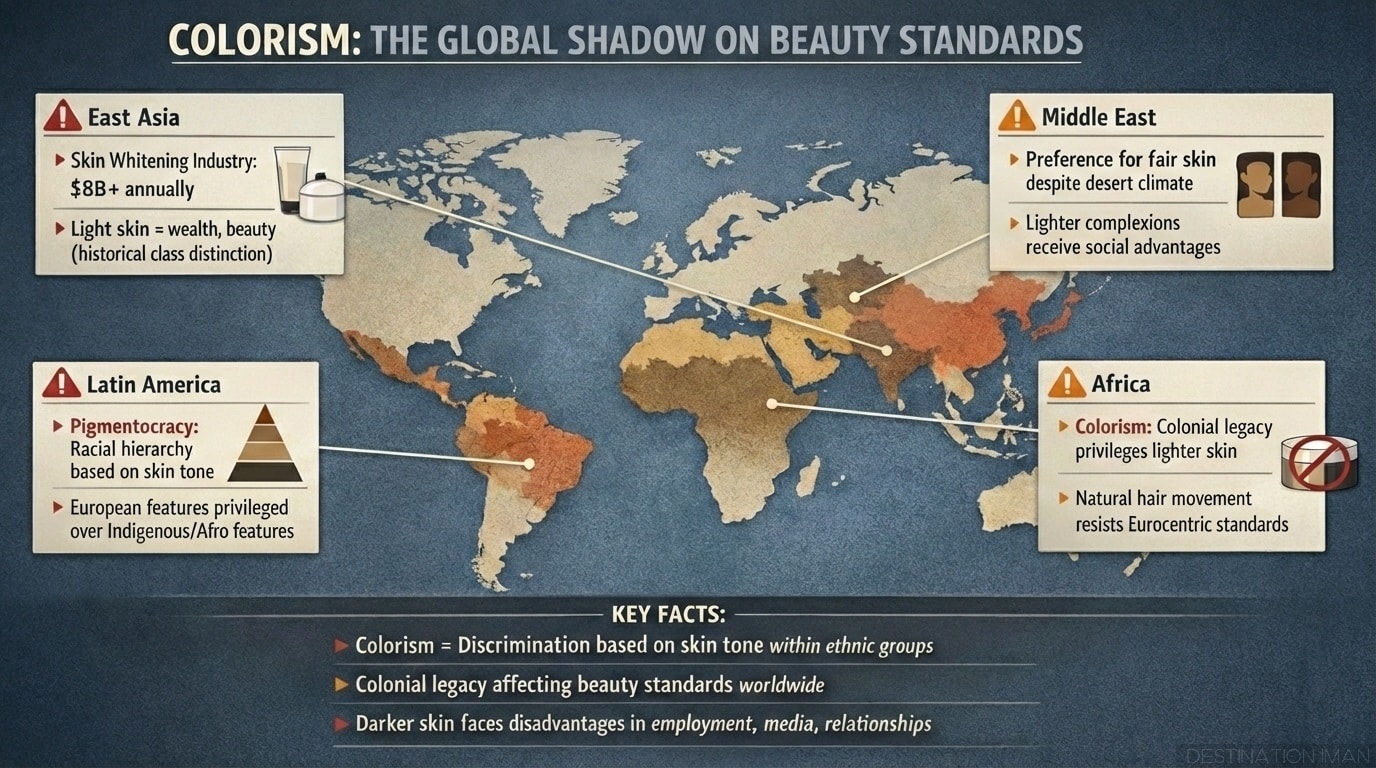
Fair skin remains highly valued across East Asia, creating a massive skin-whitening industry. This preference has historical roots (aristocrats stayed indoors; peasants tanned in fields) but perpetuates modern colorism—discrimination based on skin tone.
2025-2026 Trends: Natural Movement
African Concepts of Beauty
African beauty standards are incredibly diverse across the continent's 54 countries and thousands of ethnic groups. However, common threads include vitality, cultural identity, expressive adornment, and connection to community.
Core African Beauty Values
Pan-African Aesthetic Principles
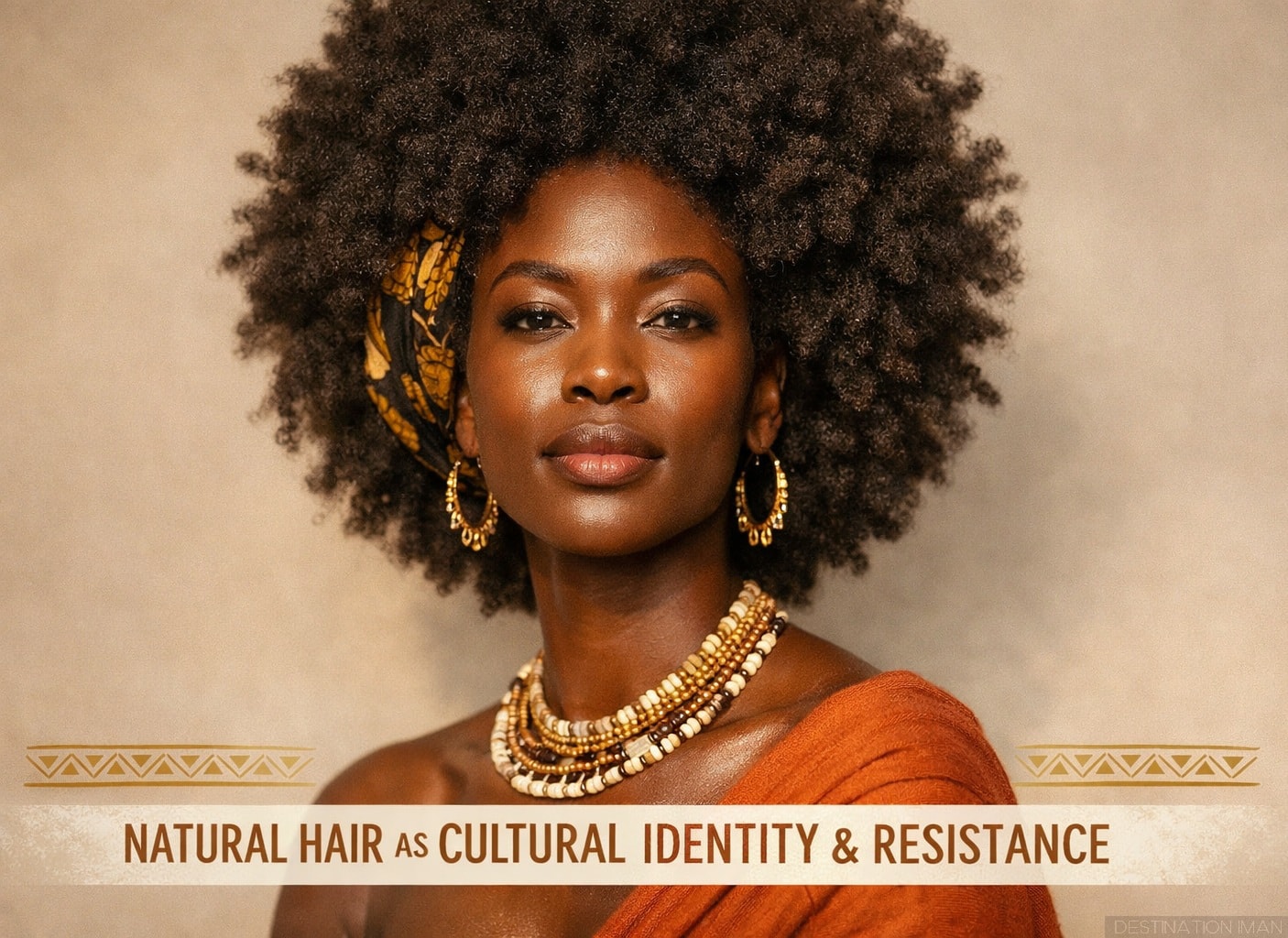
- Natural hair embrace: Afro-textured hair as cultural identity and pride
- Skin tone diversity: Beauty exists across the melanin spectrum (though colorism persists)
- Body confidence: Curves and fuller figures often celebrated over extreme thinness
- Expressive adornment: Hairstyles, beads, fabrics carry symbolic cultural meaning
- Vitality and energy: Beauty linked to strength, health, presence—not just static features
- Community belonging: Beauty practices signal tribal, regional, or cultural identity
The Natural Hair Movement
Colorism: The Internal Struggle
Despite growing pride in natural features, colorism—preference for lighter skin within Black communities—remains pervasive across Africa and the African diaspora. This legacy of colonialism creates internal hierarchies where lighter skin receives preferential treatment in employment, media, and relationships.
Regional Variation
Beauty ideals vary dramatically across Africa:
- West Africa: Often celebrates fuller figures, elaborate hairstyles, and vibrant fabrics
- East Africa: Historically valued elongated features; Maasai traditions emphasize adornment and body modification
- North Africa: Blends African, Arab, and Mediterranean aesthetics; henna and kohl traditions
- Southern Africa: Diverse; urban centers influenced by Western media, rural areas maintain traditional practices
2025 Pageant Revolution
Middle Eastern Aesthetics
Middle Eastern beauty traditions span ancient civilizations and diverse ethnic groups, but common themes include dramatic eye emphasis, rich adornment, and a blend of modesty with sensuality.
Core Middle Eastern Beauty Elements
Middle Eastern Aesthetic Traditions
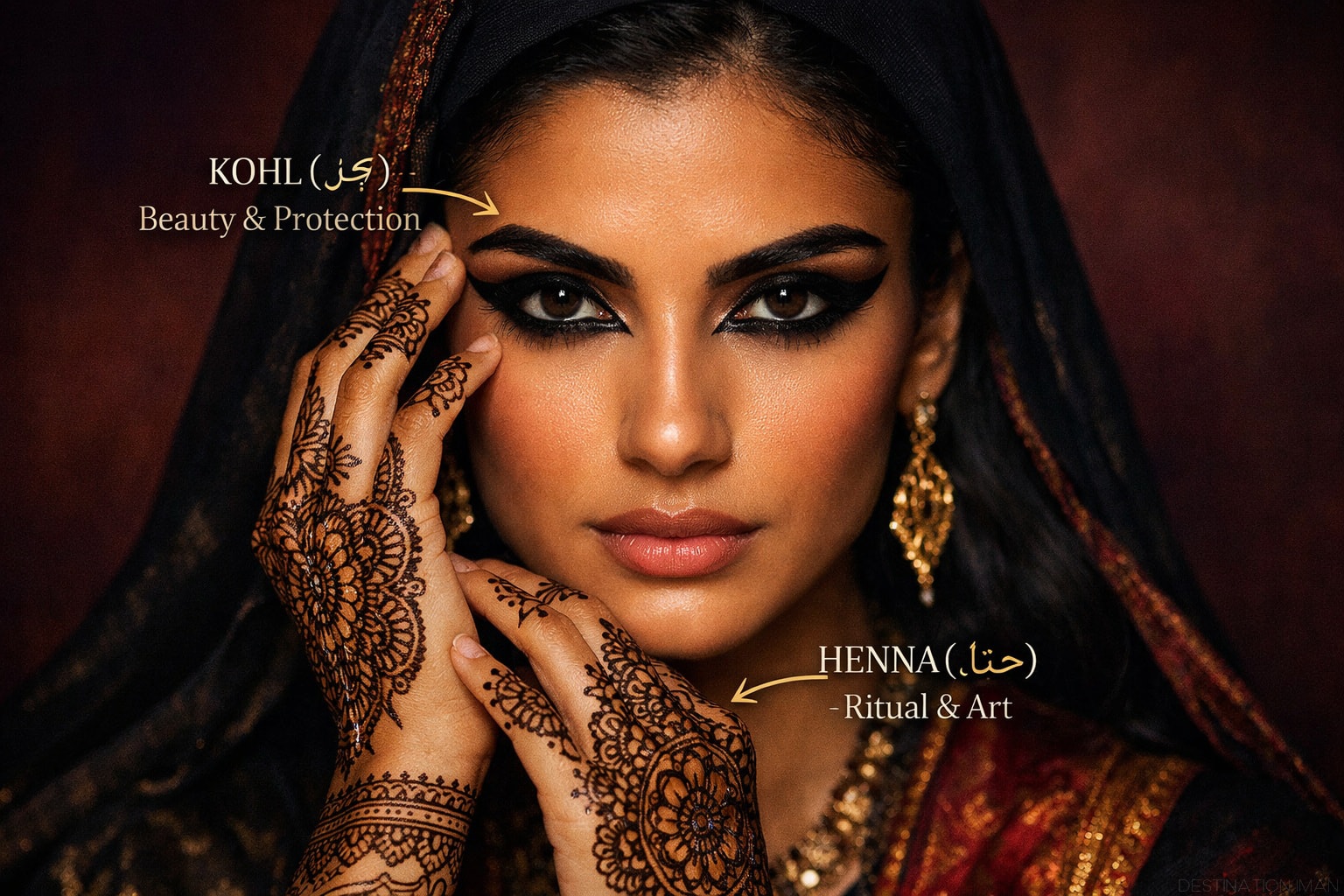
- Kohl-lined eyes (كحل): Deep black eyeliner elongating and emphasizing eyes
- Thick, defined eyebrows: Bold brows framing expressive eyes
- Henna (حنّاء): Body art and hair dye with cultural/religious significance
- Facial hair removal: Threading tradition for clean, defined features
- Luminous skin: Healthy glow, often enhanced with oils and natural ingredients
- Rich, dark hair: Thick, long hair highly valued; often adorned or covered
- Expressive features: Strong features (nose, eyes, brows) celebrated over delicate ones
Kohl: Functionality Meets Beauty
Kohl was traditionally made from antimony or galena (lead sulfide), ground into powder and applied with a thin rod. Modern versions use safer ingredients but maintain the dramatic aesthetic.
Modesty and Display
Middle Eastern beauty navigates the tension between modesty (حجاب, hijab) and adornment (زينة, zina). In many Muslim-majority cultures, beauty is displayed selectively—often emphasizing eyes and hands while covering hair and body. This creates unique aesthetic traditions where eyes become the primary canvas for expression.
Contemporary Middle Eastern Beauty
Modern Middle Eastern beauty blends traditional practices with global influences:
- Instagram beauty: Arab influencers popularize dramatic makeup (full glam, contouring) globally
- Cosmetic procedures: Rhinoplasty (nose jobs) extremely common, especially in Iran and Lebanon
- Hijab fashion: Modest fashion movement creates new aesthetic categories
- Henna evolution: Traditional weddings maintain henna rituals; contemporary designs blend tradition with modern patterns
Latin American Beauty Ideals
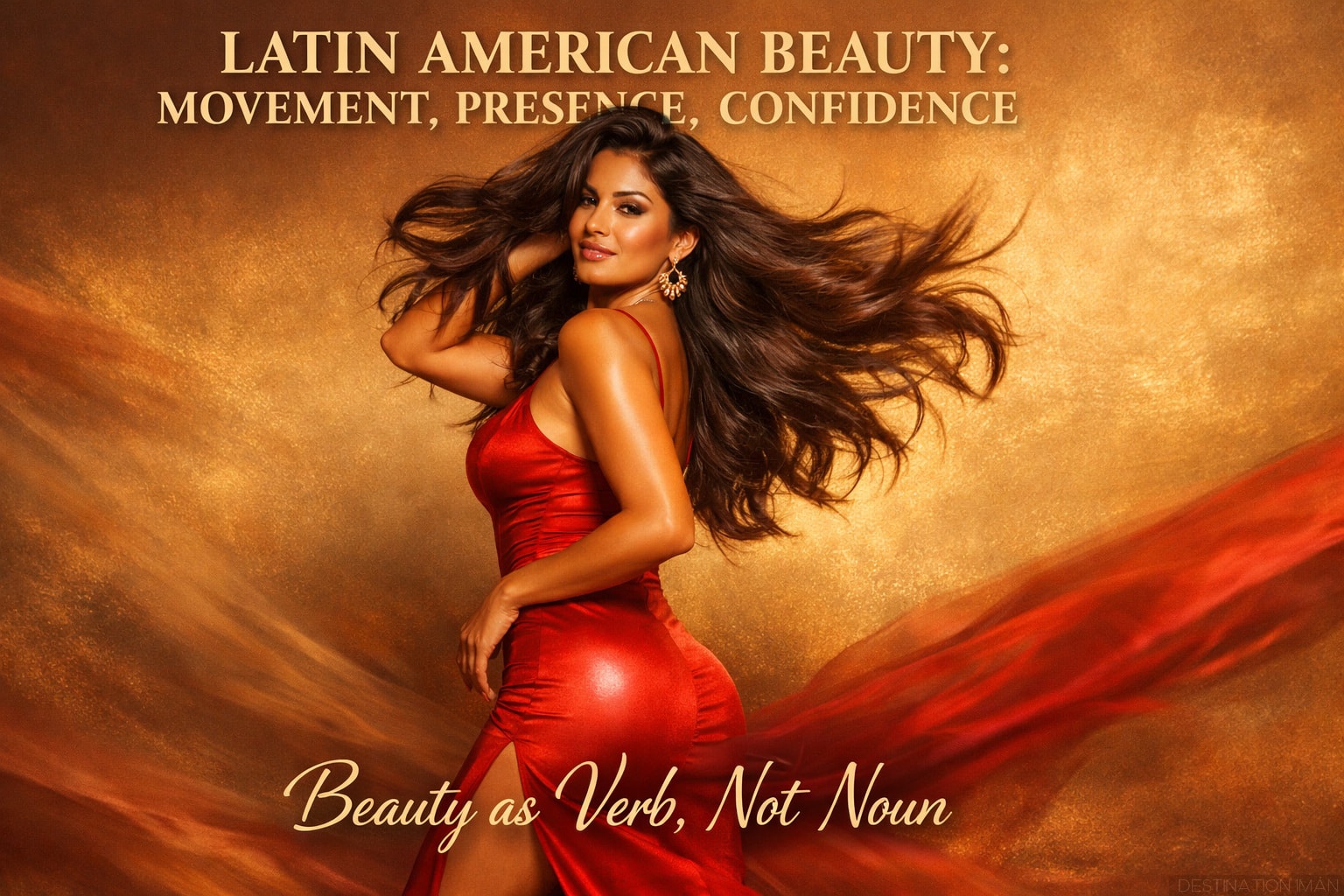
Latin American beauty standards celebrate sensuality, curves, vitality, and physical presence. Confidence, movement, and emotional expressiveness are integral to attractiveness—beauty is dynamic, not static.
Core Latin American Aesthetic Values
Latin American Beauty Principles
- Hourglass figure: Curvy "thin-yet-curvy" body celebrated over extreme thinness
- Sun-kissed skin: Tanned, glowing skin preferred over pale (contrast to East Asian ideals)
- Long, styled hair: Thick, lustrous hair often darkly colored
- Prominent features: Full lips, defined cheekbones, expressive eyes
- Confidence and presence: Posture, movement, and charisma matter as much as features
- Sensuality: Beauty linked to sexuality, femininity, and emotional expressiveness
- Cultural pride: Indigenous and African features increasingly celebrated alongside European
The Curve Celebration
This creates a "thin-yet-curvy" paradox: Latin American beauty ideals often demand slimness in waist and stomach while simultaneously expecting full hips, thighs, and breasts—an often unattainable combination driving cosmetic surgery rates.
Colorism and Mixed Heritage
Latin America's colonial history created complex racial hierarchies where European features (lighter skin, straighter hair, narrow noses) receive privilege—a phenomenon called pigmentocracy.
Body Positivity Movement
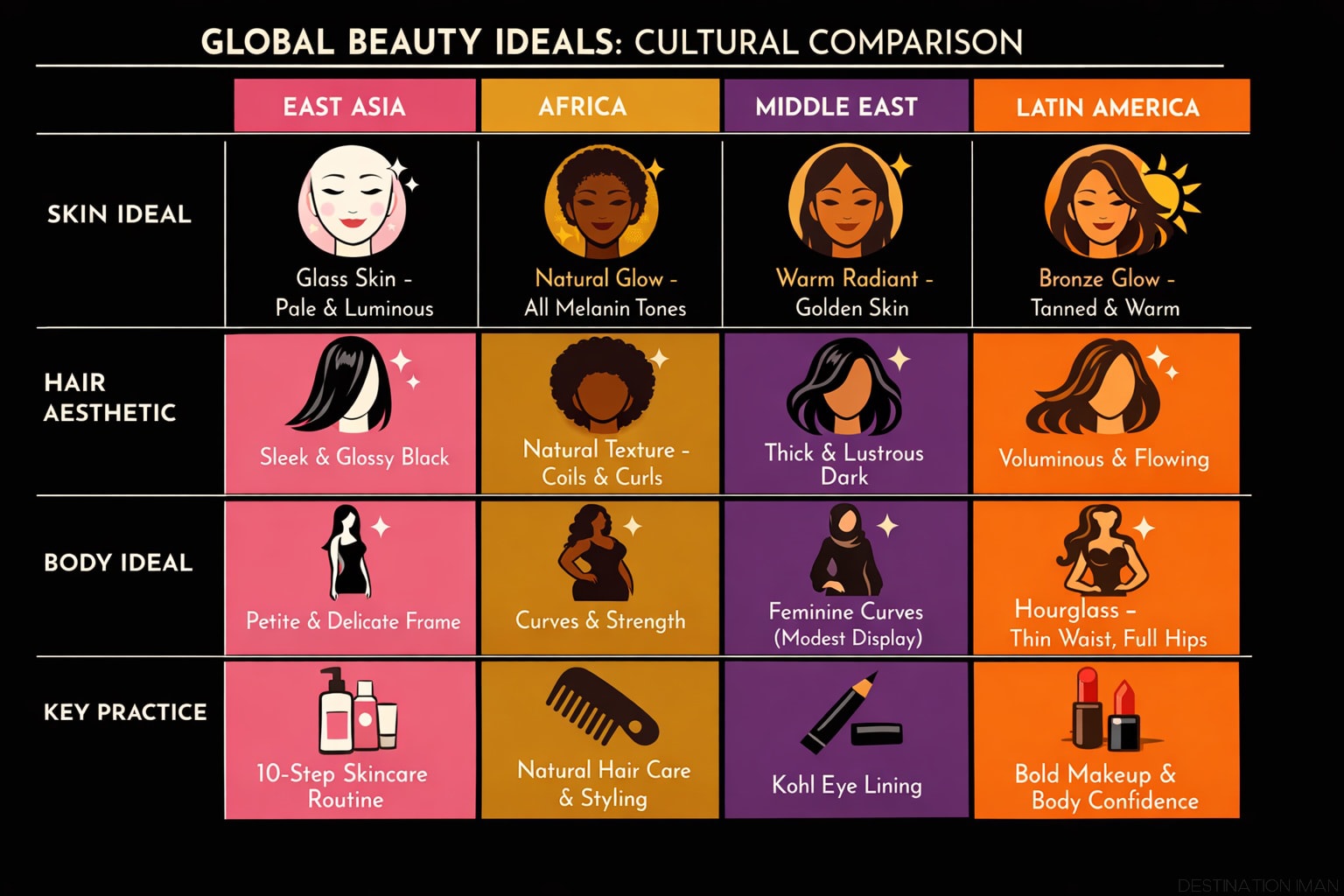
Having explored beauty standards across five major cultural regions, the stark contrasts become clear. The following comparison grid summarizes how each culture prioritizes different features, practices, and values—demonstrating that beauty is fundamentally cultural construction, not biological universal.
How Beauty Standards Evolve Over Time
Beauty ideals are not static—they shift with economic conditions, technological change, political movements, and media representation. What was admired a century ago may seem bizarre today; current ideals will likely appear dated to future generations.
Forces Driving Beauty Evolution
Why Beauty Standards Change
- Economic conditions: Scarcity = fuller figures attractive (signals wealth); abundance = thinness attractive (signals discipline)
- Gender roles: Women's liberation movements correlate with androgynous beauty ideals; conservative eras emphasize hyper-femininity
- Technological change: Photography, film, Photoshop, filters each reshape what's considered beautiful
- Media representation: Who appears in media determines whose features become normalized and desired
- Globalization: Cross-cultural contact exposes populations to new aesthetic possibilities
- Fashion cycles: Beauty follows fashion logic—novelty becomes desirable, familiarity becomes boring
- Political movements: Civil rights, feminism, LGBTQ+ rights expand beauty definitions
The Acceleration Effect
Beauty standards are evolving faster than ever due to social media. What once took decades to shift now changes in years or months. TikTok trends create micro-beauty cycles where specific aesthetics ("clean girl," "mob wife," "old money") surge and fade in weeks.
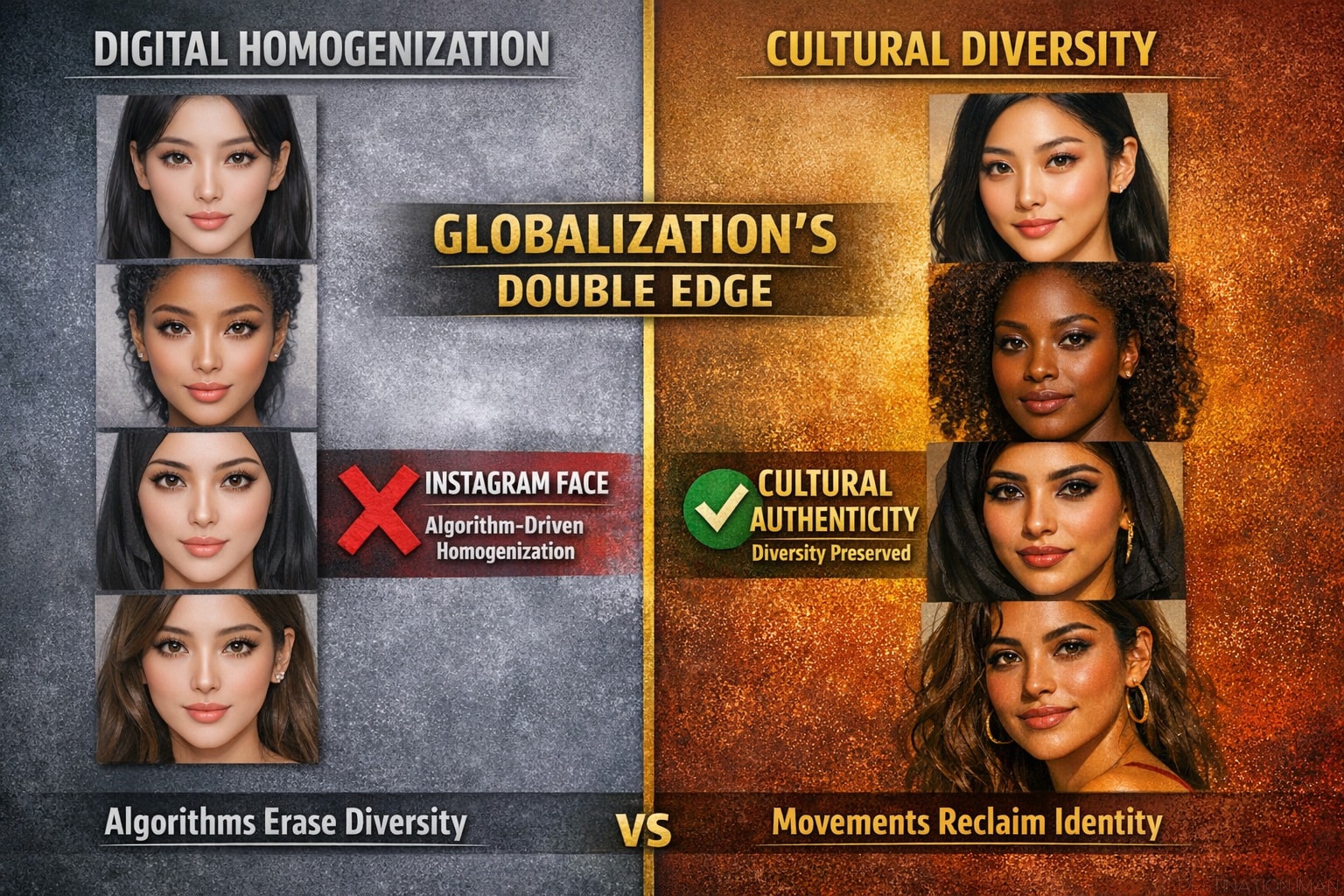
Globalization: Homogenization vs Cultural Resistance
Perhaps the most significant force reshaping global beauty is globalization—particularly through social media. The result: paradox.
The Homogenization Threat
Instagram Face: The Global Aesthetic
Critics identify the emergence of "Instagram Face"—a homogenized aesthetic combining features from multiple ethnicities but defaulting to Eurocentric base: sculpted cheekbones, full lips, small nose, large eyes, poreless skin, perfectly arched brows. This look dominates influencer culture globally, regardless of user's actual ethnicity.
Cultural Resistance and Pride Movements
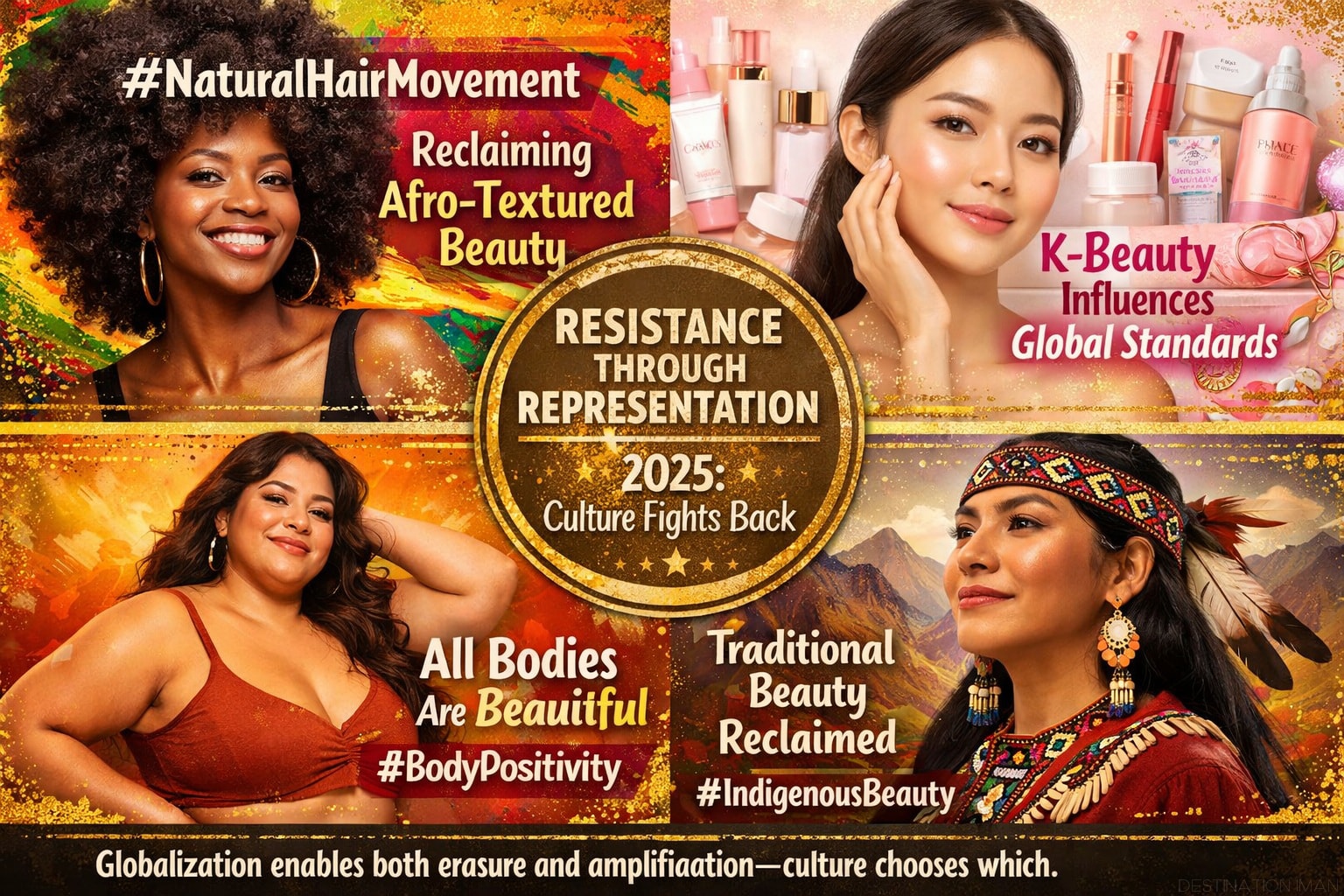
However, globalization also enables cultural resistance. Social media allows marginalized beauty aesthetics to find global audiences:
- Afrocentric beauty: Natural hair tutorials, dark skin makeup education, Black-owned beauty brands reach global markets
- K-beauty globalization: Korean skincare and makeup aesthetics influence Western beauty industry
- Indigenous visibility: Native influencers reclaim traditional adornment and reject colonial beauty standards
- Body diversity: Plus-size, disabled, and gender-nonconforming creators challenge narrow beauty definitions
Key Takeaways
Essential Insights: Beauty Across Cultures
- Beauty combines universal biological preferences (symmetry, health) with culturally specific interpretations
- No single beauty standard is universal—ideals vary dramatically across cultures and historical eras
- East Asian beauty emphasizes porcelain skin, V-line faces, and facial harmony over dramatic contrast
- African beauty celebrates natural hair, vitality, and expressive adornment as cultural identity markers
- Middle Eastern traditions highlight kohl-lined eyes, bold brows, and henna as functional and aesthetic
- Latin American ideals celebrate curves, sensuality, confidence, and physical presence as beauty
- Western standards have shifted from hourglass to androgynous to thin to curvy, proving ideals are constructed not fixed
- Colorism (preference for lighter skin) persists across multiple cultures as colonial legacy
- Beauty standards evolve due to economic conditions, gender roles, technology, and political movements
- Social media accelerates beauty trend cycles from decades to months, creating exhaustion and anxiety
- Globalization creates paradox: homogenization via algorithms vs cultural pride movements via visibility
- Instagram filters systematically push all ethnicities toward Eurocentric features, constituting "digital colonialism"
- Cultural resistance movements (natural hair, K-beauty, body diversity) use globalization to amplify marginalized aesthetics
- Algorithms reflect existing power structures—dominant beauty standards get amplified while alternatives are erased
- Understanding beauty as culturally constructed enables critical media literacy and resistance to unrealistic standards
Sources & References
Academic & Research Sources (2024-2026)
- Nature (2025) — Cultural Differences in the Beauty Premium
- Bradley University (2025) — Body & Beauty Standards
- Jivaka (2025) — Korean Beauty Standards 2025: Complete Guide to Glass Skin, V-Shape Face
- AB Plastic Surgery Korea (2025) — Korean Beauty Standards Explained: The Complete Guide for 2025
- Race Equality Matters (2025) — World Afro Day 2025: How Afro Hair Shapes and Reflects Who We Are
- BET (2025) — What Does Black Beauty Mean in 2025?
- PSYCH Journal (2025) — She Wears It How? Perceived Racism and Colorism Relate to Hair Preference
- CNN (2024) — The Eyes Have It: The Intriguing History of Kohl
- Bedouin Silver (2025) — Arabic Kohl and Its Material Culture: UNESCO Recognition
- Oreate AI Blog (2026) — Celebrating Curves: The Allure of Latina Women and Their Unique Beauty
- HipLatina (2024) — Dismantling the Damaging Beauty Ideals Latinas Face
- New York Times (2025) — When Beauty Standards and Body Positivity Collide
- ScienceDirect (2025) — How AI and Social Media Are Redefining Aesthetic Norms
- ResearchGate (2025) — Chasing the Perfect Look: Navigating Global Beauty Standards
- Phys.org (2025) — New Research Finds Instagram Promotes White Appearances, Cultural Appropriation
- Soliya (2025) — Beauty Standards and Cultural Diversity: How Can We Fight Homogenization?
- Etcoff, N. (1999). Survival of the Prettiest: The Science of Beauty. Doubleday.
- Berger, J. (1972). Ways of Seeing. Penguin Books.