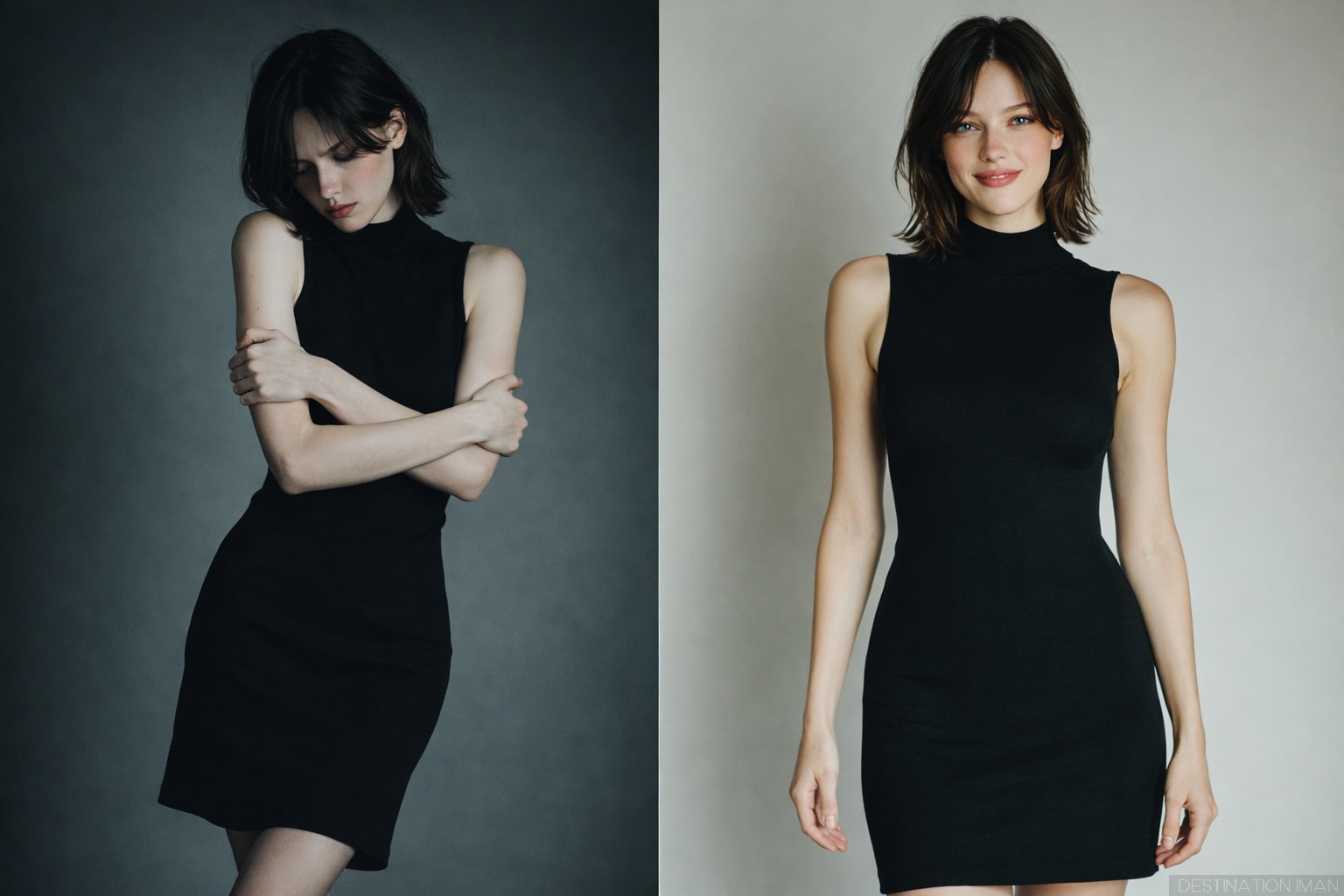
Attractiveness is not solely determined by facial features or body proportions. Research in social psychology and nonverbal communication reveals that body language—posture, gestures, movement quality, and spatial behavior—plays a decisive role in how attractive others perceive you. Two people with identical physical features can be rated vastly differently on attractiveness based purely on their nonverbal communication.
This article explores the science behind body language and attractiveness, examining which specific nonverbal cues increase or decrease perceived appeal, why these signals matter evolutionarily, and how you can consciously improve your nonverbal presence.
Why Body Language Matters More Than You Think
Humans evolved to read bodies before faces. Long before our ancestors could analyze facial details, they needed to rapidly assess whether an approaching figure was friend or foe, confident or fearful, healthy or injured. This survival mechanism created neural pathways that prioritize body language in social assessment.
The Speed of Body Language Assessment
Your brain processes body language in 100-200 milliseconds—faster than conscious awareness. By the time you're consciously thinking about someone's appearance, your subconscious has already formed judgments based on their posture, stance, and spatial positioning.
Because body language operates largely below conscious awareness, most people cannot articulate why they find someone attractive or unattractive. They simply register "good energy" or "something felt off"—intuitive responses driven by body language reading.

Open vs Closed Body Language: The Attractiveness Divide
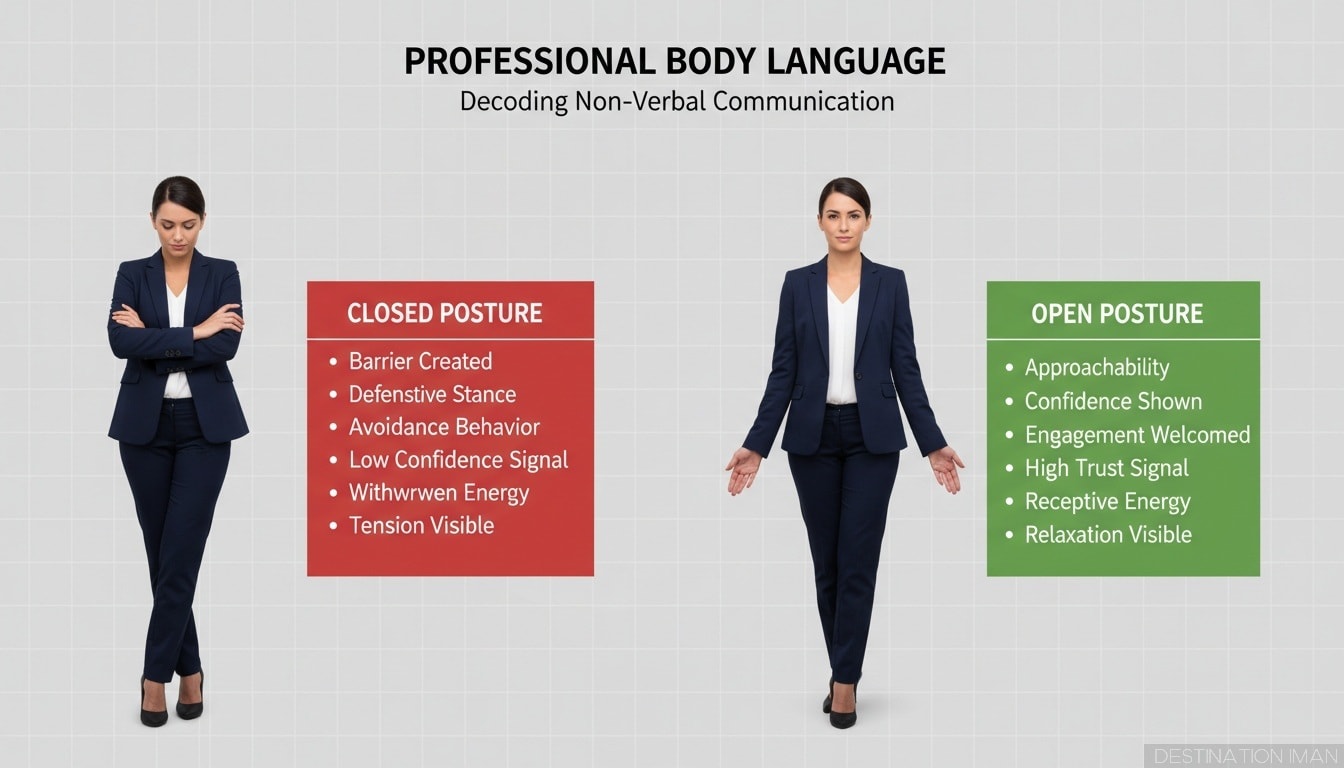
The single most important body language distinction affecting attractiveness is the difference between open and closed postures. This binary shapes perceived approachability, confidence, and emotional availability.
Open Body Language Signals
Characteristics of Open Posture
- Uncrossed arms: Arms hanging naturally at sides or gesturing openly, not defensively crossed over chest
- Chest exposed: Torso facing forward without protective barriers (bags, arms, objects)
- Palms visible: Hands open and visible, not hidden in pockets or clenched
- Legs uncrossed: Stance balanced and grounded, not tightly crossed at ankles
- Forward lean: Slight lean toward conversation partner showing engagement
- Expansive stance: Taking up reasonable space rather than minimizing physical presence
Closed Body Language Signals
Characteristics of Closed Posture
- Crossed arms: Arms folded tightly across chest creating physical barrier
- Torso shielded: Objects (bags, phones, drinks) held protectively in front of body
- Hidden hands: Hands in pockets, behind back, or fidgeting nervously
- Legs tightly crossed: Ankles or knees locked together minimizing stance
- Backward lean: Leaning away from others signaling withdrawal
- Contracted stance: Body minimized, taking up minimal space, shoulders hunched
Why Open Posture Increases Attractiveness
Open body language correlates with psychological openness, confidence, and social competence. Evolutionary psychology suggests that these traits signaled genetic fitness and social value—making them attractive to potential mates. Modern research confirms these ancient patterns persist: people consistently rate individuals with open posture as more attractive, trustworthy, and socially desirable.
Posture and Visual Presence
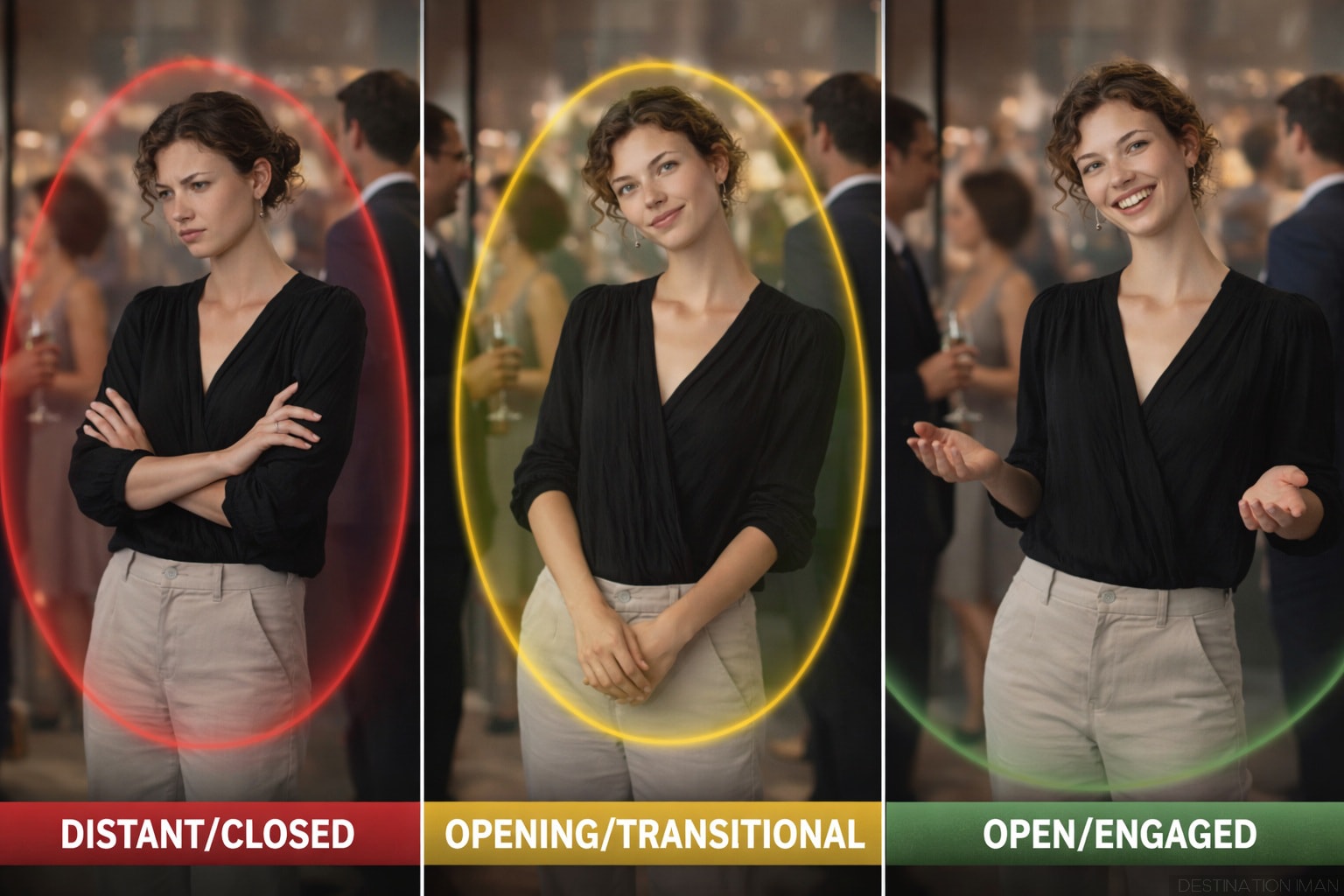
Beyond open versus closed positioning, the quality of your posture directly affects how attractive you appear. Good posture is not merely about standing straight—it's about visual balance, proportion, and the subtle communication of self-assurance.
The Anatomy of Attractive Posture
Components of Optimal Posture
- Elongated spine: Natural spinal curves maintained without excessive arch or slouch
- Shoulders back and down: Shoulder blades slightly retracted, avoiding both hunching and military rigidity
- Open chest: Sternum lifted slightly, ribcage expanded without forcing
- Level head: Chin parallel to ground, neither jutting forward nor tucking excessively
- Balanced weight: Weight distributed evenly on both feet (when standing)
- Relaxed muscles: Strength without visible tension or strain
Posture's Visual Impact
Good posture creates multiple visual advantages:
- Increased perceived height: Proper alignment can add 1-3 inches of perceived height
- Improved proportions: Elongated torso enhances waist-to-hip and shoulder-to-waist ratios
- Enhanced facial appearance: Level head positioning improves jawline and reduces double chin appearance
- Better breathing: Open chest allows fuller breathing, which affects facial color and vitality
- Confidence signaling: Upright posture unconsciously communicates social status and self-assurance
Movement Quality and Fluidity
Attractiveness is not static—it exists in motion. The quality of your movement profoundly affects how others perceive you, often more than your physical features in still positions.
Characteristics of Attractive Movement
Fluid vs Rigid Movement
- Smooth transitions: Movements flow naturally from one position to another without abrupt stops
- Coordinated gestures: Arms, torso, and legs move in harmony rather than isolated jerky movements
- Appropriate pace: Neither rushed/frantic nor excessively slow/lethargic
- Confident stride: Walking with purpose and balanced gait, not shuffling or hesitant steps
- Natural rhythm: Movement aligned with internal comfort, not forced or performative
- Spatial awareness: Moving through space with ease, not bumping into objects or people
Why Movement Matters
Movement quality reveals neurological health, emotional state, and social confidence. Smooth, coordinated movement suggests:
- Physical health: Good motor control and vitality
- Emotional calm: Lack of anxiety or stress-induced tension
- Social competence: Comfort navigating social and physical space
- Energy level: Vitality and engagement with environment
This explains why some people appear significantly more attractive in person or video than in still photographs. Photos eliminate the movement dimension—often the most attractive quality.
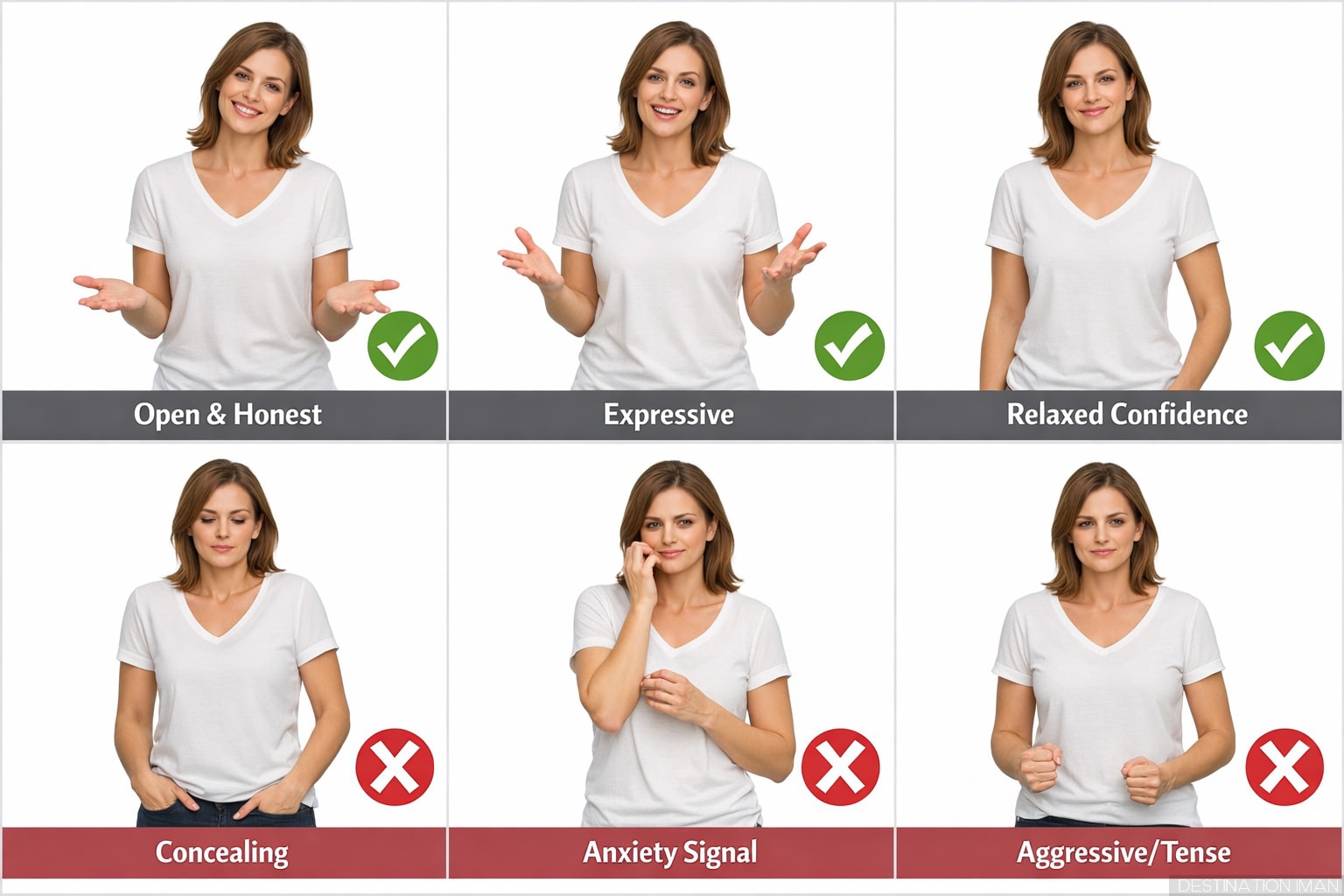
Gestures and Hand Communication
Hand gestures are one of the most visible and communicative forms of body language. They add expressiveness, clarity, and personality to interaction—or create awkwardness and distraction when poorly managed.
Attractive Gesture Patterns
Effective Hand Communication
- Moderate frequency: Gestures present but not overwhelming every word
- Purpose-aligned: Gestures reinforce meaning rather than random movement
- Open palms: Palms visible and facing up or forward signals honesty
- Appropriate amplitude: Gesture size matches environment (larger in groups, smaller in intimate settings)
- Smooth execution: Fluid hand movements without tension or abruptness
- Bilateral symmetry: Both hands used proportionally, not favoring one side excessively
Unattractive Gesture Patterns
- Hidden hands: Keeping hands in pockets or behind back suggests concealment
- Fidgeting: Constant small movements with fingers, rings, hair signal nervous energy
- Clenched fists: Tension visible in closed hands communicates aggression or stress
- Excessive touching: Repeatedly touching face, neck, or objects suggests insecurity
- Pointing: Direct finger pointing often perceived as aggressive or accusatory
- Arm barriers: Crossing arms during conversation creates psychological distance
Personal Space and Proxemics
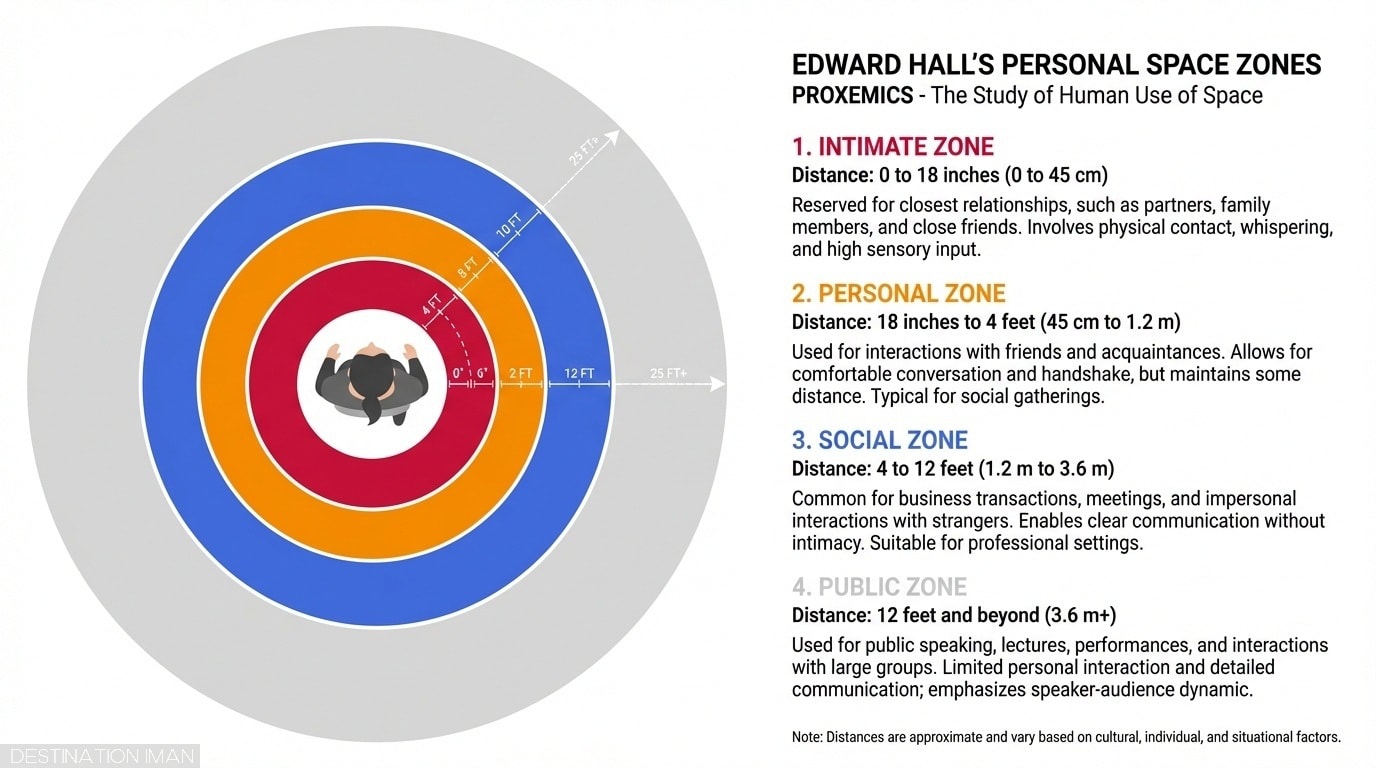
How you manage physical distance—called proxemics—affects perceived attractiveness through comfort, respect, and social calibration signals.
The Four Zones of Personal Space
Anthropologist Edward T. Hall identified four distance zones in Western cultures:
Intimate Distance (0-18 inches)
Reserved for romantic partners and very close family. Entering this zone uninvited triggers discomfort and attractiveness reduction.
Personal Distance (18 inches - 4 feet)
Used for friends and social interactions. Comfortable conversation distance showing appropriate social awareness.
Social Distance (4-12 feet)
Professional interactions and group settings. Maintains appropriate boundaries in formal contexts.
Public Distance (12+ feet)
Addressing groups or maintaining safety buffer with strangers.
Proxemics and Attractiveness
People who naturally calibrate distance based on relationship context are perceived as more socially intelligent and attractive. Violating space norms—standing too close or too far—creates discomfort that reduces attractiveness.
Attractive Proxemic Behaviors
- Gradual approach: Respecting initial distance and moving closer only as rapport builds
- Mirror matching: Adjusting distance to match conversation partner's comfort level
- Cultural awareness: Adapting space expectations to cultural norms
- Respectful retreat: Backing up if partner shows discomfort signals
- Confident spacing: Not crowding others but also not maintaining excessive fearful distance
The Evolutionary Psychology of Body Language
Why does body language affect attractiveness so powerfully? Evolutionary psychology provides answers rooted in survival and reproduction.
Ancient Signals, Modern Brains
Body language evolved long before complex verbal communication. Our ancestors needed to rapidly assess:
- Health status: Posture and movement quality indicate physical fitness
- Social rank: Confident body language signals dominance and resource access
- Emotional state: Open vs closed posture reveals approachability
- Threat level: Aggressive vs submissive signals determine safety
- Reproductive fitness: Symmetry and fluidity suggest genetic health
The Status-Attractiveness Connection
Much of body language's impact on attractiveness traces to status signaling. Throughout human history, high-status individuals had better access to resources, protection, and mates. Body language evolved as a rapid status assessment tool:
High-Status vs Low-Status Body Language
- High Status: Expansive posture, relaxed movement, takes up space, calm gestures, slow deliberate pace, maintains steady eye contact
- Low Status: Contracted posture, tense movement, minimizes presence, nervous gestures, hurried pace, avoids eye contact
- Perception: High-status body language consistently rated more attractive across gender and culture
Modern humans retain these ancient assessment mechanisms. Even though we consciously know body language doesn't necessarily reflect actual status, our subconscious still responds to these signals when judging attractiveness.

Body Language in Photography and Social Situations
Body language becomes especially critical in photography and first-impression scenarios where interaction time is limited.
Posing Psychology
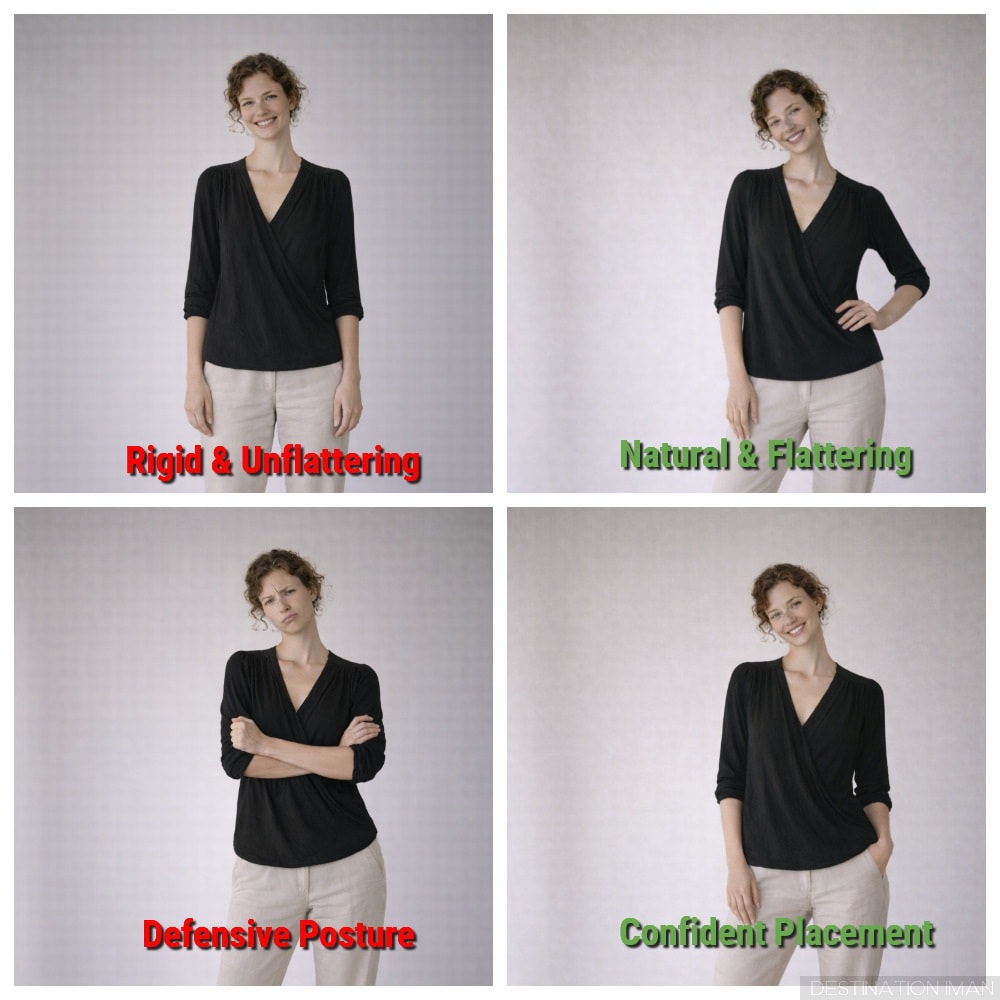
Professional photographers understand that attractive posing is not about rigidity—it's about creating confident, natural-looking body positions that signal openness and ease.
Photogenic Body Language Principles
- Weight shift: Placing weight on back leg creates natural, relaxed stance
- Angles: Slight torso turn toward camera (not full-frontal rigid) adds dimension
- Hand placement: Natural resting positions (pockets thumbs-out, touching hip lightly) avoid awkwardness
- Shoulder positioning: One shoulder slightly forward creates visual interest
- Neck elongation: Chin slightly forward and down (turtle technique) improves jawline
- Genuine expression: Real smile with engaged eyes beats posed forced grin
Social Situation Body Language
In real-world social interactions, body language effectiveness depends on context awareness and adaptability.
Context-Specific Body Language
- Job interviews: Confident but respectful posture, moderate gestures, appropriate distance
- Romantic dates: Open posture, forward lean, mirroring partner's body language
- Networking events: Expansive stance, confident handshake, open arm positions
- Conflict situations: Calm controlled posture, avoiding aggressive or defensive signals
- Group settings: Balanced attention distribution, inclusive body orientation

Gender Differences in Body Language Perception
While many body language principles are universal, research reveals some gender-specific patterns in how nonverbal communication affects attractiveness.
Women's Body Language and Attractiveness
Research suggests that for women, specific body language patterns increase perceived attractiveness:
- Slight head tilts: Subtle tilt signals interest and approachability
- Graceful movement: Fluid, feminine gestures rated more attractive
- Open posture with curves: Confident stance that doesn't minimize natural body shape
- Genuine smiling: Warm authentic smiles increase attractiveness ratings
- Hair touching: Subtle grooming gestures signal self-care and attraction
Men's Body Language and Attractiveness
For men, different nonverbal patterns typically enhance perceived attractiveness:
- Expansive posture: Taking up space signals confidence and status
- Strong gestures: Purposeful, controlled movements rather than excessive animation
- Steady eye contact: Maintained gaze signals confidence (not aggressive staring)
- Slower movement: Deliberate pace suggests confidence and control
- Upright stance: Maximum height projection through posture
Can Body Language Be Improved?
The encouraging answer: yes. Unlike fixed physical features, body language is learnable and improvable through awareness and practice.
The Body Language Development Process
Stage 1: Awareness
Begin noticing your default body language patterns. Video yourself in conversation or use mirrors to observe unconscious habits.
Stage 2: Conscious Practice
Deliberately adopt open, confident postures in low-stakes situations. This feels awkward initially—that's normal.
Stage 3: Feedback Integration
Notice how others respond to improved body language. Positive reactions reinforce new patterns.
Stage 4: Automaticity
With repetition, confident body language becomes automatic—your new default rather than conscious performance.
Practical Body Language Improvement Strategies
- Posture check-ins: Set hourly reminders to notice and adjust posture
- Mirror practice: Practice confident stances and gestures observing yourself
- Video analysis: Record yourself in conversation to identify unconscious tension patterns
- Movement classes: Dance, yoga, or martial arts improve body awareness and fluidity
- Power posing: Spend 2 minutes daily in expansive confident poses
- Gesture practice: Rehearse hand movements during presentations or conversations
- Space awareness: Practice maintaining appropriate distance in different social contexts
- Breath work: Deep breathing reduces tension that creates rigid body language
- Social exposure: Gradual increase in social situations provides practice opportunities
Key Takeaways
Core Insights: Body Language and Attractiveness
- Body language affects attractiveness as much or more than facial features
- Open posture dramatically increases perceived attractiveness; closed posture decreases it
- Movement quality and fluidity signal neurological health and emotional calm
- Good posture can add 1-3 inches of perceived height and improve body proportions
- Hand gestures should be purposeful, open-palmed, and moderate in frequency
- Appropriate personal space management signals social intelligence
- Body language assessment happens in milliseconds, mostly unconsciously
- Evolutionary psychology explains why certain nonverbal signals universally affect attractiveness
- Photography amplifies body language importance since movement cues are absent
- Body language can be systematically improved through awareness and practice
- Authentic confident body language beats forced performative signals
Sources & References
Academic & Research Sources
- NIH/PNAS (2016) — "Dominant, open nonverbal displays are attractive at zero acquaintance"
- Knapp, M. L., Hall, J. A., & Horgan, T. G. (2013). Nonverbal Communication in Human Interaction (8th ed.)
- Psychology Today (2020) — Body Language Cues That Increase Physical Attraction
- Hall, E. T. (1966). The Hidden Dimension. Anchor Books. (Proxemics research)
- ResearchGate (2023) — Nonverbal Expressivity, Physical Attractiveness, and Liking
- Frontiers in Communication (2022) — Effectiveness, Attractiveness, and Emotional Response to Voice and Hand Gestures
- Mehrabian, A. (1971). Silent Messages. Wadsworth. (7-38-55 Rule research)
- Medium (2024) — How Nonverbal Communication Connects with Attractiveness
- American Psychological Association — Nonverbal Communication Research