Many people ask the same question after seeing an unflattering photo: "Why do I look so different from what I see in the mirror?" The answer has little to do with beauty and everything to do with psychology, perception, and visual processing.
Understanding why this happens can dramatically change the way you perceive your appearance—and your photos.
Mirror vs Camera: Two Different Versions of You
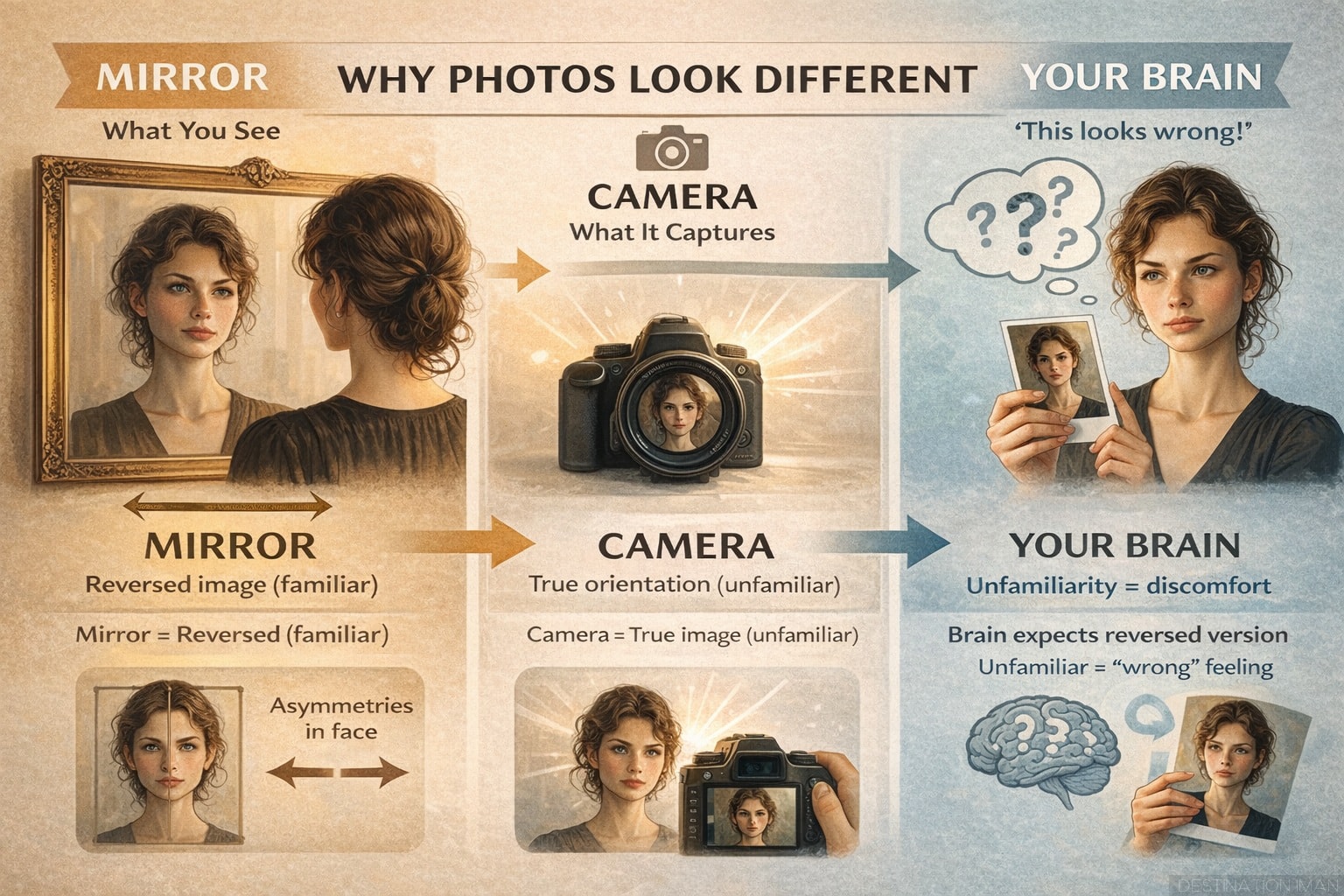
When you look in the mirror, you see a horizontally flipped version of your face. This mirrored image is the one you have been exposed to most frequently throughout your life. A camera, on the other hand, shows you exactly how others see you—without reversal.
The Core Difference
- Mirror: Shows reversed/flipped image—what you're familiar with seeing
- Camera: Shows true orientation—what others actually see
- Result: Even subtle facial asymmetries become noticeable when orientation is unfamiliar
- Brain response: Flags unfamiliar version as "wrong" even though it's objectively accurate
Even subtle facial asymmetries become noticeable when the image is unfamiliar. This is why a photo may feel "wrong," even if it is technically accurate.
The Familiarity Bias Explained
Psychologists describe this effect using the mere-exposure effect—a well-documented phenomenon where people develop a preference for things they see more often.
How Familiarity Shapes Preference
Because you are deeply familiar with your mirrored face, your brain perceives it as more natural and attractive. When you encounter a non-mirrored version in photos, your brain interprets the difference as a flaw.
In reality, the photo is not worse—it is simply unfamiliar.
Why Others Often Like Your Photos More Than You Do
Interestingly, studies show that people tend to prefer non-mirrored images of others. This means that what looks strange to you often looks completely normal—or even better—to everyone else.
Perception Gap: You vs Others
- You looking at your photo: "This looks wrong, my face is flipped, my asymmetries are noticeable"
- Others looking at your photo: "This looks normal—it's how I always see them"
- The paradox: The version you dislike is the version everyone else is familiar with and prefers
This gap in perception explains why friends may compliment a photo you personally dislike.
Camera Lenses and Perspective Distortion
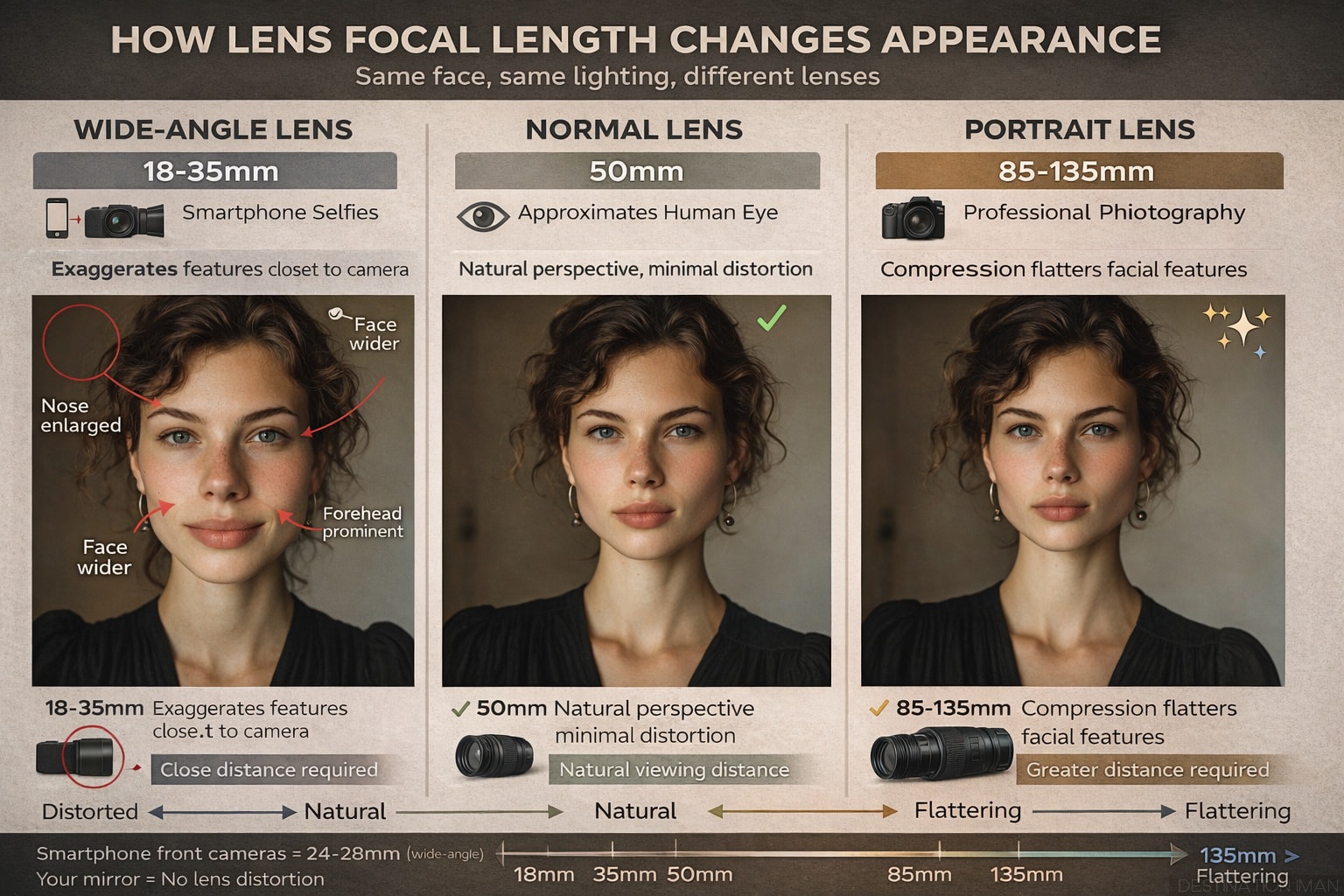
Another important factor is lens distortion. Wide-angle lenses, especially on smartphones, can exaggerate facial features depending on distance. Noses may appear larger, faces wider, and proportions slightly altered.
How Different Lenses Affect Appearance
Lens Focal Length Effects
- Wide-angle (18-35mm): Exaggerates features closest to camera (nose, forehead), distorts proportions
- Normal (50mm): Approximates human eye perspective, minimal distortion
- Portrait (85-135mm): Flattering compression, natural proportions, professional look
- Smartphone front camera: Often wide-angle (~28mm), creates subtle distortion
Mirrors do not distort perspective in the same way, which further increases the perceived difference.
Posture, Expression, and Micro-Movements
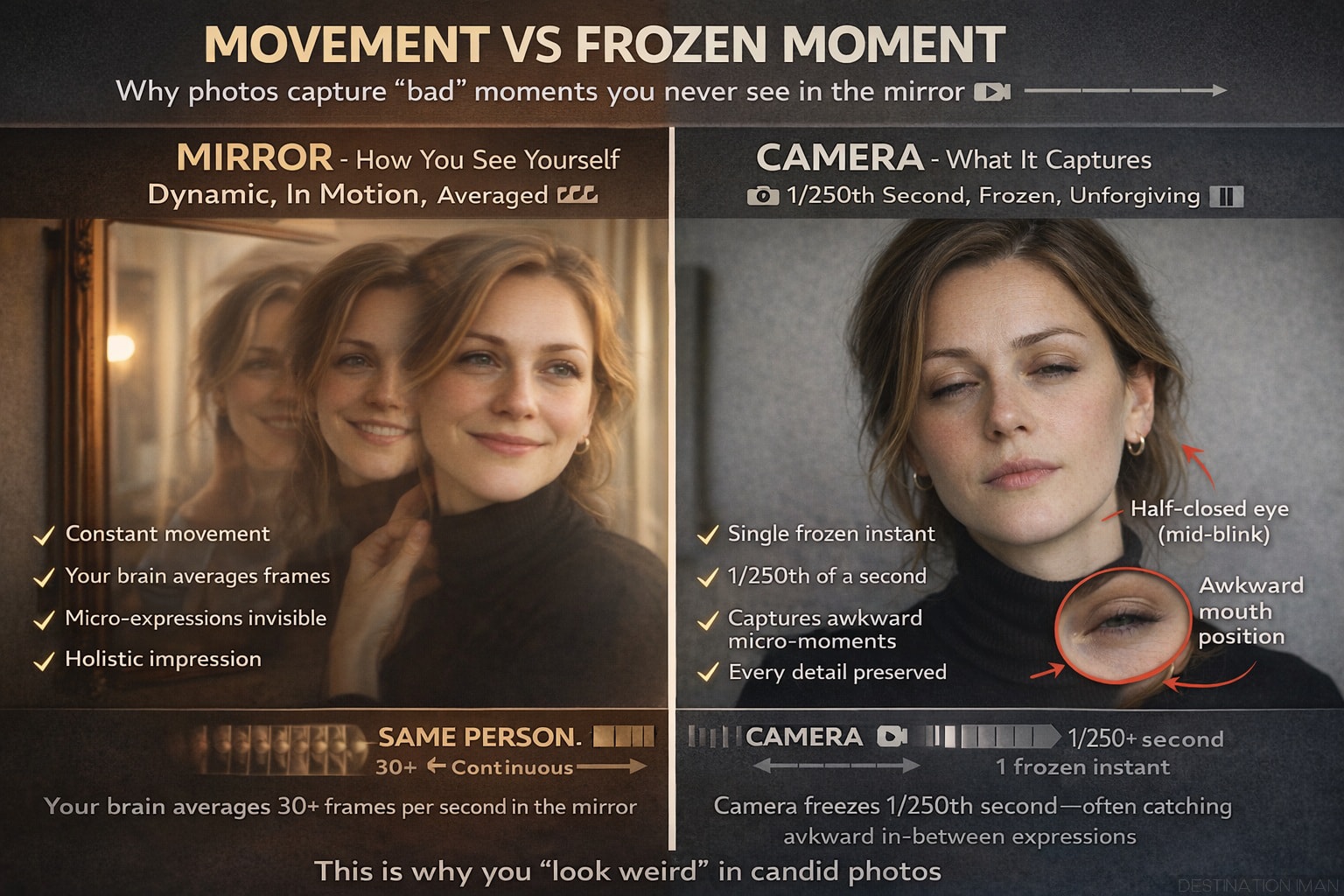
In real life, people see you in motion. Your expressions change, your posture shifts, and your personality comes through. A still photograph freezes a single moment—sometimes an unflattering one.
Why Movement Matters
This is why someone may look better in real life than in photos. Movement and emotion play a major role in how attractive we perceive a person to be.
Dynamic vs Static Perception
- Real life: Continuous movement, changing expressions, personality visible, energy present
- Photos: Single frozen moment, no movement context, personality hidden, timing critical
- Result: Photos can capture unflattering micro-expressions that pass unnoticed in real-time interaction
The Emotional Factor
Emotions strongly influence appearance. Tension in the shoulders, jaw, or eyes can subtly change facial lines. If you feel uncomfortable in front of a camera, it often shows—even if you don't consciously notice it.
Camera Anxiety and Its Visual Impact
Relaxed vs Camera-Conscious
- Comfortable/Relaxed: Natural smile, soft features, open eyes, genuine expression, body at ease
- Camera-Conscious: Forced smile, tense jaw, stiff posture, guarded expression, visible discomfort
- Visual difference: Same face, dramatically different attractiveness based purely on emotional state
Confidence and relaxation, on the other hand, soften features and improve visual balance.

Social Media and Unrealistic Comparisons
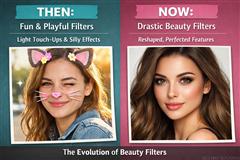
Social media intensifies dissatisfaction with photos. Filters, angles, and curated images distort reality and set unrealistic standards. Comparing an unedited photo to idealized images is psychologically harmful and visually misleading.
Understanding this helps separate perception from reality.
How This Relates to the Psychology of Appearance
This entire phenomenon is explained by the broader concept of the psychology of appearance, which studies how familiarity, emotion, culture, and perception shape the way we see ourselves.
Core Psychological Principles
- Mere-exposure effect: Familiarity breeds preference—we like what we see often
- Perceptual adaptation: Brain learns reversed mirror image as "self"
- Emotional influence: How you feel affects what you see
- Context dependency: Appearance is not fixed—it varies by medium and emotion
Your appearance is not a single image—it is a dynamic combination of form, movement, and presence.
Key Takeaways
Understanding Mirror vs Camera Perception
- Mirrors show a familiar, flipped version of your face
- Photos show an unfamiliar but accurate perspective
- Familiarity strongly affects perceived attractiveness
- Lens distortion and posture influence how photos look
- Others usually see you more positively than you see yourself
- Movement and personality matter more in real life than in frozen photos
- Social media comparisons are misleading—most images are heavily edited
- The photo you dislike may be the version others prefer and find normal
Sources & References
Academic & Research Sources
- Hood, B. (2012). The Self Illusion: How the Social Brain Creates Identity
- Mita, T. H., Dermer, M., & Knight, J. (1977). Reversed facial images and the mere-exposure hypothesis. Journal of Personality and Social Psychology
- American Psychological Association — Visual Perception
- Psychology Today — Self-Image and Face Perception
- Frontiers in Psychology — Face Recognition Research