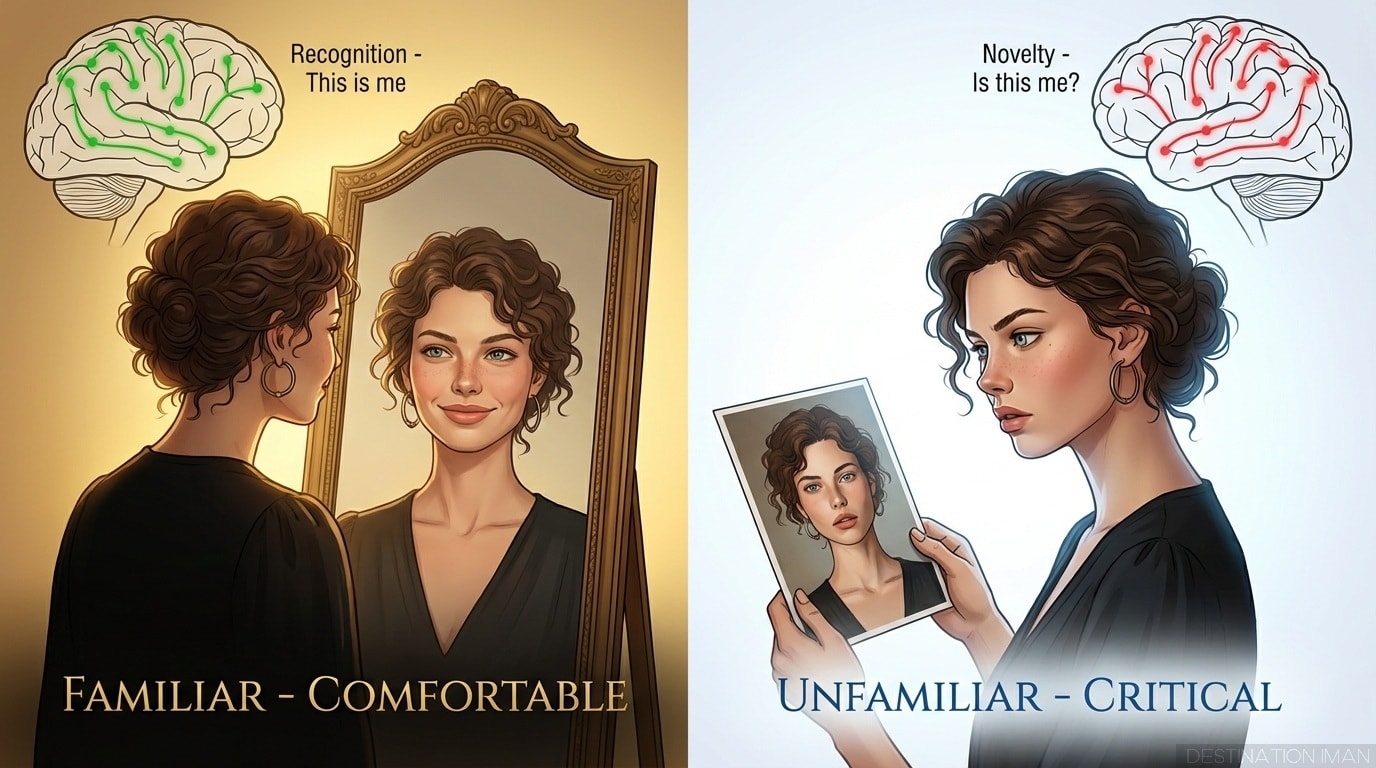
You look in the mirror and feel satisfied with your appearance. Then you see a photo from the same day and barely recognize yourself. This unsettling disconnect is not vanity or poor photography—it's fundamental psychology. Mirror vs camera perception reveals how self-image is constructed through familiarity rather than objective reality, and why the version you see every day is not the version others see.
This article explores the neuroscience, psychology, and visual perception science behind mirror vs camera differences, explaining why your reflection feels "right" and photos feel "wrong," and what this reveals about the nature of self-recognition and identity.
The Fundamental Difference: Reversed vs True Image
The core distinction between mirror and camera perception is simple but profound: mirrors reverse your image horizontally, cameras do not.
Understanding Image Reversal
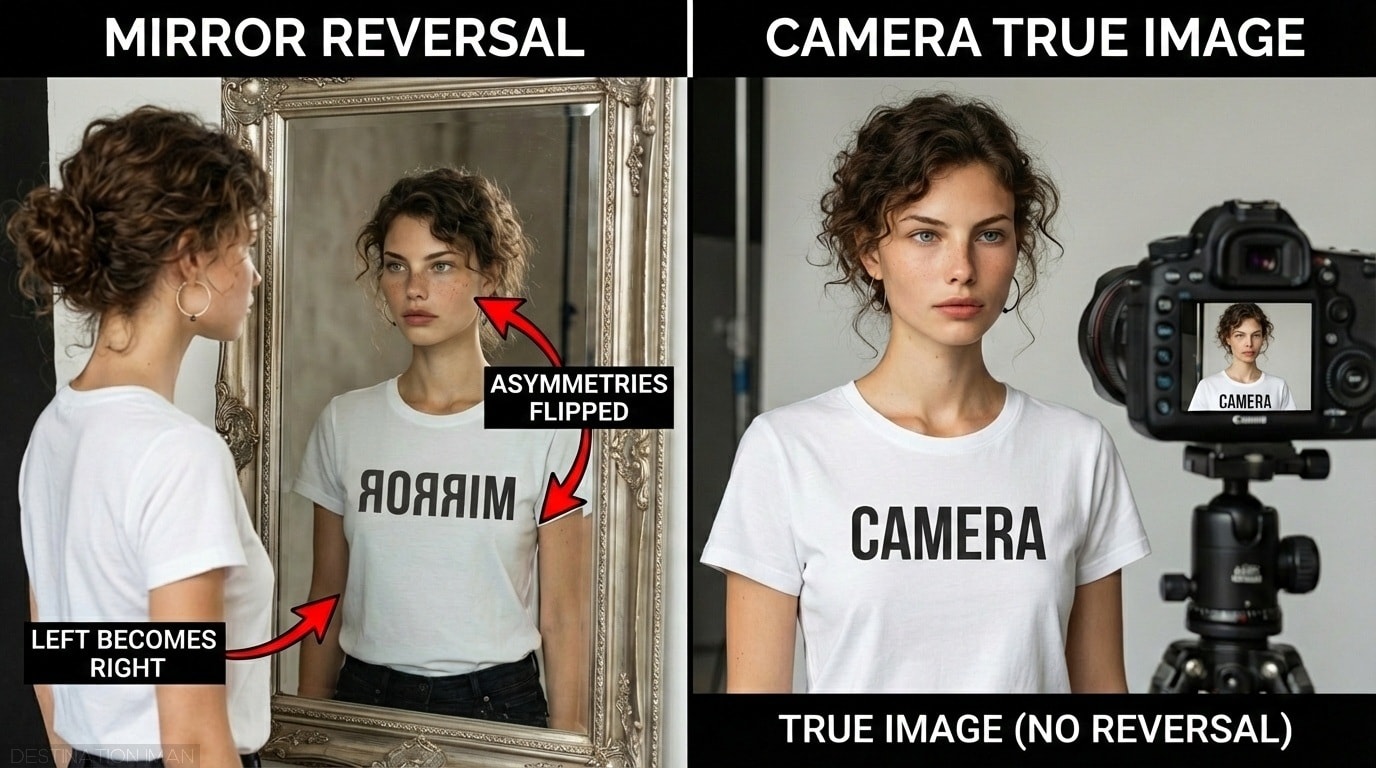
When you look in a mirror, you see a left-right flipped version of your face. Your right side appears on the left, your left side appears on the right. This reversed image becomes your primary visual reference for self-recognition. A camera, however, captures your face without reversal—showing you exactly as others see you.
Mirror vs Camera: Core Difference
- Mirror reflection: Horizontally flipped—left and right reversed from reality
- Camera photo: True orientation—left and right positioned as they actually are
- Your perception: Mirror image feels "correct" because it's familiar
- Others' perception: Camera image looks "correct" because that's what they see
- The paradox: The "wrong" image (camera) is objectively accurate; the "right" image (mirror) is reversed
Why This Reversal Matters
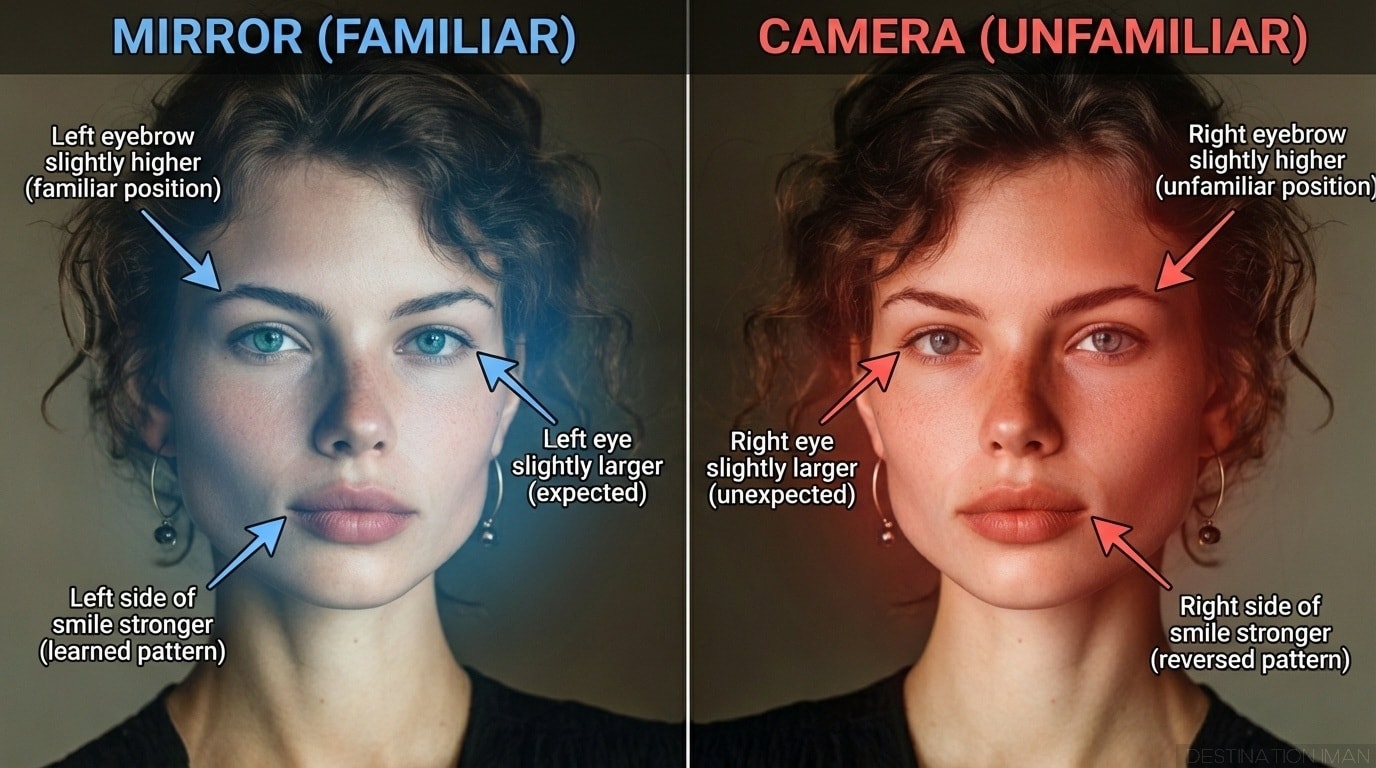
No face is perfectly symmetrical. Everyone has subtle (or not-so-subtle) asymmetries: one eye slightly larger, one eyebrow higher, jawline stronger on one side, smile asymmetrical. When your image is reversed, these asymmetries flip to the opposite side—creating an unfamiliar version of your face.
How Your Brain Learns Your Face
Self-recognition is not innate—it's learned through repeated exposure. From early childhood, your brain builds a neural template of "your face" based primarily on mirror reflections.
The Neural Template Formation
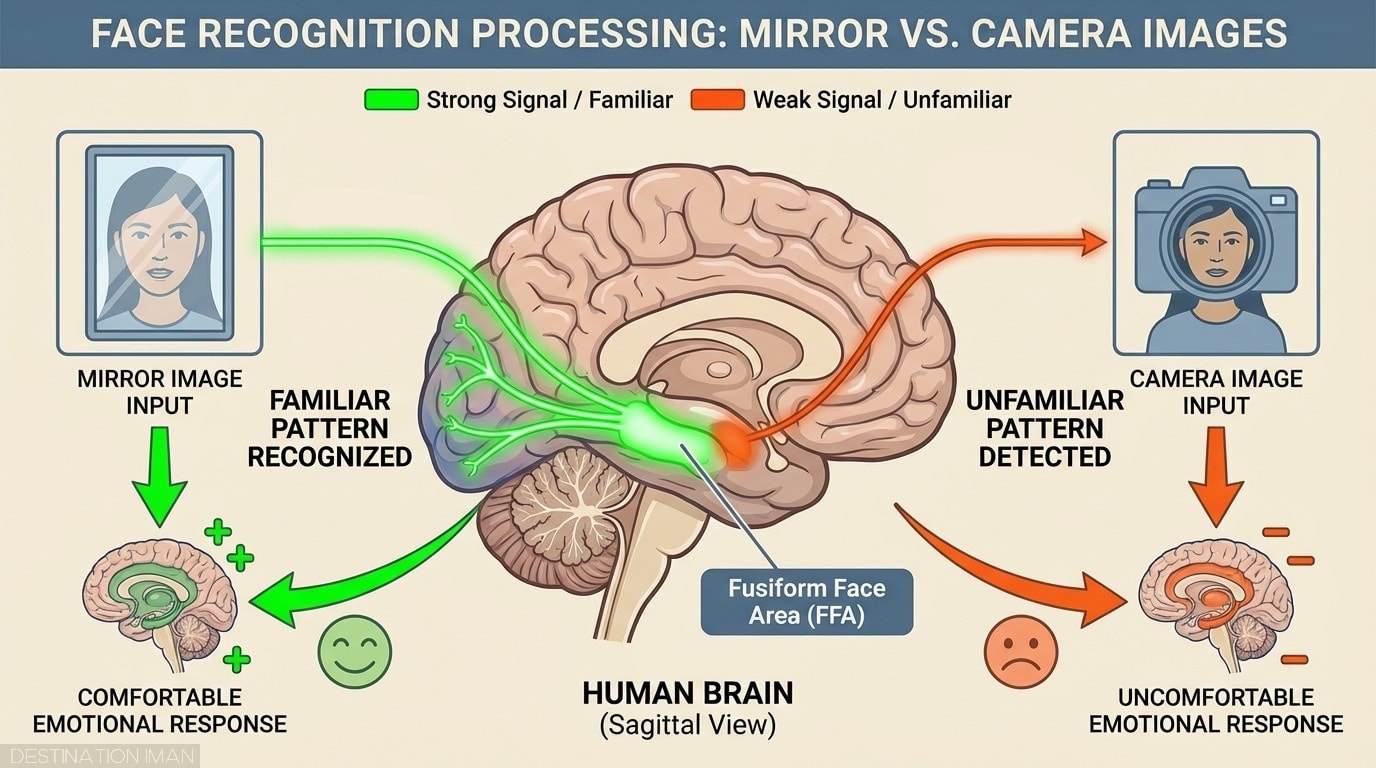
Neuroscience research reveals that face recognition involves specialized brain regions, particularly the fusiform face area (FFA). This region develops specific neural patterns for familiar faces—including your own.
The Mirror Exposure Dominance
Consider the exposure imbalance throughout your life:
This massive exposure imbalance means your brain has encoded the reversed image as your primary self-concept. The true image remains relatively unfamiliar—processed more like a stranger's face than your own.
The Identity Crisis Effect
When you see your true (camera) image, your brain experiences what psychologists call cognitive dissonance—a mismatch between expectation (familiar mirror face) and reality (unfamiliar true face). This creates psychological discomfort that manifests as "I look weird in photos."
The Power of Familiarity: Mere-Exposure Effect
The preference for your mirror image over camera photos is explained by one of psychology's most robust findings: the mere-exposure effect.
What Is the Mere-Exposure Effect?
First documented by psychologist Robert Zajonc in 1968, the mere-exposure effect demonstrates that people develop preferences for things simply because they encounter them frequently. Familiarity breeds liking—even when there's no objective reason for preference.
Why This Effect Is So Powerful
The mere-exposure effect operates unconsciously and affects perception across all domains:
- Music: Songs become more enjoyable with repeated listening
- Faces: People rated more attractive after multiple exposures
- Products: Brand familiarity increases purchase likelihood
- Self-image: Your mirror face becomes your "attractive" baseline
Mere-Exposure Effect on Self-Perception
- Repeated exposure: Seeing your mirror face thousands of times creates strong preference
- Unconscious processing: You don't consciously decide to prefer it—brain does automatically
- Resistance to change: Even knowing about reversal doesn't eliminate preference
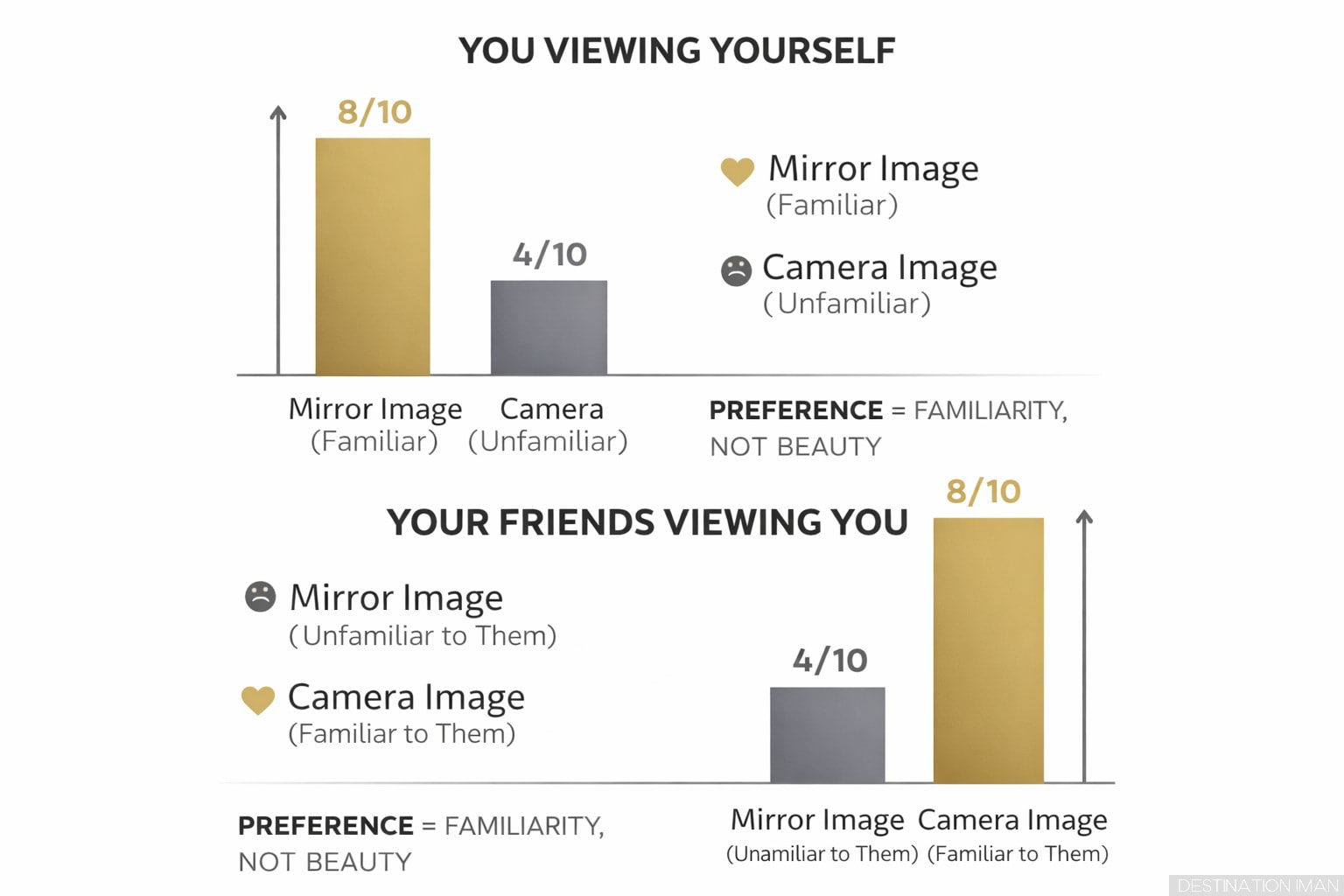
- Applies to others too: Your friends prefer your camera image because that's what they see
- Not about beauty: It's about familiarity, not objective attractiveness
Implications for Self-Image
Understanding the mere-exposure effect reveals that your dissatisfaction with photos is not evidence that you're unattractive in photos. It's evidence that you're unfamiliar with your true orientation. To others—who see your true orientation daily—that's the attractive version.
Facial Asymmetry and Why It Matters
No human face is perfectly symmetrical. Understanding how asymmetry interacts with reversal explains much of the mirror vs camera discomfort.
Universal Facial Asymmetry
Research shows that virtually all faces have measurable asymmetries:
- Eye size and position: One eye typically larger or positioned higher
- Eyebrow shape and height: Rarely perfectly matched
- Nostril size: Often subtly different
- Smile asymmetry: One side of mouth may lift more
- Jaw and chin: Frequently stronger or more defined on one side
- Facial width: One cheek may be fuller or wider
Why Reversal Amplifies Asymmetry Perception
When your image is reversed, asymmetries that your brain has learned to ignore suddenly appear on the "wrong" side. A left eyebrow that's slightly higher becomes a right eyebrow that's slightly higher—triggering novelty detection in your brain.
The Attention Bias
When viewing photos, you notice asymmetries more than others do because:
- Novelty effect: Your brain flags unfamiliar asymmetry positions
- Self-focus: You scrutinize your own face more than others' faces
- Mental comparison: You compare to idealized mental mirror image
- Confirmation bias: Once you notice asymmetry, you can't unsee it
Why Others Prefer Your Camera Image
While you prefer your mirror image, research consistently shows that others prefer your camera (true) image. This reveals that preference is entirely about familiarity, not objective attractiveness.
The Perspective Flip
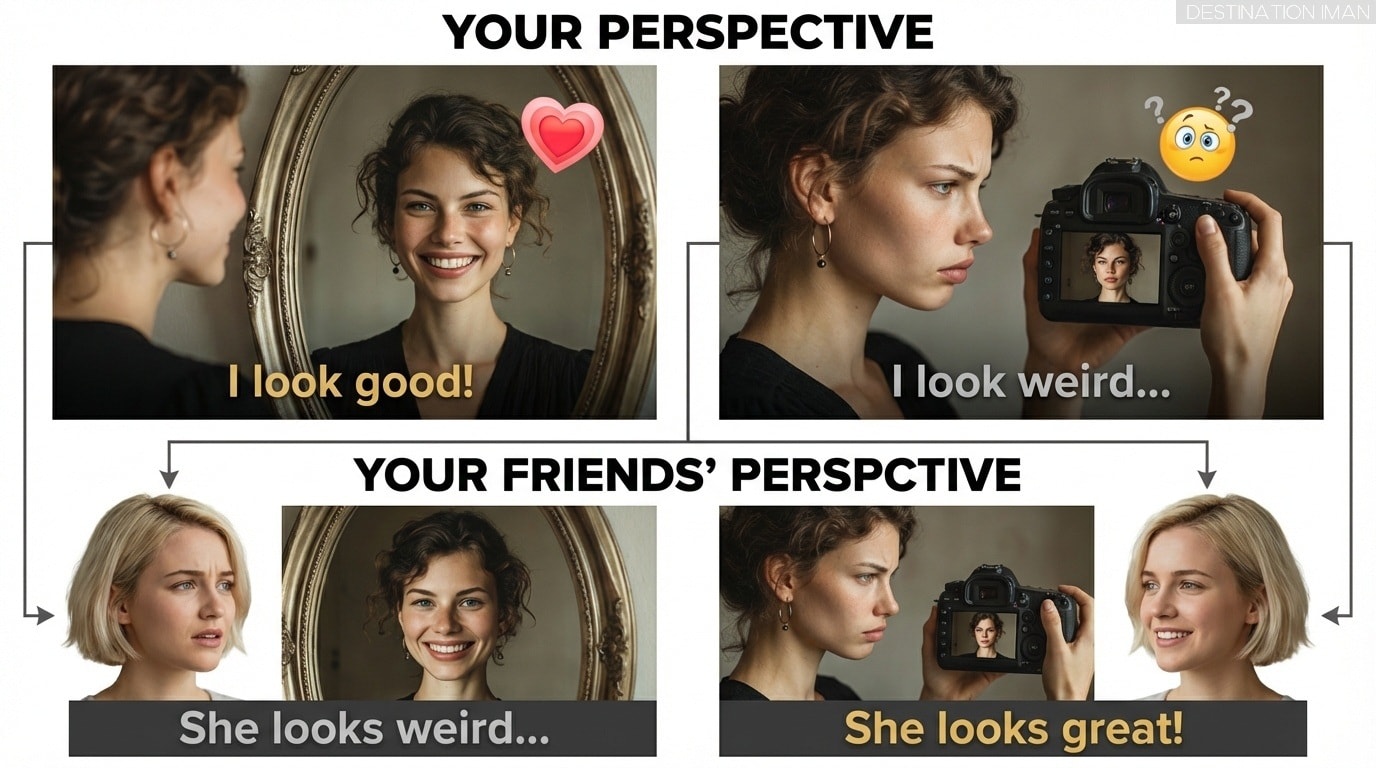
Your Perspective vs Others' Perspective
- You see yourself: Primarily in mirrors (reversed) → prefer reversed image
- Others see you: Primarily in reality (true) → prefer true image
- Your camera photo: Looks "wrong" to you but "normal" to everyone else
- Your mirror reflection: Looks "normal" to you but "wrong" if others could see it
Research Evidence
Multiple studies confirm this preference reversal:
What This Means for Self-Perception
This preference reversal has important implications:
- The photo you think is "bad" is probably how you look to everyone else—and they think you look fine
- Your dissatisfaction with photos is not evidence of being unphotogenic—it's evidence of unfamiliarity
- Others do not see the "flaws" you see because those features are familiar to them
- Your mirror face would look "wrong" to your friends if they could see it

The Movement and Real-Time Factor
Beyond reversal, mirrors offer another advantage that photos lack: real-time movement and interaction.
Dynamic vs Static Perception
Human perception evolved to process faces in motion. Mirrors provide this dynamic experience; photos do not.
Mirror Movement Advantages
- Continuous feedback: You see yourself in motion, adjusting expressions in real-time
- Expression control: You can find and hold your most flattering angle/expression
- Brain averaging: Brain averages multiple frames into idealized composite
- Micro-adjustments: Unconsciously optimize appearance moment-to-moment
- Dynamic attraction: Movement and personality shine through, enhancing attractiveness
- Selective attention: You focus on good moments, ignore bad micro-expressions
Why Photos Freeze Awkward Moments
Photos capture a single 1/250th of a second—often catching micro-expressions or transitional moments that would go unnoticed in real life:
- Mid-blink captures: Eyes half-closed in natural blinking motion
- Transitional expressions: Between smile and neutral, creating awkward look
- Mouth positions: Mid-word speaking moments that look strange frozen
- Asymmetric moments: One side of face moving while other is still
Control, Posing, and Self-Presentation
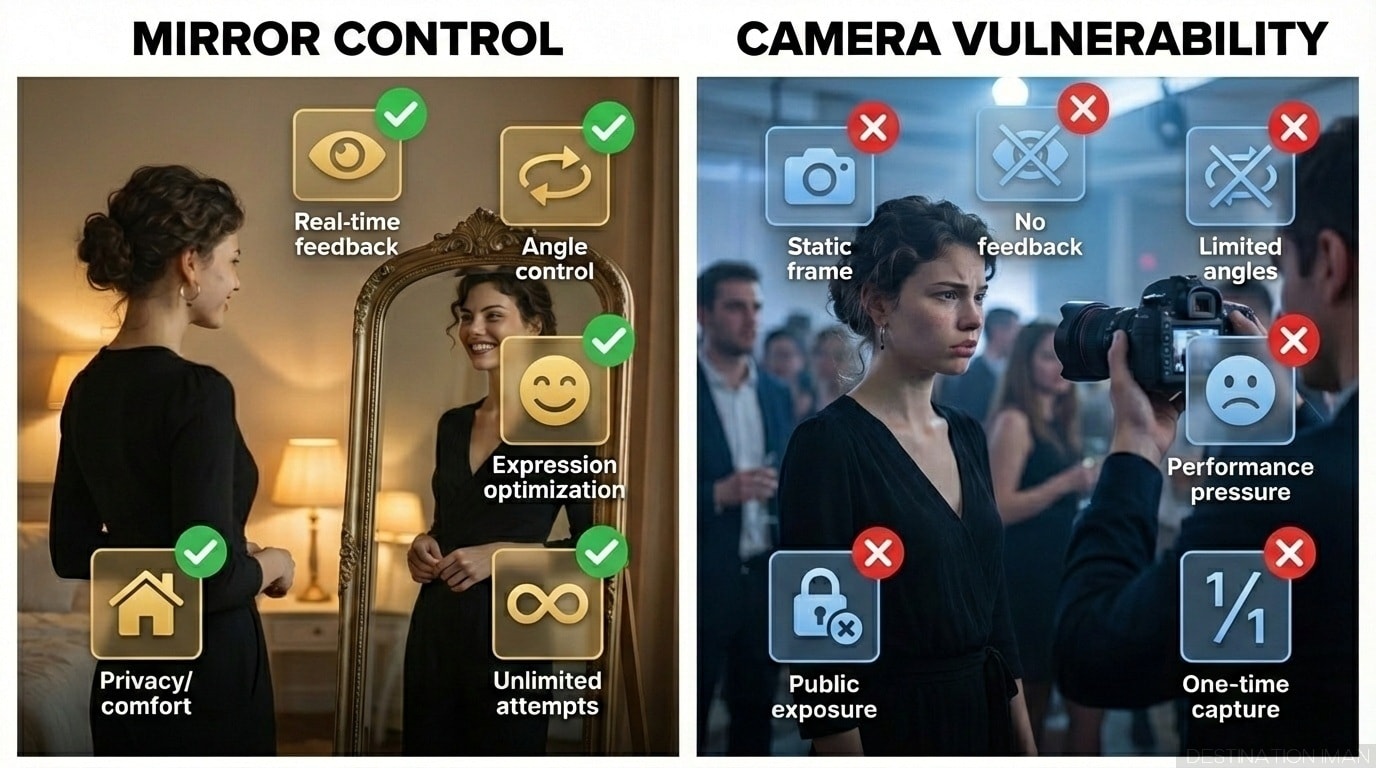
Mirrors offer something cameras often don't: complete control over presentation.
The Control Advantage
In front of a mirror, you have:
- Angle control: Adjust head tilt, body position, distance instantly
- Expression practice: Find and rehearse your best facial expressions
- Lighting awareness: See how light affects your appearance and adjust
- Real-time optimization: Continuously refine presentation until satisfied
- Psychological comfort: Private space without performance pressure
Camera Vulnerability
Cameras, especially when operated by others, remove this control:
- Unknown timing: Don't know exact moment of capture
- Angle uncertainty: Can't see yourself from camera's perspective
- Tension manifestation: Camera awareness creates facial tension
- Loss of optimization: Can't adjust in real-time based on results
- Performance pressure: Awareness of being photographed affects natural expression
The Self-Photograph Solution
Selfies partially restore control, which explains their popularity:
- You see yourself while shooting (like a mirror)
- You control timing and angle
- You can take multiple shots and select best
- Many selfie cameras flip image to mirror orientation (further increasing comfort)

Lighting, Distance, and Technical Variables
Beyond psychology, technical factors contribute to mirror vs camera differences.
Lighting Differences
Mirrors and cameras interact with light differently:
Mirror Lighting vs Camera Lighting
- Mirror lighting: Often overhead bathroom/bedroom lights, familiar and optimized by you
- Camera lighting: Varies widely, often flat direct flash or unflattering angles
- Dynamic range: Eyes see wider range of light than cameras, creating exposure issues
- Shadow patterns: Camera flash creates harsh shadows different from ambient mirror lighting
Distance and Perspective Distortion
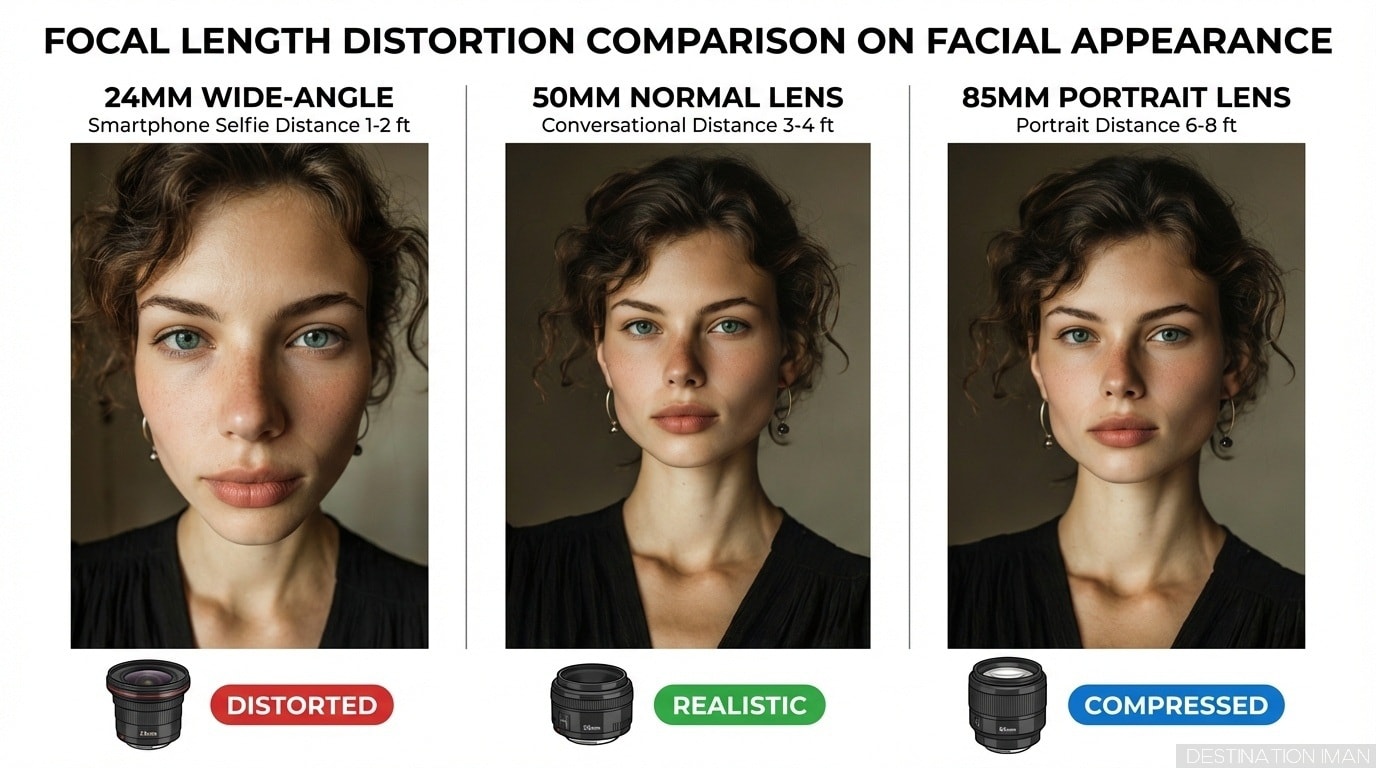
Cameras and mirrors are typically used at different distances, affecting facial proportions:
- Mirror distance: Usually 1.5-3 feet (arm's length), minimal distortion
- Selfie distance: Often 1-2 feet, creates wide-angle distortion (nose larger, face wider)
- Portrait distance: Optimal at 6-8 feet with 85-135mm lens, flattering compression
- Close-up distortion: Wide-angle lenses exaggerate features closest to camera
Focal Length Impact
Why Video Is Often Worse Than Photos
Many people find video even more uncomfortable than photos. This intensifies all mirror vs camera issues.
The Compounding Factors
Video combines multiple challenges:
Why Video Feels Worse
- Continuous unfamiliarity: Extended exposure to your true (unfamiliar) face
- Voice addition: Hearing your voice as others hear it (also unfamiliar) compounds discomfort
- Movement capture: Mannerisms and expressions you don't realize you make
- No control: Can't optimize each moment like in mirror
- Social context: Often includes awkward moments you'd ignore in real-time
- Identity challenge: Moving image feels more "real" than static photo, intensifying cognitive dissonance
The Voice Parallel
Discomfort with video mirrors (no pun intended) discomfort with recorded voice. Both occur because:
- Internal perception (how you hear your voice through bone conduction) differs from external perception (recorded voice)
- Familiarity with internal version creates preference
- External version sounds "wrong" despite being accurate
- Others prefer external version because that's what they hear
Adaptation Over Time
Interestingly, people who regularly watch themselves on video (content creators, actors, video professionals) report that discomfort fades with exposure. This supports the familiarity hypothesis—the true image becomes comfortable once it's seen frequently enough.
Learning to Accept Both Versions
Understanding mirror vs camera psychology enables healthier self-perception. The goal is not to prefer one version, but to accept that both are valid representations.
Cognitive Reframing Strategies
Building Acceptance of Both Images
- Remember the reversal: Photos show your true face—what everyone else sees and likes
- Recognize familiarity bias: Your discomfort is about novelty, not actual unattractiveness
- Trust others' perspectives: If friends say you look good in a photo, they're seeing familiar you
- Increase photo exposure: Look at more photos of yourself to build familiarity with true orientation
- Practice video tolerance: Record and watch yourself speaking to accelerate adaptation
- Use true-image mirrors: Special non-reversing mirrors exist to see yourself as others do
- Focus on expression: Both mirror and camera capture your personality and energy
- Separate emotion from appearance: How you feel affects what you see in any image
The Gradual Adaptation Process
Stage 1: Awareness
Understand that discomfort is psychological, not aesthetic—based on familiarity rather than objective attractiveness
Stage 2: Exposure
Deliberately increase viewing of your true (camera) image through photos and videos
Stage 3: Neutralization
Discomfort gradually decreases as true image becomes more familiar through repeated exposure
Stage 4: Acceptance
Both mirror and camera versions feel equally valid—neither "right" nor "wrong," just different perspectives
Philosophical Perspective
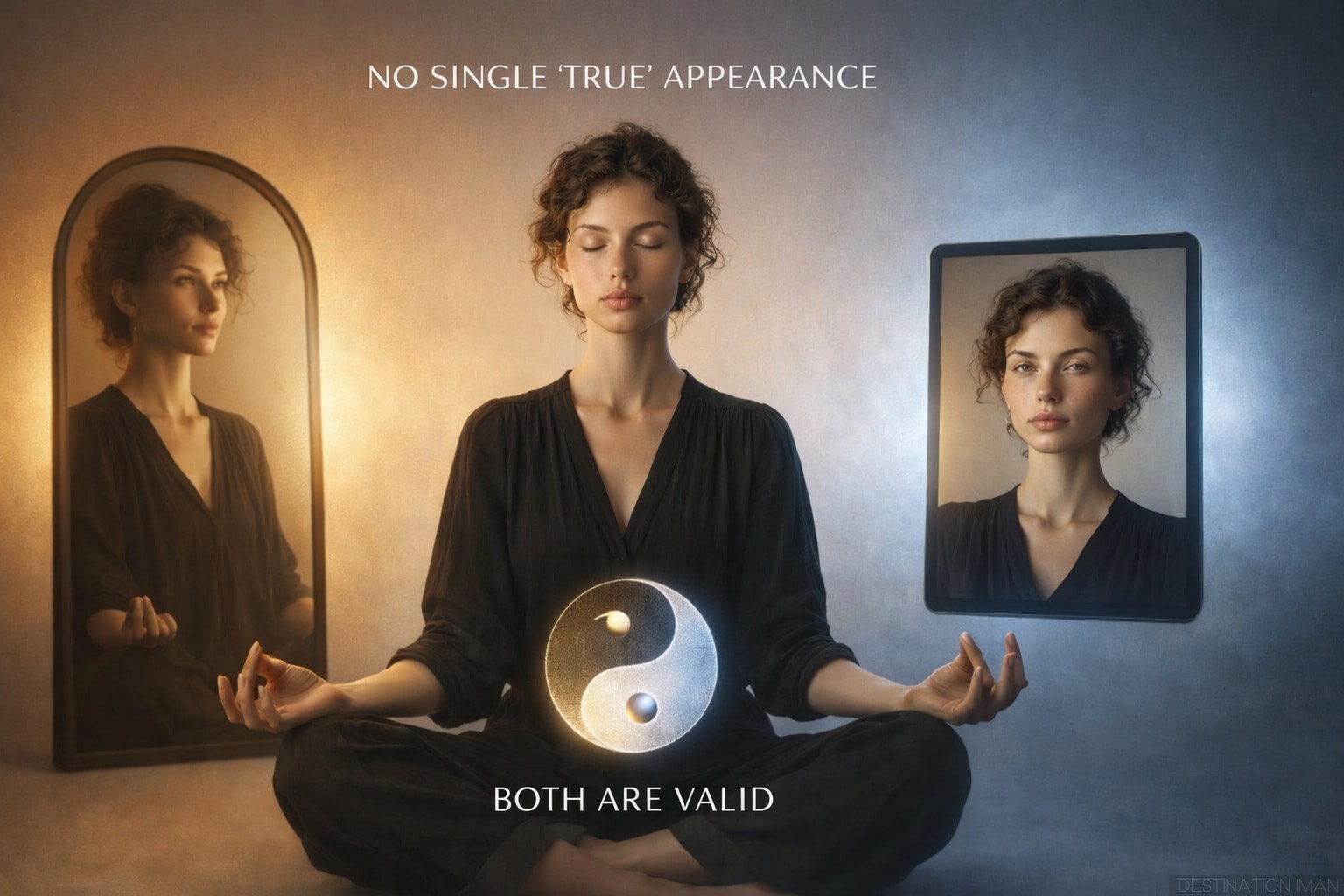
Ultimately, mirror vs camera perception reveals a profound truth: there is no single "true" appearance. Your appearance is not an objective fact but a perceptual experience that varies by:
- Perspective (reversed vs true orientation)
- Medium (mirror, photo, video, in-person)
- Context (lighting, angle, distance, emotional state)
- Observer (yourself vs others, each with different familiarity)
Key Takeaways
Core Insights: Mirror vs Camera Perception
- Mirrors reverse your image horizontally; cameras show true orientation
- Your brain learned your face primarily through mirrors, encoding reversed version as "you"
- Mere-exposure effect explains preference for mirror image—familiarity breeds liking
- Others prefer your camera image because that's the version they see daily
- Facial asymmetries become hyper-visible when reversed to unfamiliar orientation
- Mirrors provide movement, control, and real-time optimization that photos lack
- Technical factors (lighting, focal length, distance) add to mirror vs camera differences
- Video compounds discomfort by adding voice unfamiliarity and continuous exposure
- Discomfort is about novelty, not actual unattractiveness
- Increased exposure to true image gradually reduces discomfort through familiarity
- No single "true" appearance exists—you are valid across all perspectives
Sources & References
Academic & Research Sources
- Mita, T. H., Dermer, M., & Knight, J. (1977). Reversed facial images and the mere-exposure hypothesis. Journal of Personality and Social Psychology, 35(8), 597-601.
- Zajonc, R. B. (1968). Attitudinal effects of mere exposure. Journal of Personality and Social Psychology, 9(2, Pt.2), 1-27.
- Hood, B. (2012). The Self Illusion: How the Social Brain Creates Identity. Oxford University Press.
- American Psychological Association — Face Perception and Self-Recognition Research
- Psychology Today — Mirror and Self-Recognition Studies
- Frontiers in Psychology — Visual Self-Recognition and Familiarity
- Kanwisher, N., McDermott, J., & Chun, M. M. (1997). The fusiform face area: a module in human extrastriate cortex specialized for face perception. Journal of Neuroscience, 17(11), 4302-4311.