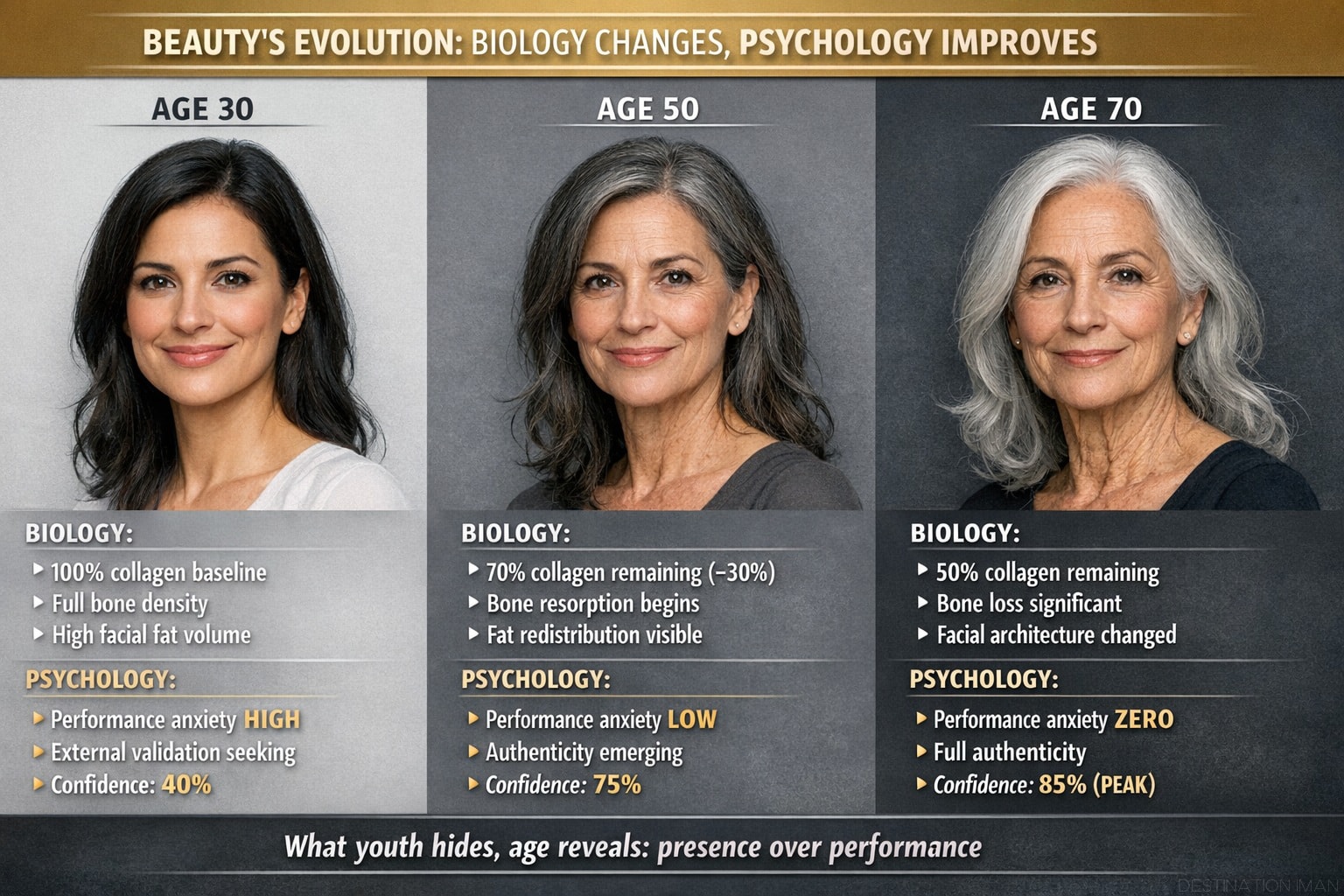
Your body loses 1-1.5% of collagen annually after age 25. Menopause accelerates this decline by 30% in five years. Bone structure shifts; fat redistributes; skin thins. Yet at age 60, confidence peaks—surpassing all earlier life stages. Gray hair, once hidden, becomes 2025's "sexy new black." This paradox reveals aging's truth: beauty doesn't fade; it evolves. Physical markers change predictably, but psychological depth, authenticity, and presence increase—creating attractiveness youth cannot replicate.
This article examines the biological reality of aging (collagen decline, hormonal shifts, structural changes) alongside psychological gains (confidence surge, self-acceptance, reduced performance anxiety). Research from 2024-2026 reveals why mature beauty—characterized by presence over performance, authenticity over artifice—often feels more attractive than youthful beauty's anxious perfection.
Evolution, Not Decline: Reframing Aging
Western culture frames aging as decline—a gradual loss of beauty, vitality, relevance. This narrative serves industries profiting from insecurity ($600B anti-aging market) but contradicts biological and psychological reality.
Aging is evolution: one form of beauty transforms into another. Youthful beauty signals reproductive fitness through smooth skin, symmetry, energy. Mature beauty signals relational fitness through confidence, emotional regulation, presence. Both are attractive—but to different observers, in different contexts, for different reasons.
The question isn't "How do I preserve youth?" but "How do I embrace the beauty aging offers?" One path leads to anxiety; the other to integration.
The Biology of Facial Aging: What Actually Changes
Aging involves predictable biological processes affecting skin, bone, fat, and hair. Understanding what changes—and why—removes mystery and fear.
The Four Layers of Facial Aging
How Facial Aging Works (Biology 101)
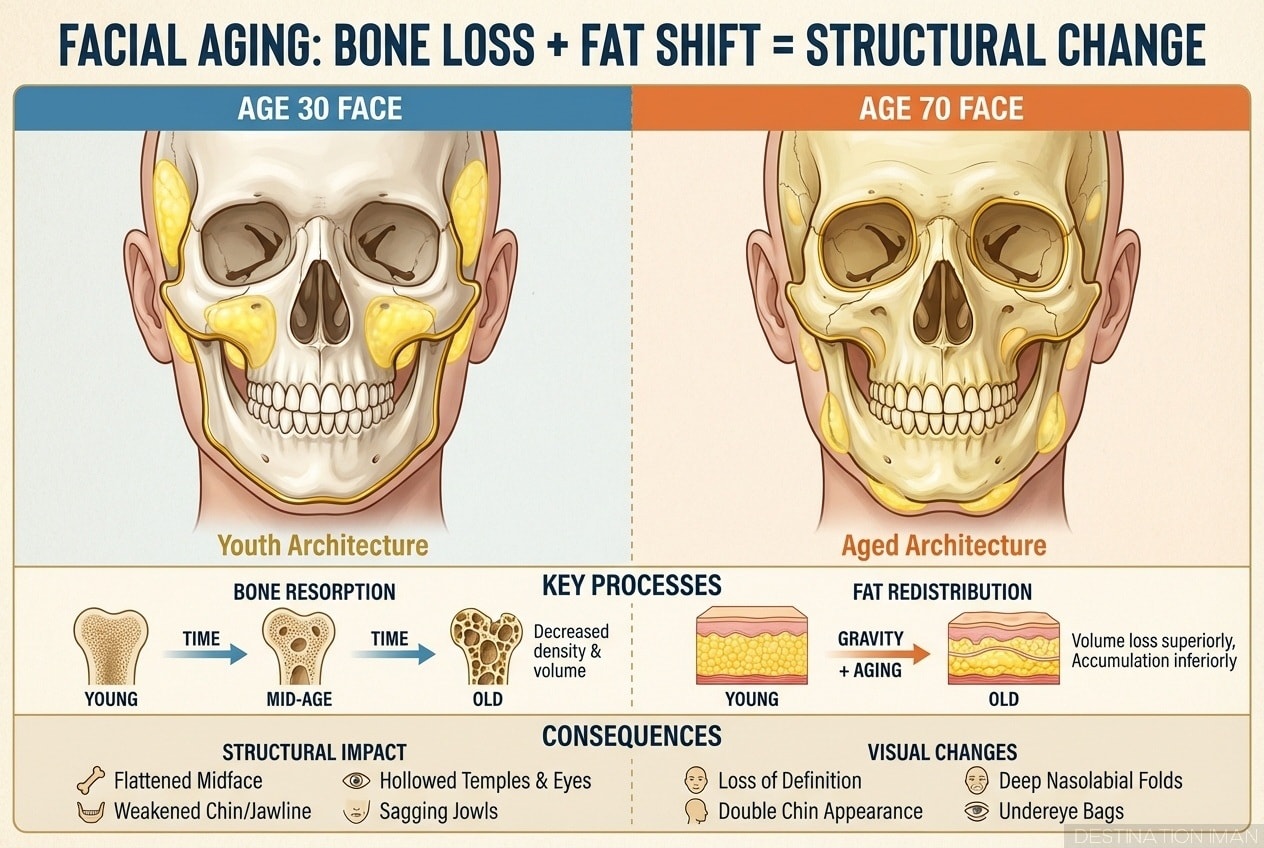
- 1. Bone Resorption: Facial bones gradually lose density and volume, especially around eye sockets, cheekbones, jawline. Result: face appears "longer" and less structured.
- 2. Fat Redistribution: Subcutaneous fat pads deflate in upper face (temples, cheeks), migrate downward. Result: volume shifts from youthful high cheeks to jowls.
- 3. Skin Changes: Collagen and elastin decline; skin thins, loses elasticity. Result: wrinkles, sagging, textural changes.
- 4. Hair Transformation: Melanocytes (pigment cells) slow production. Result: gray/silver hair; scalp hair may thin.
These changes are universal (all humans experience them) but variable (timing/severity differ by genetics, lifestyle, sun exposure, stress).
Collagen Decline: The 1% Annual Tax
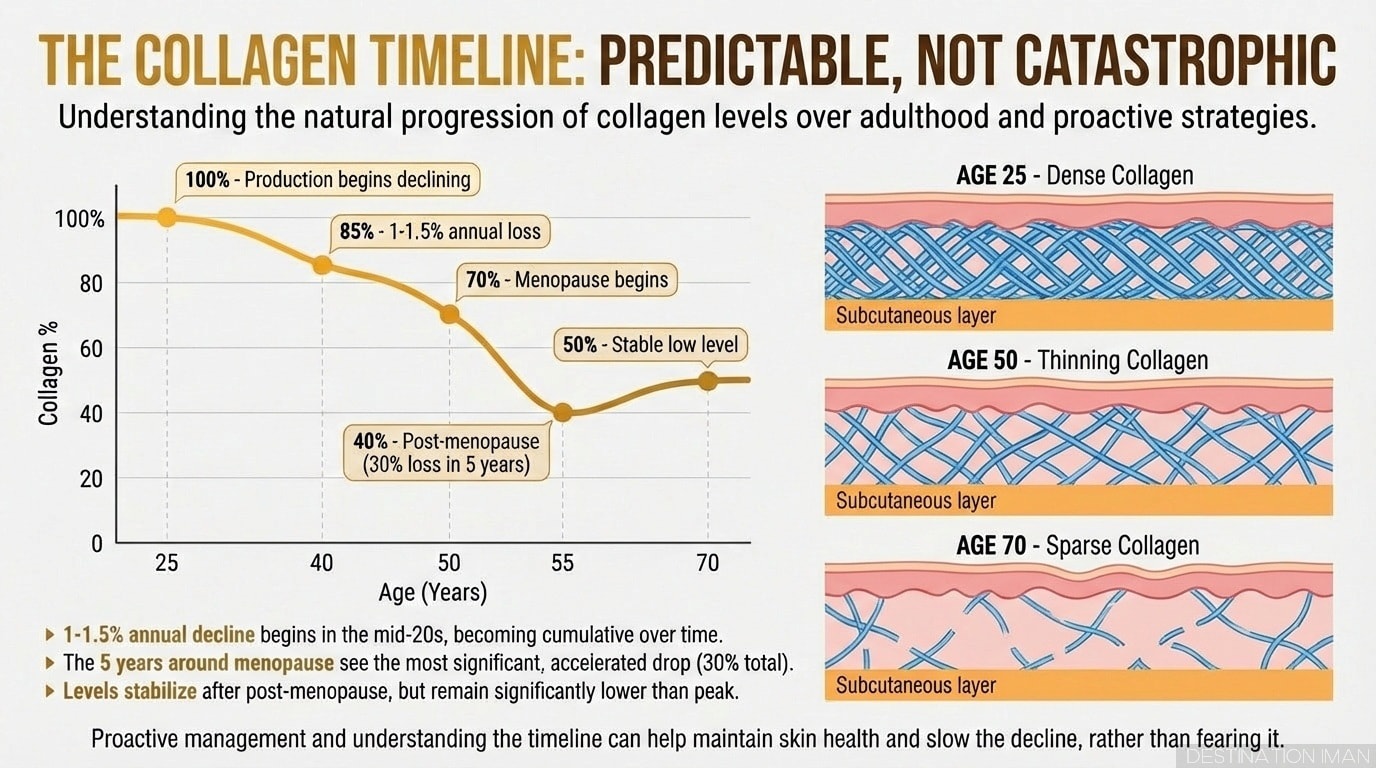
Collagen—the structural protein providing skin firmness—declines steadily after age 25. This decline is the single most visible aging marker.
The Collagen Timeline
Why Collagen Loss Matters (and Doesn't)
Collagen decline is inevitable but not catastrophic. Wrinkles and textural changes occur, but they don't erase attractiveness—they shift its basis from surface smoothness to presence and character.
Many observers find lined faces more interesting than smooth ones—not despite wrinkles but because of them. Lines signal experience, emotional depth, life lived.
Menopause and Hormonal Beauty Shifts
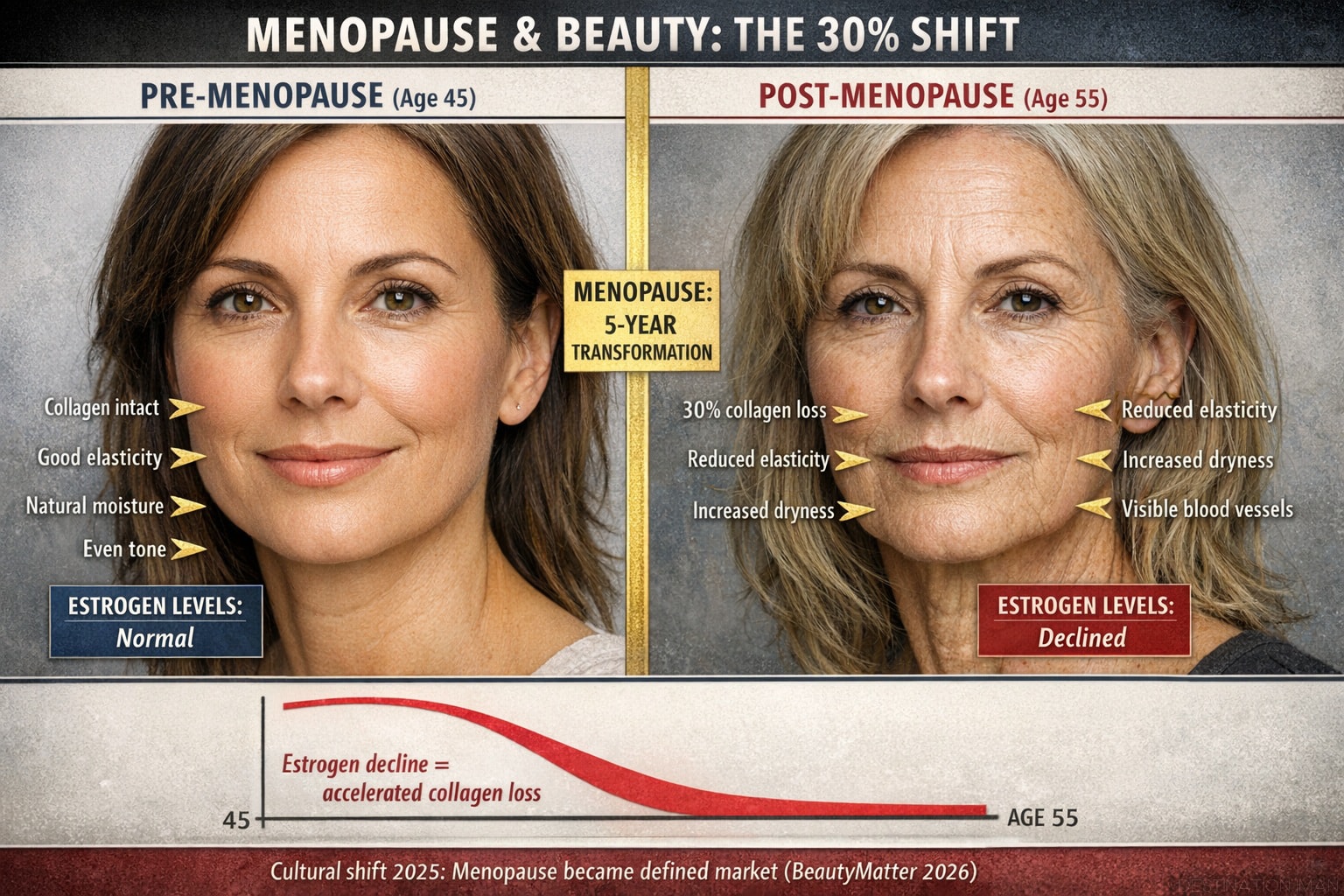
Menopause accelerates aging's visible effects through dramatic hormonal shifts—particularly estrogen decline. Yet 2025-2026 research reveals menopause as cultural moment, not medical crisis.
The Estrogen Effect on Skin
Skin Changes During Menopause
- Accelerated collagen loss: 30% in first 5 years (vs 1-1.5% annually pre-menopause)
- Elasticity decline: Skin becomes less "bouncy," slower to return to shape
- Thinning: Epidermis thins, revealing more vasculature (redness/veins)
- Dryness: Reduced sebum production creates dry, sometimes itchy skin
- Facial hair changes: Testosterone-estrogen ratio shifts; facial hair may increase
Why This Isn't Catastrophe
Menopause's skin changes are real but survivable—and increasingly normalized. Cultural shift toward pro-aging means menopausal women are no longer expected to hide changes but to integrate them into evolving self-presentation.
Bone Loss and Fat Redistribution
Beyond skin, aging alters facial architecture—bones and fat—creating structural changes independent of collagen.
Bone Resorption
Facial bones lose density over time, particularly:
- Eye sockets enlarge: Eyes appear more sunken
- Cheekbones flatten: Mid-face loses projection
- Jawline recedes: Lower face loses definition
- Nasal bones shrink: Nose may appear larger relative to face
Fat Redistribution
Subcutaneous fat pads deflate in youth-associated areas (temples, upper cheeks) and migrate to aging-associated areas (jowls, under chin). This creates the "deflated upper face, heavy lower face" appearance characteristic of aging.
Why This Matters for Beauty Perception
These structural changes alter facial proportions—but they don't eliminate beauty. They create different beauty: less "cute," more "distinguished"; less "soft," more "defined."
Cultural preference for youthful proportions is learned, not innate. Cross-cultural studies show mature facial structures are often perceived as more trustworthy, competent, and wise—traits increasingly valued in aging populations.
The Gray Hair Revolution: Silver as Statement
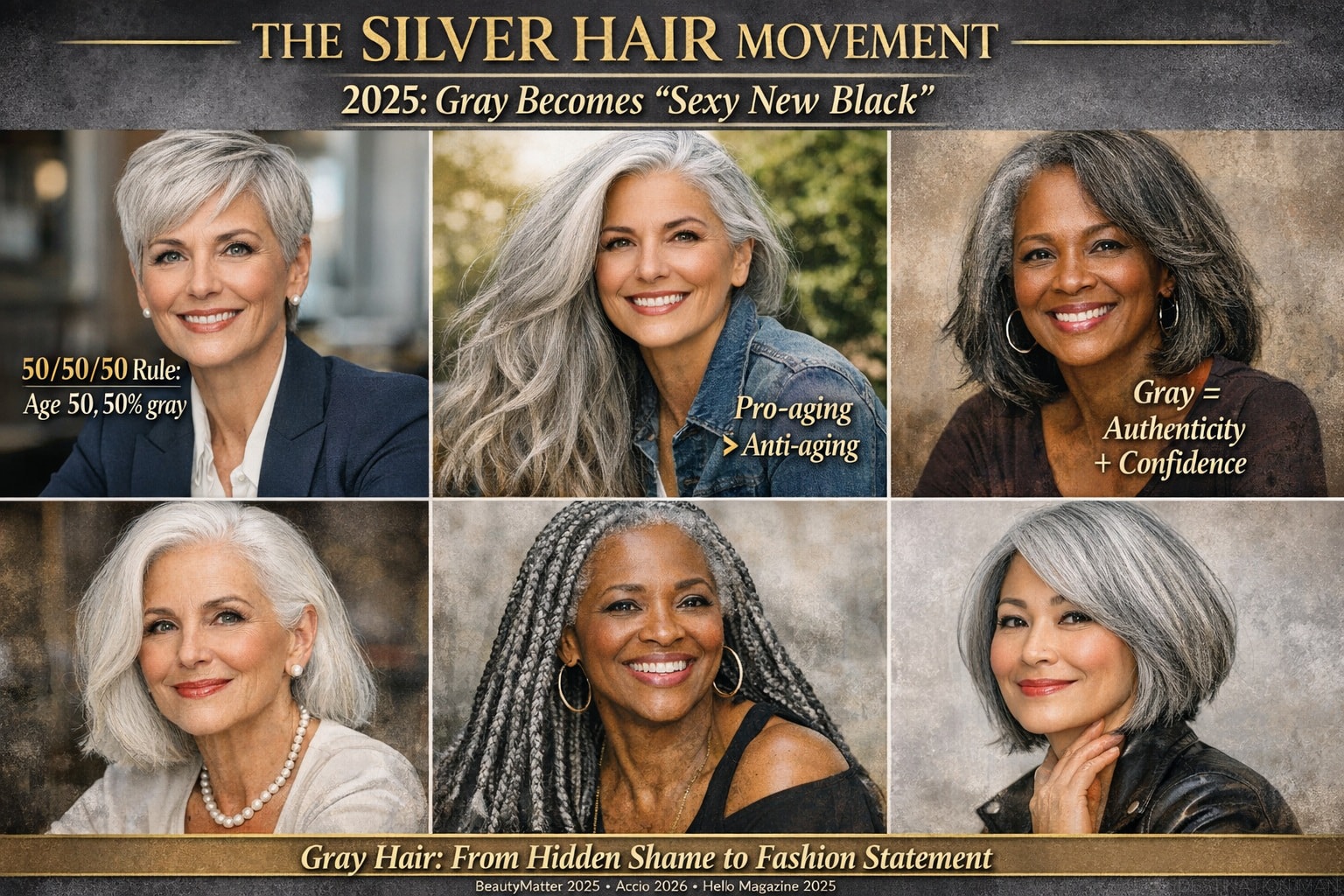
Gray hair—once hidden obsessively—became 2025's most visible pro-aging statement. The "silver hair movement" reframes graying as aesthetic choice, not biological failure.
The Gray Hair Trend (2024-2026)
Why Gray Hair Works (Psychologically)
Gray hair signals:
- Authenticity: Refusal to hide natural process = confidence
- Rebellion: Rejection of beauty industry pressure = autonomy
- Distinction: Stands out in youth-obsessed visual culture
- Low maintenance: No salon visits = practicality
Observers associate gray hair with wisdom, experience, and self-assurance—traits that enhance attractiveness in mature contexts.
Psychological Gains That Outweigh Physical Losses
While collagen declines and bones resorb, psychological traits increase—often exponentially. These gains create attractiveness biological youth cannot replicate.
What Increases With Age
Psychological Gains of Aging
- Confidence: Peaks at age 60 (data from previous article); surpasses men's confidence by midlife
- Self-acceptance: Body satisfaction increases despite physical changes; appearance matters less
- Emotional regulation: Fewer reactive outbursts; calm under stress
- Authenticity: Internal-external alignment improves as external validation matters less
- Presence: Ability to be fully engaged increases; distractibility decreases
- Empathy: Emotional intelligence and perspective-taking deepen with experience
- Reduced anxiety: Social comparison anxiety declines; FOMO disappears

The Attractiveness Trade-Off
Youth offers: smooth skin, reproductive fitness signals, high energy. Maturity offers: confidence, emotional safety, presence, authenticity.
In short-term mating contexts (bars, dating apps), youth wins. In long-term relational contexts (friendships, partnerships, professional respect), maturity often wins. Context determines which beauty form registers as "more attractive."
The Confidence Trajectory: Peaking at 60
Confidence doesn't decline with age—it surges. Data from previous article ("Why Mature Beauty Is More Attractive") showed women's confidence peaks at age 60, surpassing men's by midlife.
Why Confidence Increases
- Reduced social comparison: Less time on social media; less exposure to curated perfection
- Accomplishment accumulation: Decades of achievements create stable self-worth
- Mortality awareness: Knowing time is finite reframes priorities
- External validation irrelevance: Approval-seeking diminishes dramatically after 50
- Identity consolidation: Clear sense of self reduces identity confusion
How Confidence Manifests Physically
Confidence changes:
- Posture: Upright, open, relaxed
- Eye contact: Steady, present, without anxious darting
- Facial tension: Reduced (no performance anxiety)
- Movement: Deliberate, grounded, unhurried
- Voice: Lower pitch, slower pace (authority/competence signals)
These nonverbal cues dominate attractiveness perception, often overwhelming minor skin/hair changes.
From Performance to Presence
Youth beauty is often performative: seeking validation, monitoring appearance, adjusting for audience. Mature beauty shifts to presence: being fully engaged without self-consciousness.
Performance (Youth) vs Presence (Maturity)
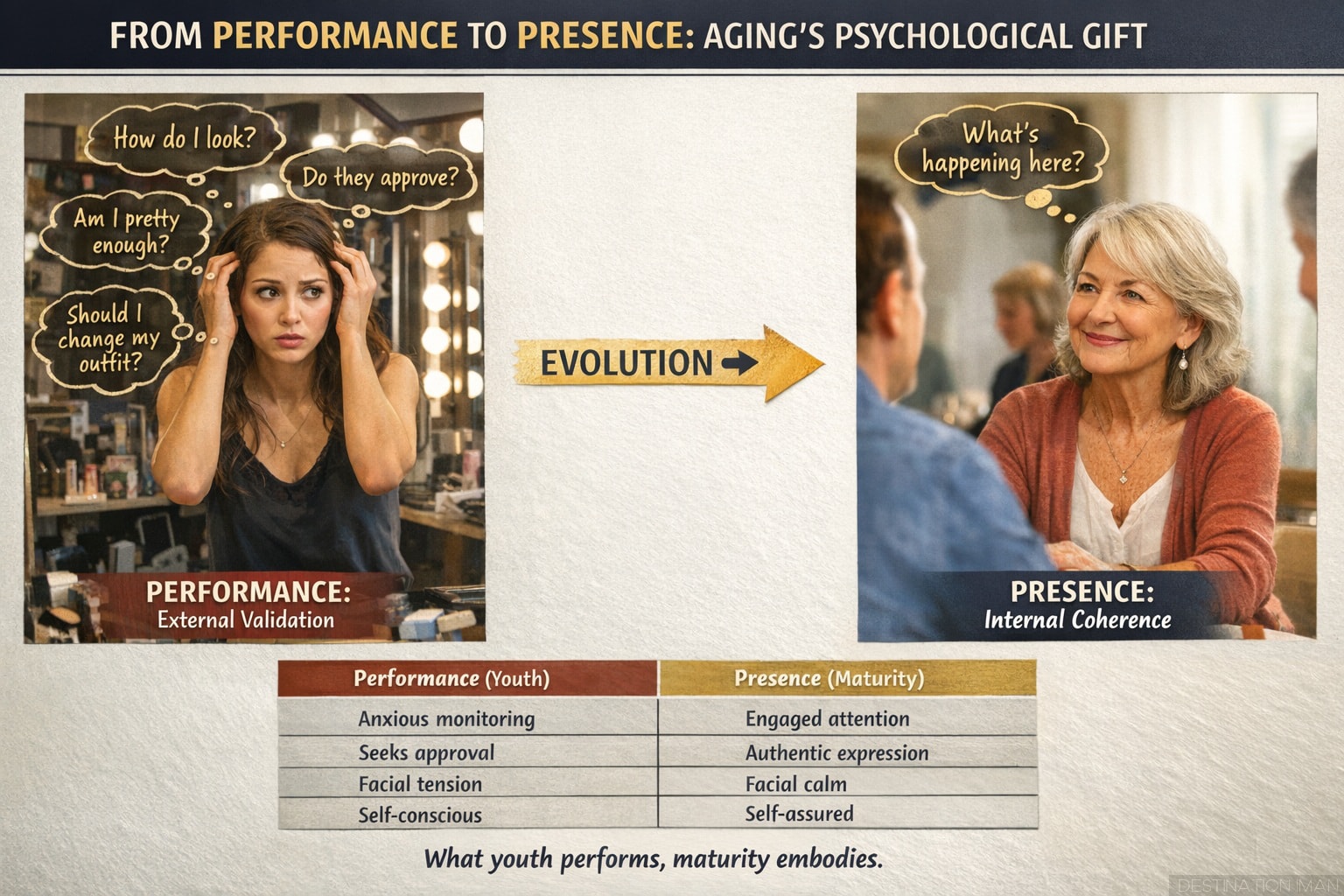
The Shift From Performance to Presence
- Performance: "How do I look?" → constant monitoring → facial tension
- Presence: "What's happening here?" → full engagement → facial calm
- Performance: External locus ("Do they approve?") → anxiety
- Presence: Internal locus ("Am I authentic?") → confidence
- Performance: Reactive to feedback → unstable self-concept
- Presence: Grounded in values → stable self-concept
Observers perceive presence as magnetic—it creates feeling of being seen rare in distraction-saturated culture.

Self-Acceptance: The Ultimate Attractiveness Multiplier
Self-acceptance—genuine comfort with who you are, including visible aging—is the most powerful attractiveness enhancer research identifies.
Why Self-Acceptance Increases Attractiveness
- Reduces cognitive dissonance: Internal-external alignment creates psychological ease
- Eliminates performance anxiety: No desperate approval-seeking
- Creates authenticity: What you see is what you get (refreshing in performative culture)
- Signals emotional maturity: Comfort with imperfection = psychological health
The Cultural Shift: Pro-Aging Replaces Anti-Aging
2024-2026 marks inflection point: pro-aging philosophy challenges anti-aging industry dominance.
Signs of the Shift
Pro-Aging Movement Indicators (2024-2026)
- Gray hair movement: Silver becomes fashion statement, not biological failure
- Menopause visibility: Becomes "defined market" with celebrity advocacy (Halle Berry, Naomi Watts)
- Mature models: 50+ women dominate campaigns (Helen Mirren, Iman, Jane Fonda)
- "Embrace midlife" trend: Beauty industry pivots from anti-aging to age-celebration
- Collagen skepticism: Independent research shows supplements don't work; consumers reject empty promises
Why This Shift Matters
Cultural narratives shape self-perception. When culture says "aging = decline," individuals internalize shame. When culture says "aging = evolution," individuals integrate change.
Pro-aging movement doesn't deny biological reality—it reframes meaning.
Celebrity Transformations: Aging as Ascent
Certain celebrities demonstrate aging as aesthetic ascent—becoming more compelling, not less, over decades.
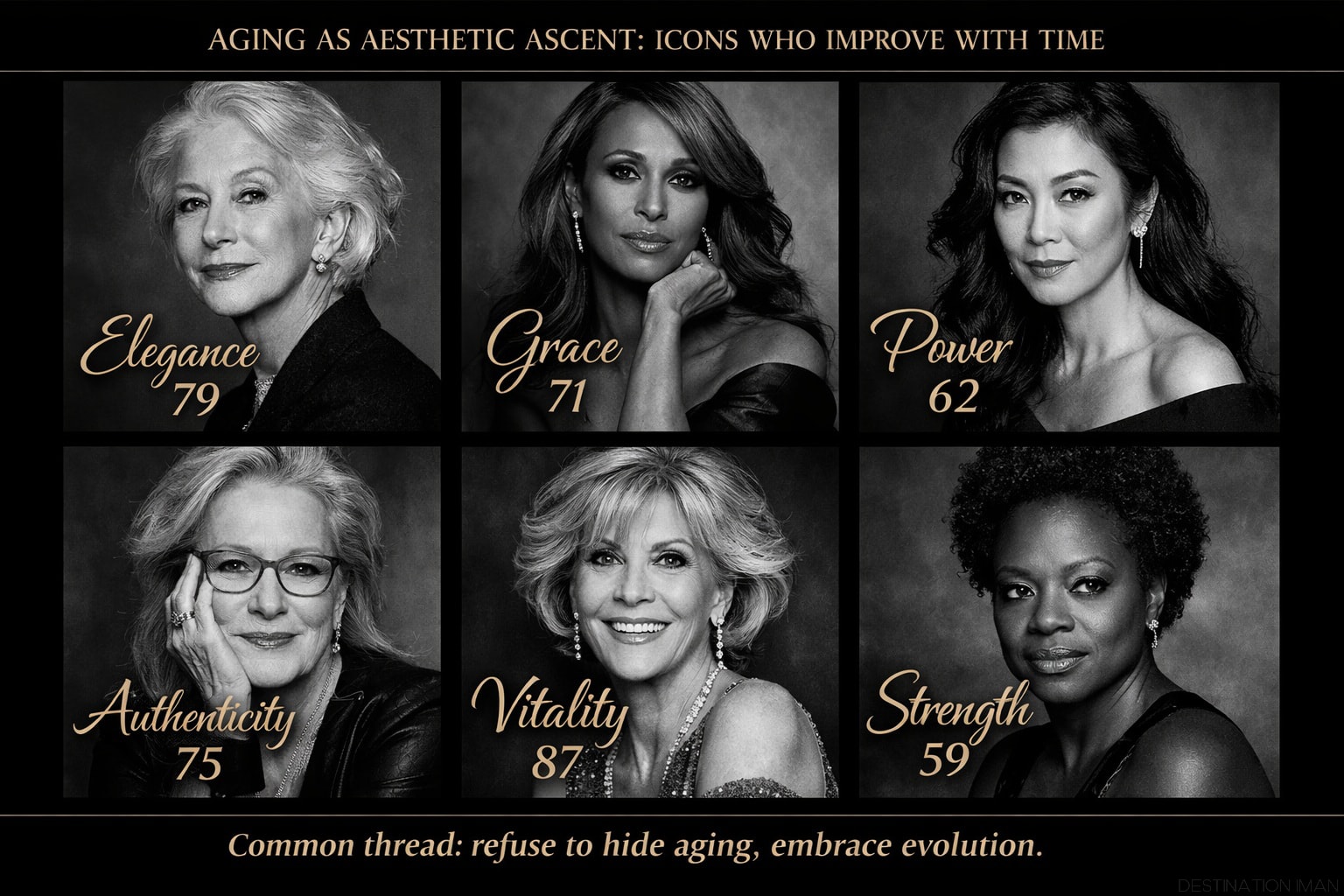
Icons Who Age Into Greater Beauty
- Helen Mirren (79): Silver hair, visible wrinkles—yet radiates elegance youth cannot touch
- Iman (71): Natural aging process visible; modeling career stronger than ever
- Michelle Yeoh (62): Career peak at 60 (Oscar win); beauty defined by presence, not youth
- Meryl Streep (75): Refuses cosmetic intervention; attractiveness rooted in talent and authenticity
- Jane Fonda (87): Activist vigor and red-carpet confidence defy ageist expectations
- Viola Davis (59): Natural hair, minimal makeup—strength as beauty standard
Common thread: these women refuse to hide aging. Their visibility normalizes mature beauty, creating cultural permission for others to age visibly.
How to Embrace Evolution (Not Fight It)
Embracing aging doesn't mean passive acceptance of decline. It means active integration of change into evolving identity.
Practical Steps to Embrace Beauty Evolution
Integration Strategies
- Reframe narrative: Replace "I'm aging" with "I'm evolving"—language shapes perception
- Identify gains: List psychological/emotional improvements (confidence, reduced anxiety, authenticity)—make invisible visible
- Update style gradually: Evolve wardrobe to reflect current self, not preserve past self
- Prioritize quality over trends: Timeless pieces outlast youth-chasing fashion experiments
- Curate social media: Unfollow youth-obsessed accounts; follow pro-aging voices
- Celebrate milestones: Treat birthdays as achievements, not defeats
- Reject anti-aging language: Use "pro-aging," "age-positive," "timeless"—not "anti-aging," "age-defying"
- Document evolution: Annual self-portraits showing change over time—make aging visible, not shameful
- Seek age-diverse community: Friendships across age spectrum normalize aging process
- Focus on what improves: Confidence, emotional regulation, presence—these are your new beauty assets
What to Avoid
- Comparison to younger self: You at 50 isn't "worse" than you at 25—you're different
- Chasing youth: Trendy clothes/procedures designed for 20-year-olds look incongruent on mature bodies
- Apologizing for aging: "I look terrible" becomes self-fulfilling prophecy
- Hiding completely: Invisibility isn't solution—visibility with confidence is
Key Takeaways
Essential Insights: Why Beauty Evolves With Age
- Collagen declines 1-1.5% annually after age 25; menopause accelerates loss by 30% in 5 years—but this doesn't eliminate attractiveness
- Facial aging involves four layers: bone resorption, fat redistribution, skin changes, hair transformation—all predictable, none catastrophic
- Menopause became "defined market" in 2025 with celebrity advocacy; hormonal skin changes increasingly normalized
- Gray hair movement reframes silver as "sexy new black" (2025); pro-aging philosophy replaces anti-aging shame
- Confidence peaks at age 60 (women surpass men); self-acceptance increases despite physical changes
- Psychological gains (confidence, authenticity, presence, emotional regulation) outweigh physical losses in attractiveness perception
- Beauty shifts from performance (youth) to presence (maturity)—latter often more compelling in relational contexts
- Self-acceptance is ultimate attractiveness multiplier—reduces cognitive dissonance, eliminates performance anxiety
- Cultural shift 2024-2026: pro-aging challenges anti-aging industry; "embrace midlife" replaces "fight aging"
- Celebrity transformations (Helen Mirren, Iman, Michelle Yeoh) normalize visible aging as aesthetic ascent
- Bone loss and fat redistribution alter facial architecture—creating "distinguished" vs "cute" beauty
- Independent research (2025-2026) shows collagen supplements don't work—industry-funded studies mislead
- 50/50/50 rule: by age 50, 50% of people have 50% gray hair—universal process, not personal failure
- Aging reframed as evolution (not decline) reduces shame, increases integration
- Practical steps: update language, curate media, celebrate milestones, focus on psychological gains, reject youth-chasing
Sources & References
Academic & Industry Sources (2024-2026)
- ScienceDirect (2025) — Effects of Collagen Supplements on Skin Aging: 1-1.5% Annual Decline
- ScienceDaily (2026) — Dermatologists: Collagen Supplements Aren't the Skin Fix People Hope
- Galderma (2026) — Menopause-Related Skin Changes: 30% Collagen Reduction in 5 Years
- BeautyMatter (2026) — The Perimenopause Opportunity: Menopause Became Defined Market in 2025
- Forbes (2025) — How to Combat Menopause Skin Changes: Experts Weigh In
- NIH (2025) — Managing Menopausal Skin Changes: A Narrative Review
- BeautyMatter (2025) — Gray Days: A Delve into Beauty's Silver Hair Movement
- Accio (2026) — Is Gray Hair the New Trend in 2025? Silver Hair Movement Gains Traction
- Hello Magazine (2025) — Why Having Grey Hair in 2025 Is More Fashionable Than Ever
- The New Knew (2025) — I'm Calling it Now: These Will Be the Gray Hair Trends of 2025
- SAGE Journals (2025) — Perceptions of Ageing and Psychological Well-Being in Older Adults
- Medical Xpress (2025) — Older Adults Can Bounce Back to Thriving Health, Study Finds
- JMIR Aging (2025) — Enhancing Older Adults' Lives Through Positive Aging Perception
- Croda Beauty (2024) — Beauty Trends 2025: The "Embrace Midlife" Movement
- BBC (2025) — Do Collagen Supplements Work to Reduce Signs of Skin Ageing?
- Etcoff, N. (1999). Survival of the Prettiest: The Science of Beauty. Doubleday.